
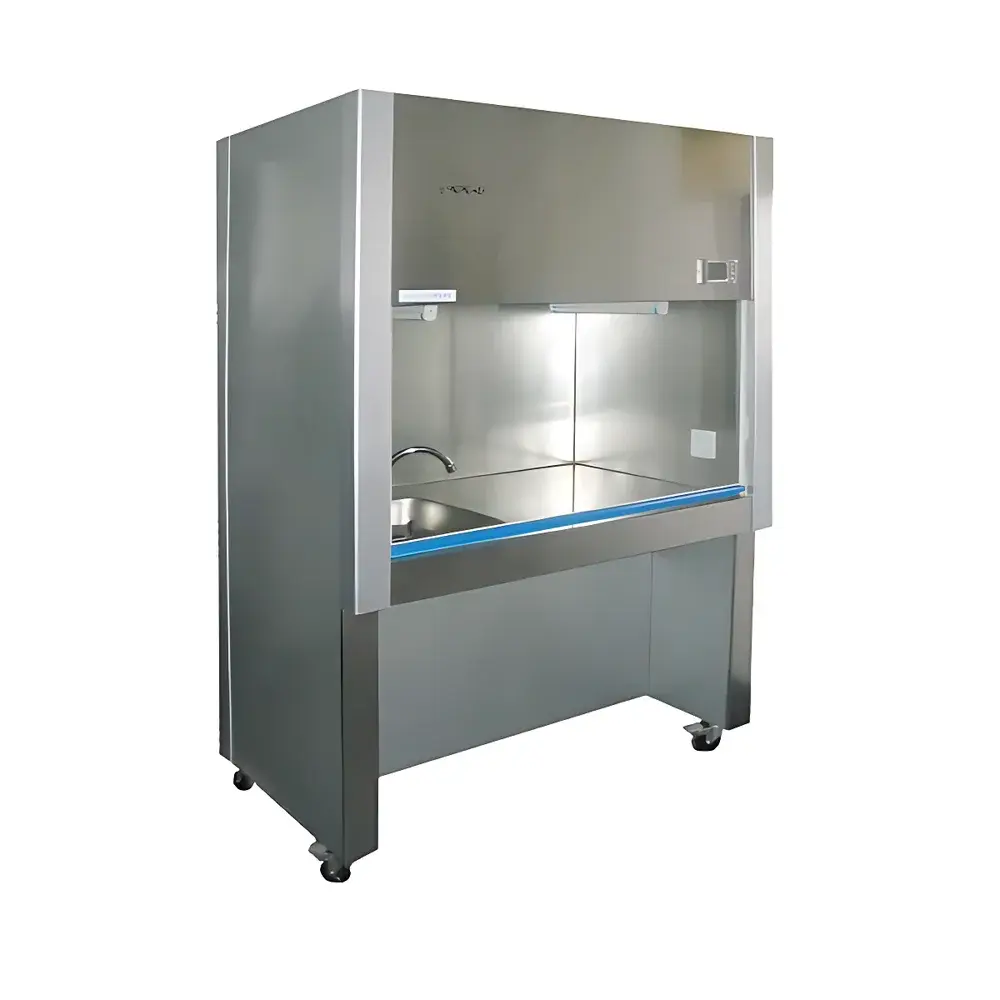
HJ SW-TFG-12 Stainless Steel Lined Single-Face Fume Hood
| Brand | HJ Purification |
|---|---|
| Origin | Shanghai, China |
| Manufacturer Type | Direct Manufacturer |
| Country of Origin | China |
| Model | SW-TFG-12 |
| Construction | Steel-Wood Frame with Stainless Steel Interior Liner |
| Configuration | Single-Face (Front-Access) Fume Hood |
| Face Velocity Range | 0.3–0.6 m/s (adjustable) |
| Average Face Velocity | 0.25–0.45 m/s |
| Water Inlet Pressure Requirement | >0.5 bar |
| Electrical Supply | AC 220 V, 50 Hz, 200 W (Control Circuit), Total Power Consumption: 400 W |
| Net Weight | 160 kg |
| Work Area Dimensions | 1030 × 700 × 600 mm (W×D×H) |
| Overall Dimensions | 1200 × 760 × 1950 mm (W×D×H) |
| Interior Liner Material | 304 Stainless Steel |
| Structural Frame | Five-Layer Fire-Retardant High-Density Fiberboard |
| Sash | Vertically Sliding Tempered Glass Panel |
| Integrated Services | Dual GFCI-Protected Electrical Outlets, Quick-Connect Faucet Valve, Built-in Stainless Steel Sink (304 SS, 350 × 350 × 200 mm) |
Overview
The HJ SW-TFG-12 Stainless Steel Lined Single-Face Fume Hood is an engineered containment solution designed for routine chemical handling in academic teaching labs, quality control environments, and industrial R&D facilities where moderate volatility, low-to-medium toxicity substances are processed. It operates on the principle of directional airflow containment—drawing ambient laboratory air across the work surface at a controlled face velocity, transporting vapors, aerosols, and particulates away from the operator’s breathing zone through a dedicated ducted exhaust system. Unlike recirculating or filtered units, the SW-TFG-12 is strictly ducted, ensuring complete removal of hazardous effluents to the external environment in compliance with ASHRAE 110 and EN 14175 standards for fume hood performance verification. Its structural design prioritizes operator safety, long-term corrosion resistance, and serviceability—featuring a fully welded 304 stainless steel interior liner that resists acid splashes, organic solvents, and oxidizing agents common in wet chemistry workflows.
Key Features
- Stainless steel (AISI 304) interior liner—fully welded seams, radius-curved corners, and seamless sink integration minimize crevices for effective decontamination and prevent residue accumulation.
- Vertically sliding tempered glass sash with counterbalanced mechanism ensures smooth operation and stable positioning at any height; sash stop positions are calibrated to maintain face velocity within the ISO 10964-recommended range (0.25–0.45 m/s) under typical lab static pressure conditions.
- Dual GFCI-protected 220 V / 50 Hz electrical outlets integrated into the work surface support concurrent use of centrifuges, pH meters, magnetic stirrers, or other low-power instrumentation without external extension cords.
- Quick-connect faucet valve with ceramic cartridge enables reliable, drip-free water delivery directly above the built-in sink; inlet pressure compatibility (>0.5 bar) ensures consistent flow under standard municipal supply conditions.
- Fire-retardant five-layer high-density fiberboard frame meets EN 13501-1 Class B-s1,d0 fire performance requirements and provides thermal insulation between the work chamber and external structure.
- Low-noise axial exhaust fan (rated ≤65 dB(A) at 1 m) mounted internally at the canopy level ensures stable airflow without requiring rooftop mechanical rooms—ideal for retrofit installations.
Sample Compatibility & Compliance
The SW-TFG-12 is validated for use with aqueous reagents, dilute acids and bases (e.g., HCl ≤10%, NaOH ≤5%), ethanol, acetone, and chloroform at room temperature and atmospheric pressure. It is not rated for perchloric acid, hydrofluoric acid, or explosive peroxide-forming solvents without supplemental scrubber or wash-down systems. The unit complies with key international safety frameworks including EN 14175-3 (type testing for airflow containment), ISO 10964 (face velocity measurement protocol), and GB/T 24819–2009 (Chinese national standard for laboratory fume hoods). Structural materials conform to ASTM A240 for 304 stainless steel and EN 622-5 for formaldehyde-emission-controlled fiberboard. Optional third-party ASHRAE 110 tracer gas testing (SF₆ or sulfur hexafluoride) can be arranged pre-shipment for GLP/GMP-aligned validation documentation.
Software & Data Management
While the SW-TFG-12 is a manually operated, non-digital fume hood, it supports integration into facility-wide monitoring infrastructures via optional analog 4–20 mA face velocity transducer output (available as field-upgrade kit). This signal may be logged by building management systems (BMS) or centralized lab safety dashboards for continuous compliance tracking. All electrical components meet IEC 61000-4 immunity standards; wiring conforms to IEC 60204-1 for industrial machinery safety. Audit-ready installation records—including airflow commissioning reports, electrical certification, and material traceability documents—are provided with each unit to support FDA 21 CFR Part 11–aligned quality systems in regulated laboratories.
Applications
- General chemistry instruction: titration, distillation, reflux, and qualitative analysis where vapor generation is intermittent and low-volume.
- Pharmaceutical QC labs: sample preparation for HPLC, dissolution testing, and buffer formulation involving volatile excipients.
- Environmental testing labs: digestion of soil/water samples using nitric-perchloric acid mixtures (when equipped with optional acid-resistant canopy liner).
- Materials science labs: solvent-based thin-film deposition, polymer dissolution, and catalyst synthesis under inert atmosphere (when used with nitrogen purge adapter).
- Veterinary and food safety labs: microbiological media preparation, antibiotic residue extraction, and enzymatic assays requiring odor and aerosol control.
FAQ
Is the SW-TFG-12 certified for perchloric acid use?
No—the standard configuration is not suitable for perchloric acid applications. A dedicated perchloric acid hood with wash-down canopy, polypropylene liner, and explosion-proof motor must be specified separately.
Can this fume hood be connected to variable air volume (VAV) ductwork?
Yes—its face velocity remains stable across 60–100% exhaust flow modulation when paired with a compatible VAV box and airflow sensor feedback loop.
What maintenance intervals are recommended for the exhaust fan and sash mechanism?
Fan bearings require lubrication every 12 months; sash counterbalance springs should be inspected quarterly for tension consistency and replaced if sag exceeds 3 mm over 12 months.
Does the unit include ductwork or mounting hardware?
No—duct connections, seismic anchoring kits, and wall/ceiling penetration sleeves are supplied separately per site-specific HVAC engineering specifications.
Is the stainless steel sink NSF/ANSI 51 certified for food contact?
The sink meets NSF/ANSI 51 mechanical requirements but lacks full certification due to absence of third-party antimicrobial surface testing; it is intended for lab waste drainage—not food processing.



