
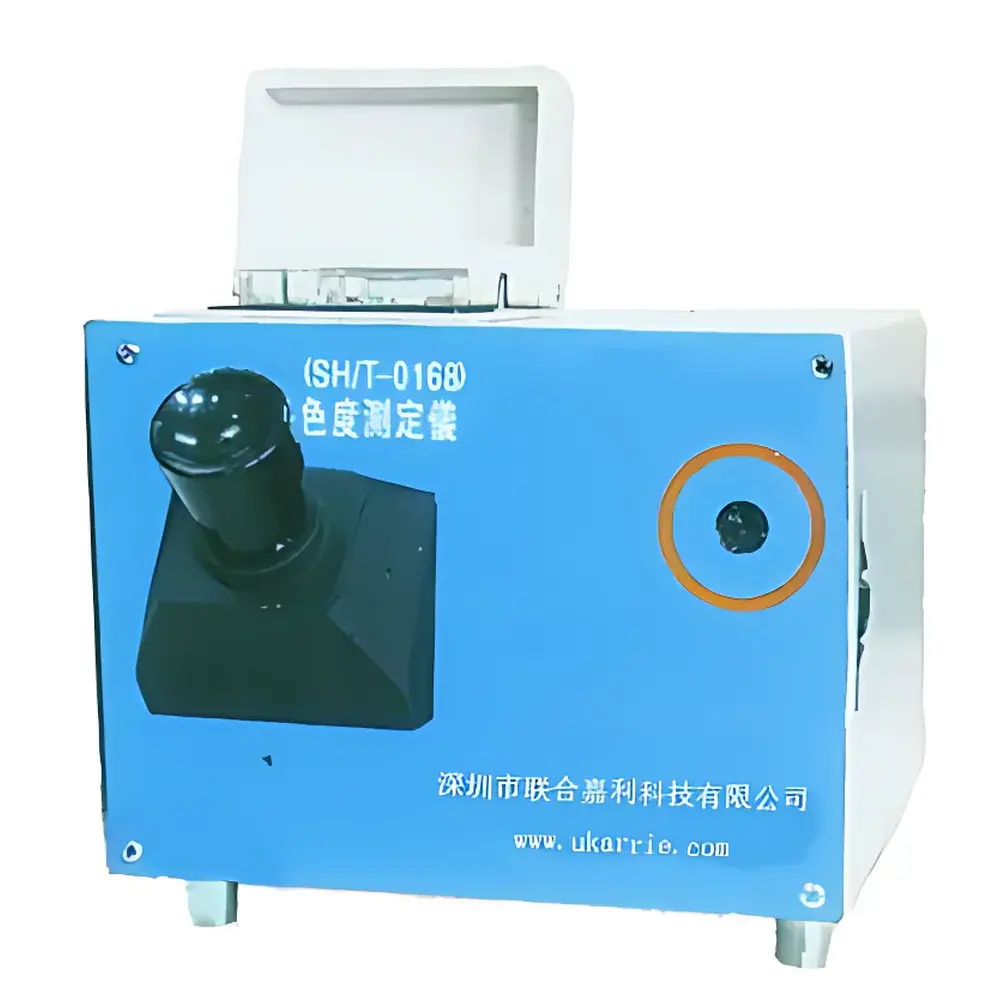
KA-225 Petroleum Product Colorimeter (KARRIE)
| Brand | KARRIE |
|---|---|
| Origin | Shenzhen, China |
| Model | KA-225 |
| Power Supply | 220 V ±10% AC |
| Power Consumption | 100 W |
| Light Source Color Temperature | 2750 ±50 K |
| Standard Color Disc | 25 graded color glass filters + 1 blank position (Ø14 mm apertures) |
| Sample Cell | Clear cylindrical borosilicate glass tube, Ø32 mm × 120–130 mm |
| Housing Material | Anodized aluminum alloy |
| Compliance | SH/T 0168, GB/T 6540 |
Overview
The KA-225 Petroleum Product Colorimeter is a visual comparison instrument engineered for precise, standardized determination of color in liquid petroleum products according to the Chinese national standard SH/T 0168—“Test Method for Color of Petroleum Products (Visual Comparison)” and fully compatible with GB/T 6540—“Petroleum Products—Determination of Color Number”. It operates on the principle of matched-field visual color comparison under controlled spectral illumination. The instrument utilizes a calibrated tungsten-filament lamp (220 V, 100 W) with a color temperature of 2750 ±50 K, filtered through opal diffusing glass and daylight-simulating interference filters to replicate the spectral power distribution of north sky daylight—essential for reproducible visual assessment per ASTM D1500 and ISO 2049 methodologies. Unlike spectrophotometric systems, this comparator relies on human observer judgment under rigorously defined photometric conditions, ensuring traceability to the established 0–8 (or 0–25) color scale used globally for lubricants, distillates, and middle distillates.
Key Features
- Optically balanced dual-beam viewing system: Simultaneously presents the sample and reference color side-by-side in a split-field eyepiece, each occupying 50% of the visual field—enabling direct chromatic evaluation without temporal or spatial bias.
- 26-position precision-machined color disc: Holds twenty-five certified glass color standards (ASTM D1500 equivalent grades 0.5 to 8.0, extended to 25 per GB/T 6540), plus one blank aperture for zero-reference verification; all filters mounted in indexed, light-tight aluminum housing.
- Standardized sample cell geometry: Cylindrical borosilicate glass tube (Ø32 mm × 120–130 mm) ensures consistent optical path length and minimizes meniscus and wall-reflection artifacts during visual assessment.
- Stable, spectrally conditioned illumination: Internally mounted 100 W frosted tungsten lamp with integrated daylight filtration delivers uniform irradiance across both observation fields, maintaining compliance with SH/T 0168’s photometric requirements.
- Durable anodized aluminum chassis: Lightweight yet rigid construction provides mechanical stability during repeated disc rotation and long-term calibration retention; designed for benchtop use in QC laboratories and refinery testing facilities.
Sample Compatibility & Compliance
The KA-225 is validated for transparent to slightly hazy liquid petroleum products including mineral oils, turbine oils, hydraulic fluids, kerosene, diesel fuel, and naphtha fractions. It excludes opaque, highly fluorescent, or turbid samples that violate the fundamental assumptions of visual comparison methodology. Instrument operation and reporting conform strictly to SH/T 0168 and GB/T 6540, supporting regulatory submissions under China’s GB standards framework. While not inherently compliant with FDA 21 CFR Part 11 or EU Annex 11, its manual, observer-based workflow aligns with GLP-compliant visual test protocols when paired with documented observer training, lighting environment controls (e.g., ISO 8554 Class A viewing booth), and periodic verification using NIST-traceable color standards.
Software & Data Management
The KA-225 is a purely optical-mechanical instrument with no embedded electronics, firmware, or digital interface. All measurements are recorded manually by trained personnel using standardized lab notebooks or LIMS-integrated paper forms. No software validation, audit trail, or electronic signature functionality is provided—consistent with traditional visual comparator design philosophy. Laboratories implementing computerized systems may integrate KA-225 results via structured data entry into validated LIMS platforms, where metadata (operator ID, sample ID, date/time, observed color number, disc position verified) are captured in accordance with internal SOPs and ISO/IEC 17025 documentation requirements.
Applications
- Quality control of base oils and finished lubricants against specification limits (e.g., API Group I–III, MIL-PRF-2104G).
- Routine monitoring of diesel fuel color stability during storage and distribution (per GB 19147).
- Batch release testing for kerosene used in aviation turbine fuel blending (aligned with ASTM D1655 Annex A1).
- Refinery process troubleshooting: Detection of oxidation, thermal degradation, or contamination-induced color shifts in distillation fractions.
- Educational and method validation labs requiring a reference-grade comparator for ASTM D1500 cross-checking and inter-laboratory comparison studies.
FAQ
What standards does the KA-225 comply with?
It is designed and verified for SH/T 0168 and GB/T 6540; its color scale correlates directly with ASTM D1500 and ISO 2049 when operated under specified viewing conditions.
Can the KA-225 be used for biodiesel or bio-blended fuels?
Yes—if the sample is optically clear and falls within the 0–25 color number range; however, fluorescence or haze may impair reliability and require supplemental testing per EN 14214 Annex B.
Is operator training required?
Yes—SH/T 0168 mandates trained observers with normal color vision (verified per ISO 8554 or DIN 5033); routine color vision screening is recommended.
How often should the color disc be recalibrated or replaced?
Certified color glass filters are stable under normal storage; replacement is only necessary if physical damage, scratches, or measurable spectral drift (>±2 nm deviation at peak transmission) is confirmed using a reference spectroradiometer.
Does the instrument include traceable calibration documentation?
KARRIE supplies a factory-issued certificate of conformance referencing SH/T 0168; users must establish their own metrological traceability chain to national standards (e.g., CNAS-accredited labs) for audit readiness.




