
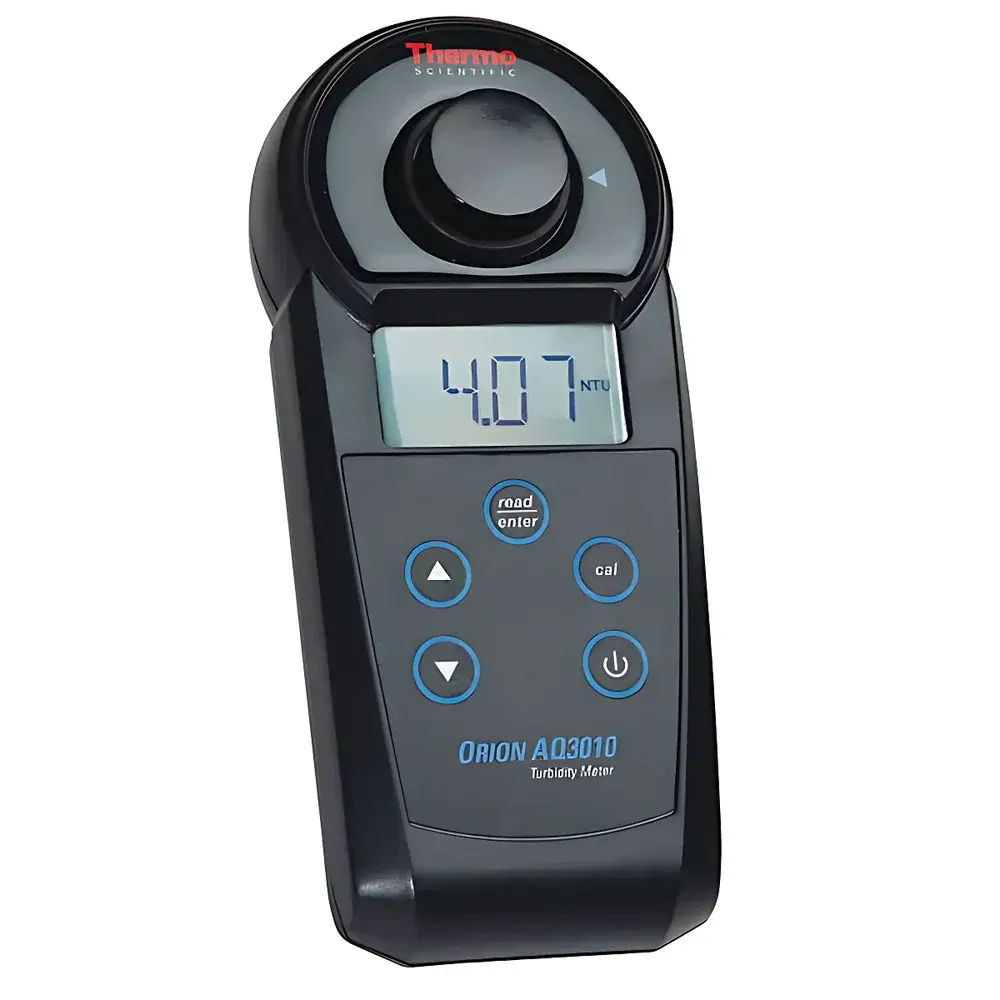
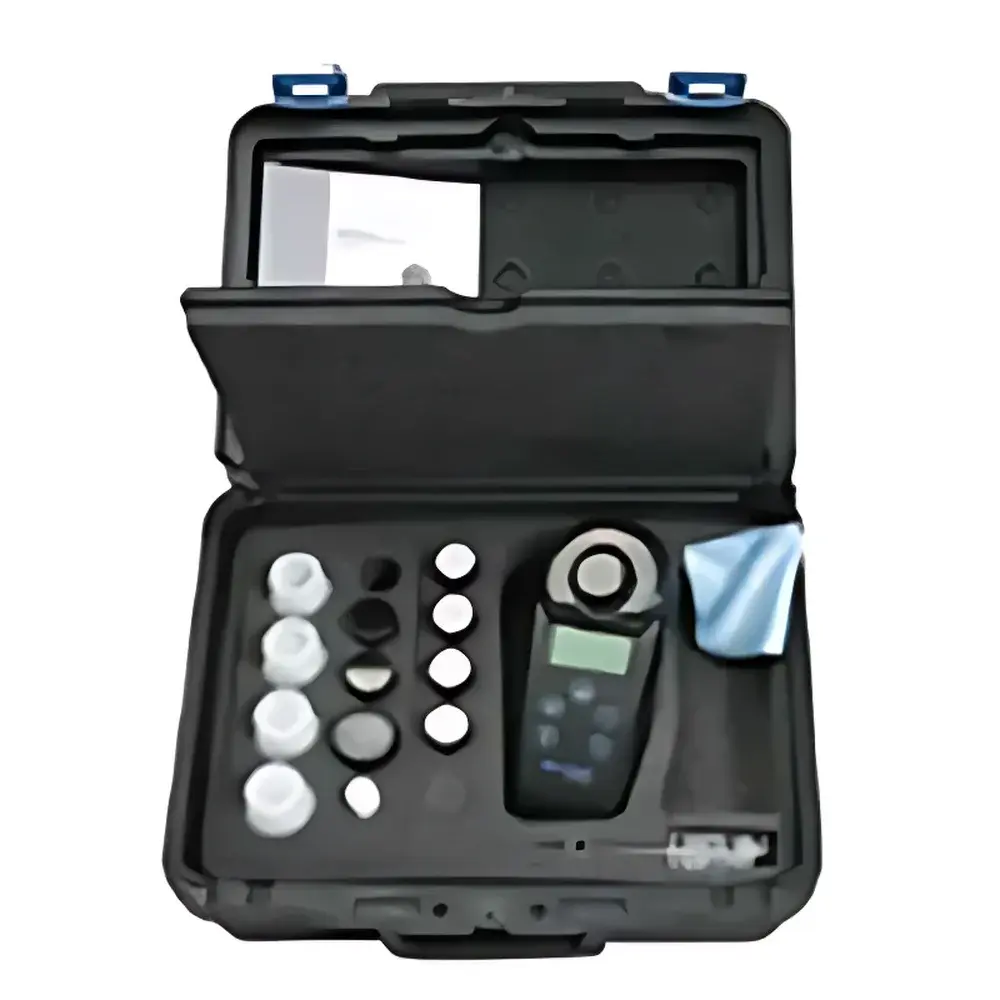
Orion AQ3010 Portable Turbidimeter
| Brand | Orion |
|---|---|
| Origin | USA |
| Model | AQ3010 |
| Product Type | Portable |
| Measurement Range | 0.01–1000 NTU |
| Resolution | 0.01 NTU (0.01–19.99 NTU), 0.1 NTU (20.0–99.9 NTU), 1 NTU (100–1000 NTU) |
| Accuracy | ±2% of reading (0–500 NTU), ±3% of reading (501–1000 NTU), ±1 digit |
| Operating Temperature | 0–50 °C |
| Response Time | <6 s |
| Sample Volume | 10 mL |
| Calibration Standards | 0.02, 20.0, 100, and 800 NTU |
| Light Source | ISO 7027-compliant infrared LED |
| Sample Cell | 25 mm diameter vial with alphanumeric ID |
| Power Supply | 4 × AAA alkaline batteries (≥3000 measurements) or 4 × AAA lithium batteries (≥12,000 measurements) |
| Auto-power-off | After 20 min idle |
| Ingress Protection | IP67 |
| Certifications | CE, TÜV, CSA-US (3-in-1), FCC Part 15 |
| Self-diagnostic Function | Yes, with error code display |
Overview
The Orion AQ3010 Portable Turbidimeter is an ISO 7027–compliant optical instrument engineered for high-reproducibility turbidity measurement across diverse environmental, industrial, and laboratory settings. It employs the 90° side-scatter detection principle using a stable, temperature-insensitive infrared LED light source—eliminating spectral interference from sample coloration and ensuring robust performance with colored or yellowish water matrices. Unlike tungsten-based systems, this design delivers long-term photometric stability without lamp replacement or warm-up delays. The instrument automatically selects one of three measurement ranges (0.01–19.99 NTU, 20.0–99.9 NTU, 100–1000 NTU) based on sample turbidity, optimizing resolution and minimizing manual range switching. Its compact, ruggedized chassis meets IP67 ingress protection standards, enabling reliable operation in rain, dust, high-humidity field conditions (up to 90% RH at 30 °C), and controlled lab environments alike.
Key Features
- ISO 7027–certified 90° scattered-light detection geometry for metrologically traceable turbidity quantification
- Infrared LED light source with inherent immunity to ambient temperature fluctuations and chromatic interference
- Three-tier auto-ranging system with variable resolution: 0.01 NTU (low range), 0.1 NTU (mid range), and 1 NTU (high range)
- IP67-rated housing ensures full dust-tightness and submersion resistance up to 1 m for 30 minutes
- Integrated self-diagnostic routine with alphanumeric error codes for rapid troubleshooting and preventive maintenance
- Large backlit LCD display with intuitive button navigation (Power, Calibrate, Up/Down, Read/Enter)
- Single-standard calibration workflow compliant with U.S. EPA Standard Methods 2130B and SDVB protocols
- Low-power architecture supporting >3,000 measurements per set of alkaline AAA batteries or >12,000 with lithium variants
Sample Compatibility & Compliance
The AQ3010 accepts standard 25 mm diameter glass or disposable plastic vials marked with unique alphanumeric identifiers—ensuring traceability in multi-sample workflows. Its infrared detection scheme minimizes errors from absorbance-related artifacts common in highly colored samples (e.g., humic-rich surface waters, wastewater effluents, or process streams containing dyes or organic pigments). The instrument conforms to ISO 7027:2016 for instrumental turbidity measurement and satisfies U.S. EPA Method 180.1 requirements for drinking water and wastewater analysis. It supports GLP/GMP-aligned documentation through standardized calibration verification using four certified reference standards (0.02, 20.0, 100, and 800 NTU), eliminating dilution steps and reducing operator-induced variability. CE marking, TÜV certification, CSA-US (3-in-1), and FCC Part 15 compliance confirm electromagnetic compatibility and safety for global deployment.
Software & Data Management
While the AQ3010 operates as a standalone, battery-powered field instrument with no embedded Bluetooth or USB connectivity, its measurement protocol is fully compatible with LIMS and QA/QC data pipelines via manual transcription or optional third-party barcode-scanning integration. All calibration events—including date, standard used, and deviation from expected value—are stored in non-volatile memory and retrievable via on-device review. The built-in auto-zero function compensates for vial wall scatter and background noise prior to each measurement cycle. For regulated environments, the device supports audit-ready operation under FDA 21 CFR Part 11–aligned procedures when paired with validated electronic logbooks or paper-based calibration records meeting ISO/IEC 17025 documentation requirements.
Applications
- Drinking water quality monitoring at intake, treatment, and distribution points
- Wastewater effluent compliance testing per NPDES permit limits
- Environmental field surveys of rivers, lakes, and reservoirs under EPA Region-specific protocols
- Pharmaceutical water system validation (PW, WFI) per USP turbidity thresholds
- Industrial process control in food & beverage, pulp & paper, and semiconductor ultrapure water loops
- Educational laboratories requiring NIST-traceable, hands-on turbidity training tools
FAQ
Does the AQ3010 require frequent recalibration?
Calibration is recommended before each use session or after extended storage; however, the infrared LED’s thermal stability enables multi-day calibration retention under stable ambient conditions.
Can it measure turbidity in highly colored samples?
Yes—the ISO 7027–compliant 860 nm infrared source minimizes absorption bias, yielding more accurate results than visible-light turbidimeters for yellow/brown water matrices.
Is the instrument suitable for regulatory reporting?
It meets EPA, ISO, and ASTM D6508 requirements for field-deployable turbidity measurement and supports auditable calibration records essential for compliance submissions.
What vial types are compatible?
Standard 25 mm round glass or polystyrene vials with flat bottoms and clear sidewalls—vials must be clean, scratch-free, and free of fingerprints or residual detergent film.
How is accuracy verified between calibrations?
Users may perform a quick accuracy check using the 20.0 NTU standard; deviation exceeding ±2% triggers full recalibration per SOP.





