
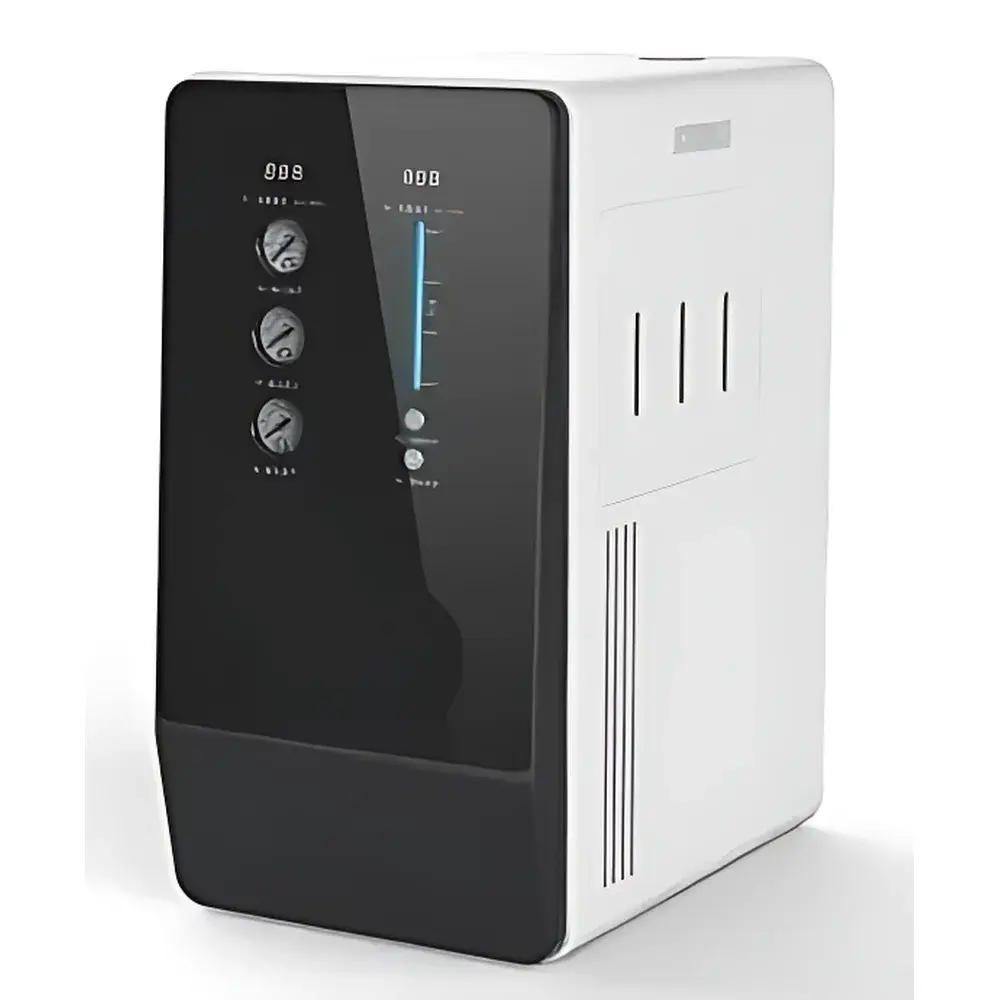
HLT HLA-300G & HLA-500G Nitrogen-Hydrogen-Air Integrated Gas Generator with Oil-Free Compressor
| Brand | Hailong |
|---|---|
| Origin | Shanghai, China |
| Model | HLA-300G, HLA-500G |
| Gas Purity | N₂ > 99.997%, H₂ > 99.999% |
| Output Flow | N₂/H₂: 0–300 mL/min (HLA-300G), 0–500 mL/min (HLA-500G) |
| Air | 0–2000 mL/min (HLA-300G), 0–5000 mL/min (HLA-500G) |
| Output Pressure | 0–0.5 MPa (factory-set at 0.4 MPa) for all gases |
| Design | Integrated monoblock chassis |
| Control Mode | On/Off switch control |
| Power Supply | 220 V ±10%, 50 Hz ±5% |
| Max Power | 750 W (HLA-300G), 850 W (HLA-500G) |
| Dimensions | 460 × 310 × 670 mm |
| Weight | 47 kg |
| Operating Environment | 10–40 °C, RH ≤85%, non-corrosive, low-dust ambient |
Overview
The HLT HLA-300G and HLA-500G Nitrogen-Hydrogen-Air Integrated Gas Generators are engineered for continuous, on-demand supply of high-purity carrier, fuel, and combustion gases in analytical laboratories—primarily supporting gas chromatography (GC), GC–mass spectrometry (GC–MS), and flame-based detectors including FID, TCD, and NPD. Unlike conventional cylinder-based gas delivery, these systems eliminate logistical risks associated with high-pressure gas storage, regulatory compliance for cylinder handling, and supply chain interruptions. The core architecture integrates three independent gas generation modules—electrolytic hydrogen, pressure-swing adsorption (PSA) nitrogen, and oil-free compressed air—within a single, space-efficient stainless-steel enclosure. Each module employs multi-stage purification (three-stage filtration for H₂ and N₂; two-stage pressure regulation and three-stage filtration for air), automatic anti-alkaline backflow protection for electrolytic cells, and intelligent flow tracking to match instrument demand dynamically. All internal wetted parts contacting H₂ or N₂ are constructed from electropolished 316L stainless steel to prevent catalytic degradation and ensure long-term stability of gas purity.
Key Features
- Integrated tri-gas architecture: Simultaneous, independent generation of nitrogen (PSA), hydrogen (PEM electrolysis), and zero-air (oil-free compression + desiccant + coalescing filtration)
- High-reliability oil-free air compression system: Stainless-steel tank, dual-stage pressure stabilization, automated condensate drainage, and triple-stage particulate/adsorbent filtration ensuring dew point ≤ −40 °C and hydrocarbon content < 0.01 ppm
- Hydrogen module with PEM electrolyzer: Produces ultra-high-purity H₂ (>99.999%) with built-in alkaline backflow prevention, real-time current monitoring, and over-pressure safety shutoff
- Nitrogen module based on carbon molecular sieve (CMS) PSA technology: Delivers N₂ >99.997% purity with integrated oxygen sensor feedback for purity verification and automatic regeneration cycle management
- Unified front-panel on/off control with LED status indicators per gas stream and audible/visual fault alerts for low water level, filter saturation, or pressure deviation
- Compact footprint (460 × 310 × 670 mm) and 47 kg mass enable benchtop deployment without structural reinforcement—ideal for shared instrumentation labs and mobile analytical platforms
Sample Compatibility & Compliance
These generators are validated for use with all major GC and GC–MS platforms requiring certified-grade carrier (N₂), fuel (H₂), and make-up/combustion (air) gases—including Agilent, Thermo Fisher Scientific, Shimadzu, PerkinElmer, and Waters instruments. Gas output meets ASTM D6349 (for laboratory air), ISO 8573-1 Class 1:2:1 (compressed air quality), and USP requirements for instrumental gas purity in pharmaceutical QC testing. The system supports GLP and GMP environments through traceable operational logs (via optional RS232/USB interface), configurable alarm thresholds, and mechanical interlocks that halt H₂ generation if system pressure exceeds 0.5 MPa or electrolyte level falls below minimum. No external venting or exhaust ducting is required, as all generated gases are fully contained and delivered at regulated pressure.
Software & Data Management
While the base configuration operates via hardware-level on/off control, optional firmware upgrades support ASCII protocol communication over RS232 or USB. This enables integration into lab-wide asset monitoring systems (e.g., LabVantage, STARLIMS) for remote status polling, scheduled maintenance alerts (e.g., filter replacement every 6,000 operating hours), and audit-trail generation compliant with FDA 21 CFR Part 11 when paired with validated electronic signature modules. Internal memory retains last 100 event logs—including startup/shutdown timestamps, pressure excursions, and self-diagnostic results—accessible via serial dump. No proprietary software installation is required for basic operation; all calibration and service routines are performed via front-panel menu navigation with password-protected engineering mode.
Applications
- Carrier gas supply for capillary GC columns (N₂ at 0.4 MPa, 1–30 mL/min typical)
- Fuel gas for flame ionization detectors (FID) and thermal conductivity detectors (TCD) (H₂ at 0.4 MPa, 30–50 mL/min)
- Make-up and combustion air for FID, ECD, and NPD (zero-air at 0.4 MPa, 300–2000 mL/min)
- Blank gas source for leak testing, purge-and-trap systems, and inert atmosphere purging in sample preparation hoods
- On-site gas supply for field-deployable GC units used in environmental monitoring, petrochemical QA, and forensic mobile labs
- Replacement for high-pressure cylinder banks in ISO/IEC 17025-accredited testing laboratories seeking reduced audit complexity and improved gas consistency
FAQ
What safety certifications does this generator hold?
The HLA series complies with IEC 61010-1 (Safety Requirements for Electrical Equipment for Measurement, Control, and Laboratory Use) and carries CE marking for EMC Directive 2014/30/EU and Low Voltage Directive 2014/35/EU. Hydrogen generation conforms to EN 13852-1 for electrolytic gas equipment.
Can the output pressure be adjusted beyond the factory setting of 0.4 MPa?
Yes—pressure regulators for each gas line are user-accessible via calibrated adjustment screws located behind the front panel access cover. Maximum allowable setpoint remains 0.5 MPa per ASME B31.3 process piping limits.
How often do filters require replacement?
Pre-filters (particulate) should be inspected quarterly; coalescing and activated carbon filters are rated for 6,000 hours under typical lab usage (8 hrs/day, 5 days/week). Filter life is extended by maintaining ambient humidity ≤70% and avoiding dusty environments.
Is this generator compatible with GC–MS systems requiring ultra-high-purity hydrogen?
Yes—H₂ purity >99.999% (O₂ < 0.1 ppm, H₂O < 1 ppm, total hydrocarbons < 0.1 ppm) satisfies ASTM D7622 and ICH Q5C specifications for MS-grade fuel gas.
Does the system include remote monitoring capability?
Standard models feature dry-contact relay outputs for “Gas Ready” and “Fault” signals. RS232/USB telemetry and Modbus RTU protocol support are available as factory-installed options.



