
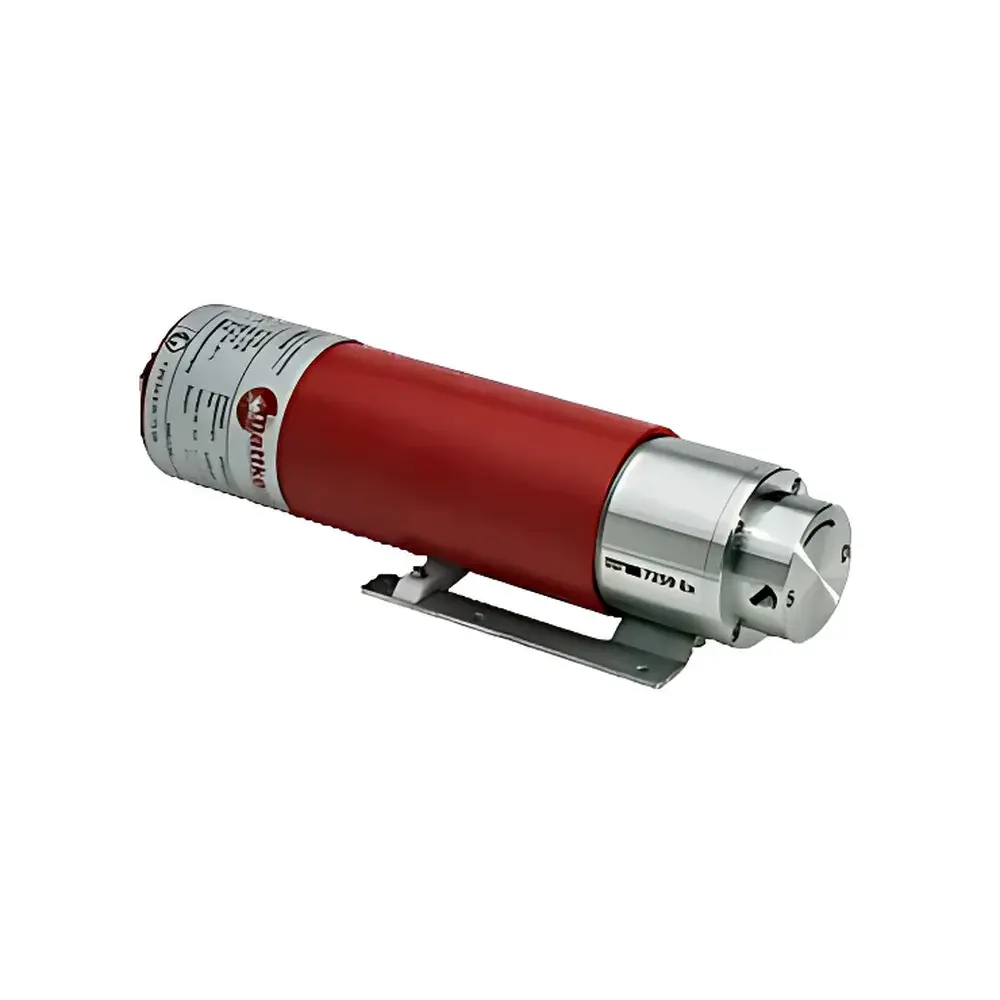
HNPM MZR-7259 Ex Intrinsically Safe Micro-Dosing Peristaltic Pump
| Brand | HNPM |
|---|---|
| Origin | Germany |
| Model | MZR-7259 Ex |
| Explosion Protection | ATEX II 2G IIC c T4 X |
| Flow Rate | 0.048–225 mL/min |
| Precision (CV) | <1% |
| Viscosity Range | 0.3–100 mPa·s |
| Max Differential Pressure | 40 bar (at >16 mPa·s) |
| Max System Pressure | 80 bar |
| Displacement per Revolution | 48 µL |
| Minimum Dose | 30 µL |
| Motor | 24 V DC, 53 W, 500 PPR Encoder |
| Ambient Temp | 0–40 °C |
| Fluid Temp | −5–+60 °C (−20–+100 °C with optional thermal isolation module) |
| Wetted Materials | Alloy C22 (DIN 2.4602), SSiC, Al₂O₃, ZrO₂, FFKM (Kalrez® 6375) |
| Connection | 1/8" NPT internal thread |
| Weight | ~4900 g |
| Dimensions (L×W×H) | 280 × 120 × 140 mm |
Overview
The HNPM MZR-7259 Ex is a certified intrinsically safe, high-precision micro-dosing pump engineered for continuous or discrete delivery of aggressive, corrosive, and ultra-low-volume liquids in hazardous environments. Unlike conventional diaphragm or piston pumps, it employs a robust rotary ring-gear displacement principle—eliminating valves, check balls, and pulsation-inducing mechanisms. This design ensures laminar, low-shear fluid transport with exceptional dose reproducibility (CV < 1%) across viscosity ranges from 0.3 to 100 mPa·s. Its explosion-proof certification complies fully with ATEX Directive 94/9/EC (Category II 2G IIC c T4 X), permitting safe operation in Zone 1 and Zone 2 classified areas per EN 60079-0 and EN 60079-31. The pump’s core architecture integrates magnetically coupled drive transmission (NdFeB permanent magnets), eliminating dynamic seals and mechanical shaft penetrations—thereby preventing leakage paths and enhancing long-term integrity under cyclic pressure loads up to 80 bar system pressure.
Key Features
- ATEX-certified explosion protection (II 2G IIC c T4 X) for use in flammable gas atmospheres (e.g., hydrogen, ethylene, acetylene)
- Chemically inert wetted path constructed from Alloy C22 (DIN 2.4602), sintered silicon carbide (SSiC) shafts/bearings, alumina (Al₂O₃) bearing housings, and zirconia (ZrO₂) rotor elements
- FFKM (Kalrez® 6375) elastomeric seals rated for aggressive solvents, strong acids (e.g., HF, aqua regia), and halogenated hydrocarbons
- DC motor (24 V, 53 W) with integrated 500-pulse-per-revolution optical encoder enabling closed-loop speed control and traceable dosing events
- Compact footprint (280 mm length) with modular mounting options compatible with OEM integration into analytical flow cells, reactor feed systems, and automated coating lines
- No valves, no dead volume, no backflow—enabling true bidirectional dosing and quantitative recovery down to 30 µL minimum dose volume
Sample Compatibility & Compliance
The MZR-7259 Ex is validated for handling chemically demanding media including concentrated mineral acids (HNO₃, H₂SO₄, HCl), oxidizing agents (H₂O₂, NaOCl), organic solvents (THF, DMF, chlorobenzene), and high-purity monomers used in polymer synthesis. Its material compatibility aligns with ASTM G155 (corrosion resistance testing) and DIN EN ISO 15142-1 (pump classification for aggressive fluids). All electrical interfaces meet EMC Directive 2014/30/EU and Low Voltage Directive 2014/35/EU. The device supports GLP/GMP-compliant workflows via configurable encoder-triggered data logging and is suitable for installations requiring adherence to IEC 61508 (SIL2-capable when integrated with certified safety controllers).
Software & Data Management
While the MZR-7259 Ex operates as a stand-alone analog/digital-controlled unit (0–10 V input or PWM signal), it is fully compatible with third-party SCADA, PLC, and LabVIEW-based control architectures. The integrated encoder enables real-time RPM monitoring and pulse-count-based volumetric tracking—facilitating audit-ready dose verification. When deployed in regulated environments (e.g., pharmaceutical process validation or chemical R&D labs), users may implement external timestamped logging to satisfy FDA 21 CFR Part 11 requirements for electronic records and signatures. Optional RS-485 Modbus RTU interface kits are available for centralized fleet monitoring and remote parameter adjustment.
Applications
- Precise catalyst injection in continuous-flow hydrogenation and cross-coupling reactors
- Controlled reagent addition in microreactor arrays for kinetic studies and DoE experimentation
- Dosing of UV-curable adhesives and conductive inks in electronics assembly under inert atmosphere gloveboxes
- Calibration fluid delivery in online NIR/FTIR spectroscopy systems requiring sub-milliliter repeatability
- Vacuum-compatible metering of volatile organics in thin-film deposition precursor delivery systems
- Automated sample preparation for ICP-MS and HPLC-MS where carryover and contamination must be minimized
FAQ
Is the MZR-7259 Ex suitable for vacuum inlet conditions?
Yes—the pump is designed for differential pressure operation and functions reliably with inlet pressures down to 0.1 bar abs, provided vapor pressure constraints of the fluid are observed.
Can it handle abrasive slurries or particulates?
No—this is a precision positive displacement pump intended for homogeneous, particle-free liquids; suspended solids >1 µm will accelerate wear of ceramic components.
What documentation is supplied for regulatory audits?
Each unit ships with an EU Declaration of Conformity, ATEX Certificate of Conformity (TÜV-certified), full material traceability reports (including mill test certs for Alloy C22), and calibration certificate (as-tested flow vs. RPM curve at 25 °C with water/glycerol standards).
Is firmware upgrade capability supported?
Firmware is embedded and non-upgradable; however, motor control parameters (acceleration ramp, current limit, direction logic) are adjustable via external analog/PWM signals or optional Modbus register mapping.
Does HNPM offer custom wetted material configurations?
Yes—upon request, alternative rotor alloys (e.g., tungsten carbide-nickel matrix), specialized seal compounds (e.g., perfluoroelastomer variants for plasma etch compatibility), and thermally insulated housing variants are available under NDA-backed engineering collaboration.



