
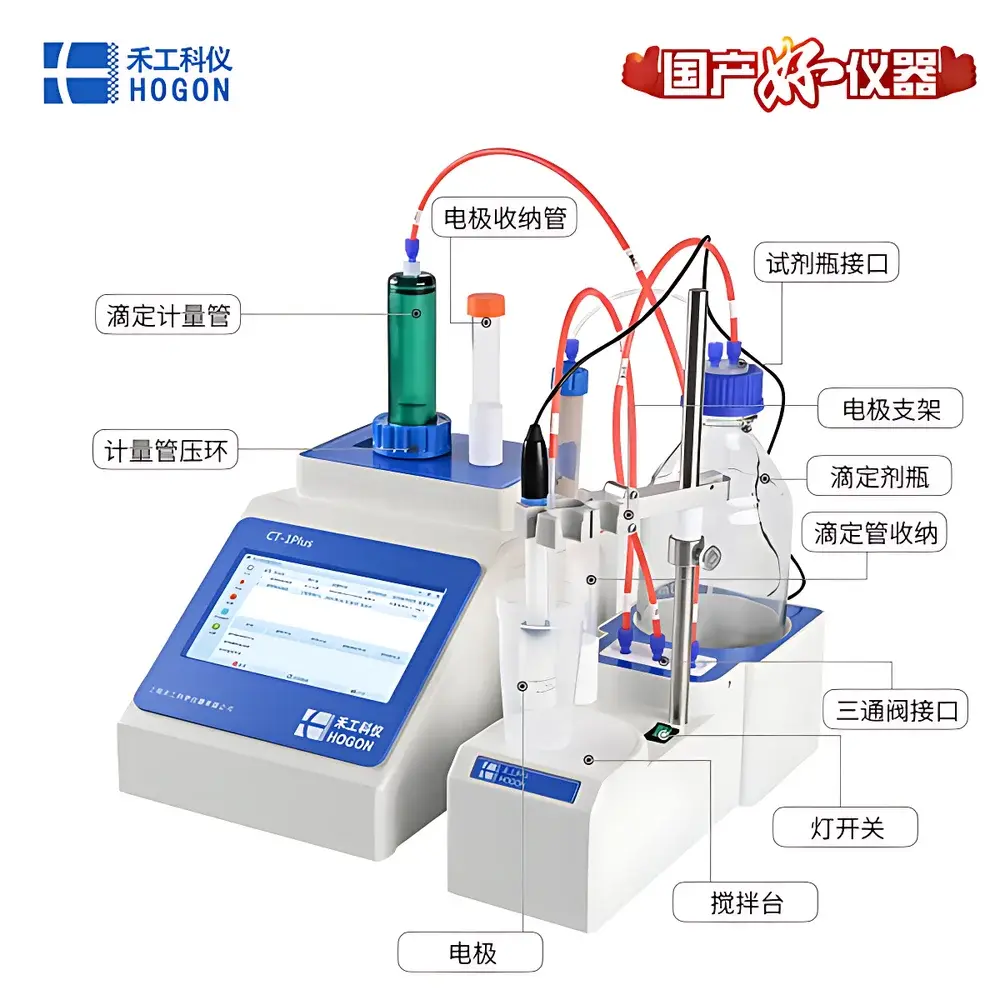
HOGON CT-1Plus Intelligent Automatic Potentiometric Titrator
| Brand | HOGON |
|---|---|
| Origin | Shanghai, China |
| Manufacturer Type | Direct Manufacturer |
| Instrument Type | Universal Automatic Potentiometric Titrator |
| Model | CT-1Plus (Potentiometric Endpoint Module) |
| Measuring Range | Potential: ±1024 mV |
| pH | 0–14 pH |
| Meter Accuracy | ±0.5% |
| Meter Resolution | 0.01 mV / 0.001 pH |
| Titration Accuracy | (±0.3 mV ±1 digit) / 3 h |
| Titration Resolution | ±2000 mV (0.1 mV resolution, ±0.2 mV accuracy) |
| pH | 0–14 (0.001 pH resolution, ±0.003 pH accuracy) |
Overview
The HOGON CT-1Plus Intelligent Automatic Potentiometric Titrator is a modular, dual-mode analytical platform engineered for precision potentiometric and colorimetric endpoint detection in routine and regulated laboratory environments. It operates on the fundamental principle of potentiometric titration—measuring the potential difference between a reference electrode and an indicator electrode as titrant is incrementally added—while integrating a complementary vision-based color detection module for applications where electrochemical endpoints are ambiguous or unavailable (e.g., weak acid–weak base systems, turbid samples, or redox reactions lacking sharp potential inflections). The system employs a high-precision syringe-driven burette with sub-1 µL volumetric control repeatability, enabling robust performance across acid–base, redox, precipitation, and complexometric titrations per ISO 8655-5 and ASTM E2087 standards.
Key Features
- Modular architecture comprising three independent subsystems: high-accuracy titration drive unit (with integrated syringe pump and anti-drip valve), intelligent control unit (ARM Cortex-M7 processor with real-time OS), and multi-sensor detection unit (dual-channel potentiometric input + optional RGB color sensor module)
- Potentiometric measurement compliance with IUPAC recommended electrode interface specifications: input impedance >1013 Ω, common-mode rejection ratio >120 dB, and temperature-compensated electrode calibration (mV/pH mode)
- Color endpoint detection via industrial-grade CMOS imager with programmable white balance, auto-exposure control, and CIE L*a*b* color space analysis—validated against USP visual endpoint equivalence criteria
- Endpoint recognition algorithms supporting fixed-point, dynamic (first-derivative), inflection-point, and user-defined multi-step crossover titration modes
- Hardware-level emergency stop circuitry integrated into all motorized components (burette drive, sample stirrer, reagent selector), meeting IEC 61000-6-2 electromagnetic immunity requirements
- GLP/GMP-ready operation: full audit trail (user ID, timestamp, method version, raw sensor data, manual overrides), digital signature support, and tamper-evident PDF report generation to USB storage
Sample Compatibility & Compliance
The CT-1Plus accommodates aqueous and non-aqueous matrices within standard 50–250 mL titration vessels. Compatible with glass, platinum, silver/silver chloride, calomel, and combination pH electrodes (BNC and DIN connectors). Supports standard titrant concentrations from 0.001 M to 1.0 M, with viscosity tolerance up to 500 cP. All firmware and method files comply with FDA 21 CFR Part 11 requirements for electronic records and signatures when configured with password-protected user roles and encrypted USB export. Instrument validation documentation includes IQ/OQ protocols aligned with ISO/IEC 17025:2017 clause 5.5.2 for titration equipment.
Software & Data Management
The embedded HOGON TitrSoft v3.2 software provides method development, sequence programming, real-time curve visualization (E vs. V, dE/dV vs. V), and automated report generation. Data export supports CSV (raw sensor logs), XML (structured method definitions), and PDF/A-2u (archival-grade reports with embedded metadata and digital watermarking). Cloud synchronization is available via optional TLS 1.3-secured API gateway for centralized lab information management system (LIMS) integration. Audit trails retain ≥10,000 entries with automatic rollover and SHA-256 hash verification of all critical events.
Applications
- Pharmaceutical QC: assay of active pharmaceutical ingredients (APIs) per USP , chloride content in saline formulations, residual catalyst quantification in synthesis intermediates
- Food & Beverage: titratable acidity in dairy products (AOAC 947.05), sulfite determination in wines (OIV-MA-AS313-01A), free fatty acid analysis in edible oils (ISO 660)
- Environmental Testing: alkalinity profiling in wastewater (APHA 2320B), cyanide quantification via silver nitrate titration (EPA 335.4), chloride in drinking water (ISO 9297)
- Chemical Manufacturing: acid number and base number in lubricants (ASTM D974/D2896), peroxide value in unsaturated compounds (AOCS Cd 8-53)
FAQ
Does the CT-1Plus support ASTM D664 or ISO 8295 acid number titration methods?
Yes—pre-configured method templates are included for both standards, with automatic endpoint detection optimized for non-aqueous media and thermometric compensation per ASTM D664 Annex A3.
Can the color detection module replace pH electrodes entirely?
No—it serves as a complementary endpoint modality; potentiometric measurement remains primary for trace-level accuracy. Color mode is validated only for specified dye-based assays (e.g., phenolphthalein, methyl orange) per ICH Q2(R2) specificity criteria.
Is firmware update capability available over network connection?
Firmware updates require authenticated USB drive import only; no remote network update functionality is implemented to maintain air-gapped security per GAMP 5 Annex 11 controls.
What electrode calibration protocols are supported?
Two-point and three-point calibration using NIST-traceable buffer solutions (pH 4.01, 7.00, 10.01); slope calculation and asymmetry potential diagnostics are automatically logged in audit trail.
How is data integrity ensured during power interruption?
Non-volatile FRAM memory retains all active titration state variables (volume dispensed, electrode potential, stir speed) with battery-backed real-time clock; recovery resumes from last stable endpoint upon reboot.
Related Products






