
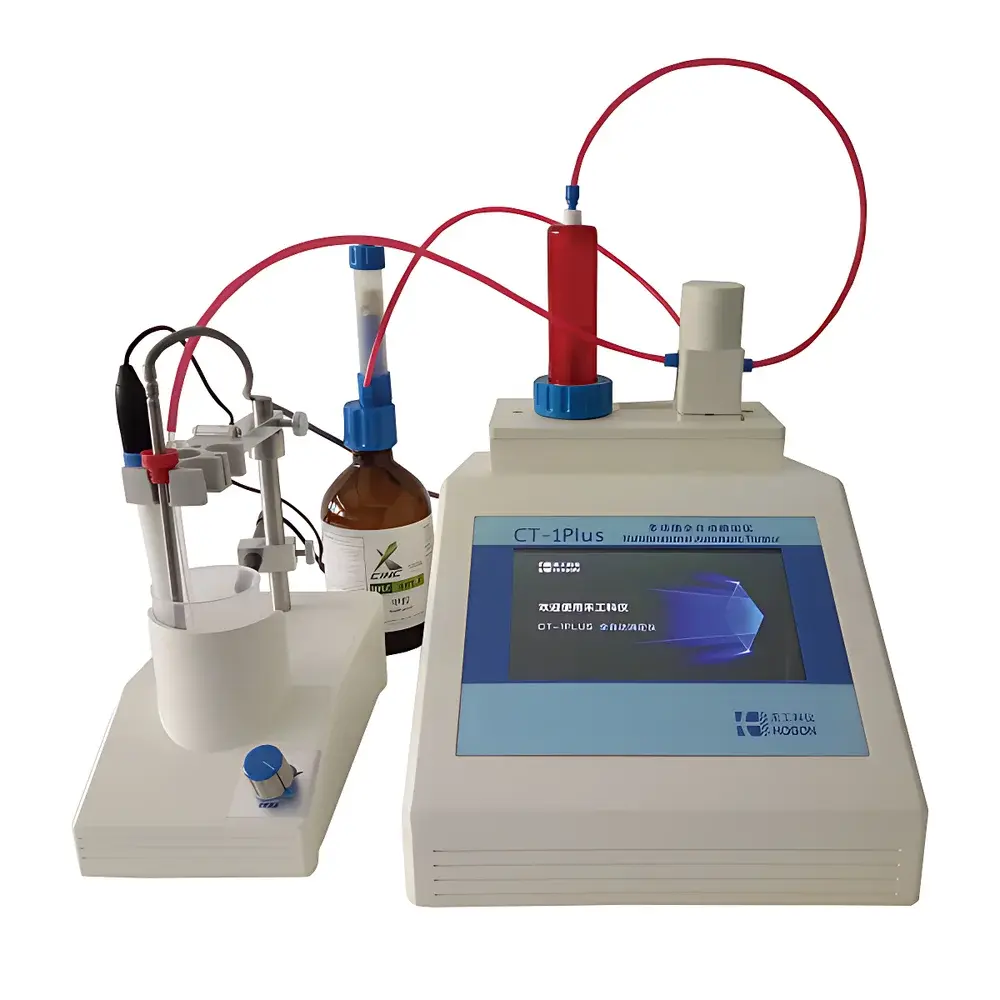
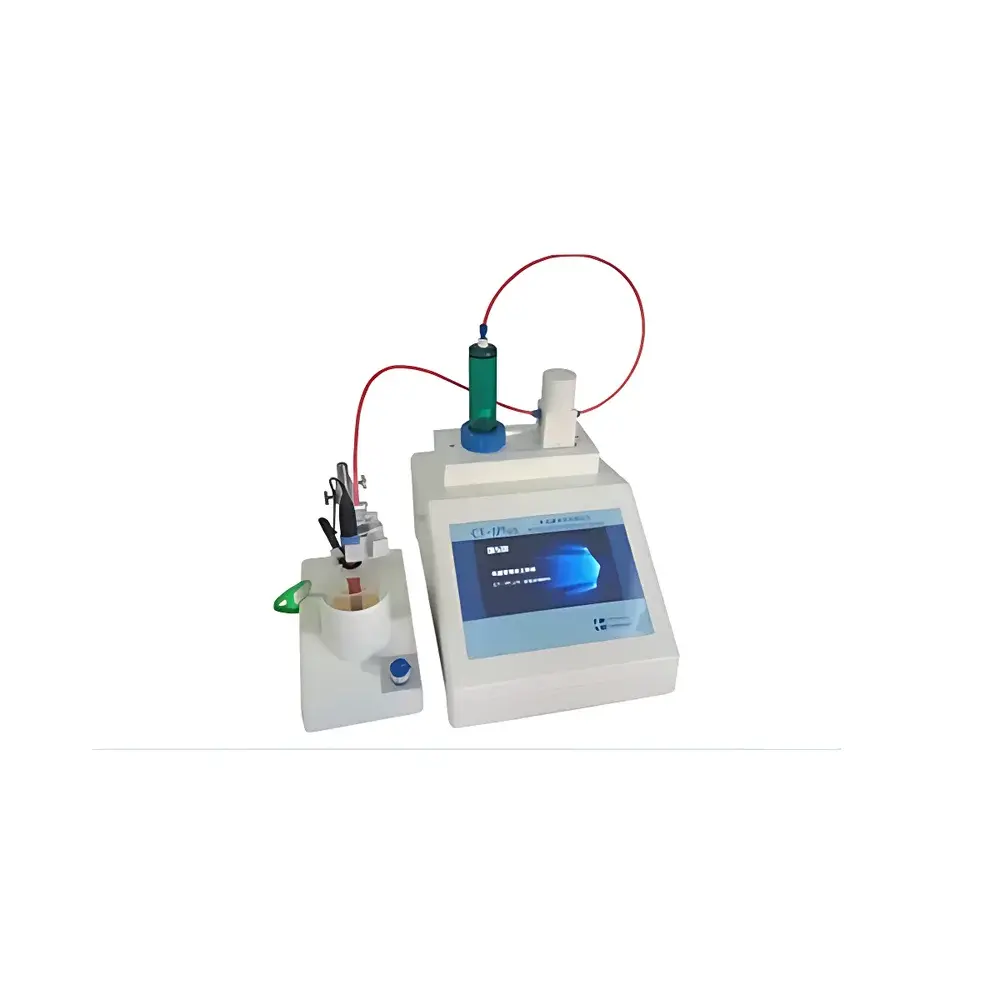
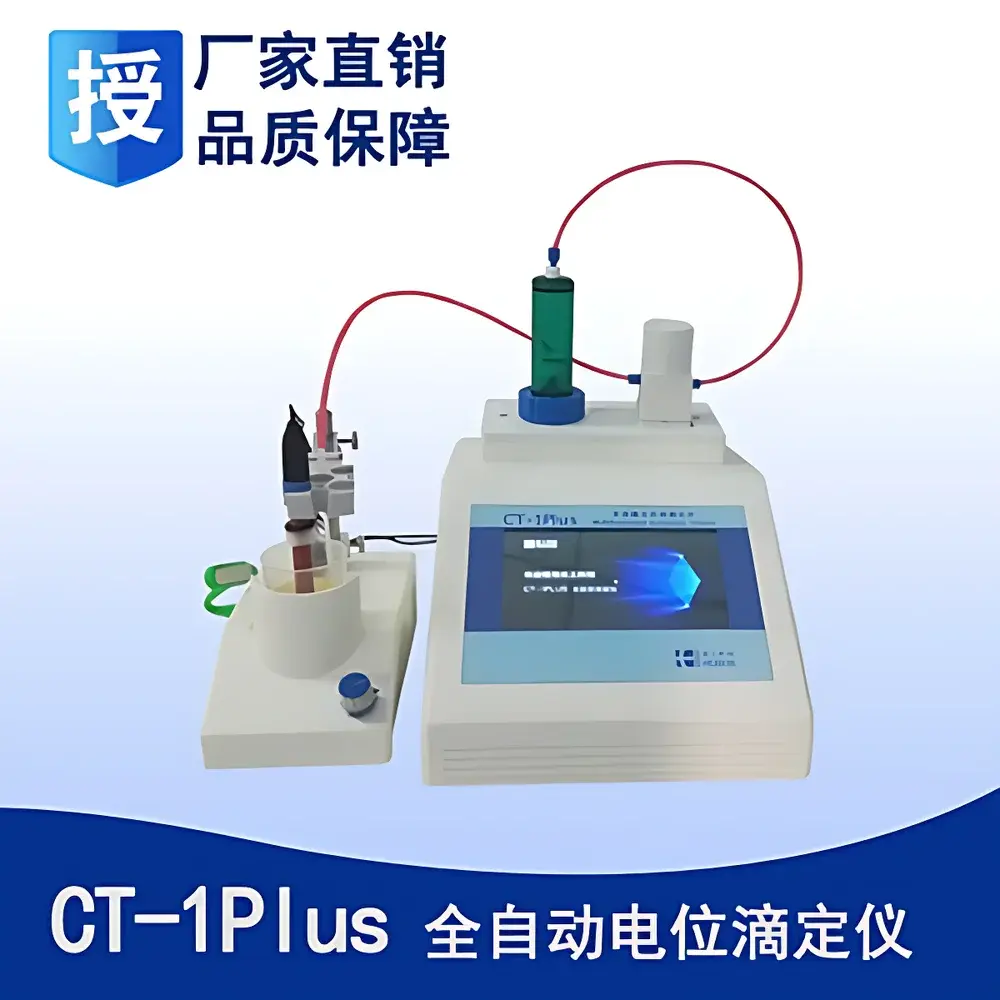
HOGON CT-1Plus Multifunctional Automatic Potentiometric Titrator
| Brand | HOGON |
|---|---|
| Origin | Shanghai, China |
| Manufacturer Type | Direct Manufacturer |
| Instrument Type | General-Purpose Potentiometric Titrator |
| Model | CT-1Plus (Fully Automated) |
| Measurement Range | Potential: ±1024 mV |
| pH | 0–14 pH |
| Meter Accuracy | ±0.5% of full scale |
| Meter Resolution | 0.01 mV (potential), 0.001 pH (pH) |
| Titration Precision | (±0.3 mV ±1 digit) over 3 h |
| Burette Precision | 0.001 mL (20 mL standard burette), 0.0005 mL (10 mL optional burette) |
| Temperature Range | 0–100 °C (±0.1 °C) |
| Display | 7.0″ TFT LCD touchscreen with real-time titration and first-derivative curve overlay |
| Compliance | GLP/GMP-compliant data handling, audit-trail-capable user management, electrode & burette calibration history logging |
| Interfaces | RS-232C, USB, Ethernet, stirrer control port |
| Ambient Conditions | 5–35 °C, <85% RH (non-condensing) |
| Power | AC 100–240 V, 50/60 Hz, ~30 W |
| Dimensions (Main Unit) | 250 × 360 × 330 mm (W×D×H) |
| Stirrer Unit | 120 × 200 × 230 mm |
| Weight | 10 kg |
Overview
The HOGON CT-1Plus Multifunctional Automatic Potentiometric Titrator is an engineered solution for high-reproducibility quantitative chemical analysis based on potentiometric endpoint detection and complementary colorimetric endpoint recognition. It operates on the fundamental electrochemical principle of measuring potential difference between a reference electrode and an indicator electrode as titrant is incrementally added—enabling precise identification of stoichiometric equivalence points in acid-base, redox, precipitation, complexometric, and Karl Fischer moisture titrations. Unlike single-mode titrators, the CT-1Plus integrates a vision-based color detection module that applies machine vision algorithms to quantify chromatic transitions in indicator-based titrations—extending applicability to samples where electrode fouling, low conductivity, or insufficient potential inflection preclude reliable potentiometric detection. Its modular architecture separates fluidic control (high-precision burette assembly), electrochemical sensing (dual-channel electrode interface), and computational intelligence (embedded real-time derivative calculation engine), ensuring operational stability across diverse laboratory environments—from QC labs in pharmaceutical manufacturing to R&D facilities performing method development per USP , ASTM E2087, or ISO 8655-3.
Key Features
- Hybrid endpoint detection: Simultaneous support for potentiometric titration (with automatic inflection point, intersection, and level-stop algorithms) and colorimetric titration via calibrated RGB sensor array and adaptive thresholding.
- Sub-microliter dispensing precision: Standard 20 mL burette delivers ±0.001 mL resolution; optional 10 mL burette achieves ±0.0005 mL—validated per ISO 8655-3 gravimetric protocols.
- Real-time dual-curve visualization: 7.0″ capacitive touchscreen displays both raw potential/pH vs. volume curve and its numerically computed first derivative—enabling immediate visual verification of endpoint sharpness and method robustness.
- Full GLP/GMP traceability: Built-in user authentication (role-based access control), electronic signature support, audit trail for all calibrations (electrode slope/mV offset, burette linearity), and tamper-evident PDF report generation with embedded digital signatures stored on USB media.
- Modular hardware design: Independent stirrer unit with speed regulation (0–1200 rpm), detachable electrode holder with automatic rinse cycle, and tool-free burette exchange—minimizing downtime during maintenance or method reconfiguration.
Sample Compatibility & Compliance
The CT-1Plus accommodates aqueous and non-aqueous matrices across pH 0–14 and redox potentials up to ±1024 mV, supporting standardized methods for titratable acidity (AOAC 940.09), chloride content (ASTM D512), total alkalinity (EPA 310.1), and water content (USP ). Its electrode interface complies with DIN 19262 and ASTM E1127 specifications for reference junction compatibility and liquid junction potential compensation. All data acquisition, storage, and reporting functions conform to FDA 21 CFR Part 11 requirements for electronic records and signatures—including time-stamped operator logins, immutable calibration logs, and version-controlled method files. The instrument meets IEC 61010-1 safety standards for laboratory electrical equipment and operates within ISO/IEC 17025-accredited environmental conditions (5–35 °C, <85% RH).
Software & Data Management
The embedded firmware implements a deterministic real-time operating system optimized for synchronized motor control, analog-to-digital conversion (24-bit ADC), and numerical differentiation using Savitzky-Golay filtering. Method files (.TMD) store complete procedural parameters—including dynamic addition volume profiles, pause durations, temperature compensation coefficients, and endpoint criteria—and are protected against unauthorized modification via SHA-256 hashing. Data export supports CSV (for LIMS integration), XML (for ELN ingestion), and encrypted PDF (with embedded metadata: operator ID, timestamp, instrument serial number, calibration status). USB storage enforces write-once-read-many (WORM) behavior for audit-ready archiving; network interface enables remote monitoring via HTTP API compliant with IEEE 11073-20601 for interoperability with enterprise laboratory systems.
Applications
- Pharmaceutical QC: Quantification of active pharmaceutical ingredients (APIs) via acid-base titration (e.g., amine hydrochloride assays), residual catalyst metals by complexometric EDTA titration, and water content in lyophilized products using Karl Fischer coulometric mode.
- Food & Beverage: Total acidity in wines and juices (AOAC 942.15), salt content in processed foods (potentiometric argentometry), and peroxide value in edible oils (redox iodometric titration).
- Environmental Testing: Alkalinity and hardness profiling in wastewater (APHA 2320B), cyanide determination via silver nitrate titration (EPA 335.4), and fluoride analysis using lanthanum nitrate potentiometry.
- Academic Research: Development of novel titration protocols requiring multi-step additions, conditional endpoint logic, or simultaneous monitoring of multiple parameters (e.g., pH + redox potential).
FAQ
Does the CT-1Plus support ASTM D664 for acid number determination?
Yes—the instrument includes a preconfigured method template compliant with ASTM D664, featuring controlled addition rate, temperature stabilization at 80 °C, and automatic endpoint detection via second-derivative maxima.
Can electrode calibration data be exported separately from titration reports?
Yes—calibration history (date, operator, slope, offset, reference electrode potential) is stored in ISO 8601-compliant XML format and exportable via USB or Ethernet without requiring report generation.
Is the color detection module compatible with non-standard indicators such as alizarin red or xylenol orange?
Yes—the RGB sensor allows user-defined wavelength band selection and dynamic threshold adjustment, validated for indicators with absorbance peaks between 400–700 nm.
How is burette accuracy maintained over extended operation?
The system performs automated gravimetric verification at startup and after every 50 titrations; results are logged with uncertainty estimates per ISO/IEC 17025 clause 7.7.
What cybersecurity measures are implemented for network-connected units?
All Ethernet communications use TLS 1.2 encryption; firmware updates require signed packages verified via embedded RSA-2048 keys; default credentials are disabled after initial setup.




