
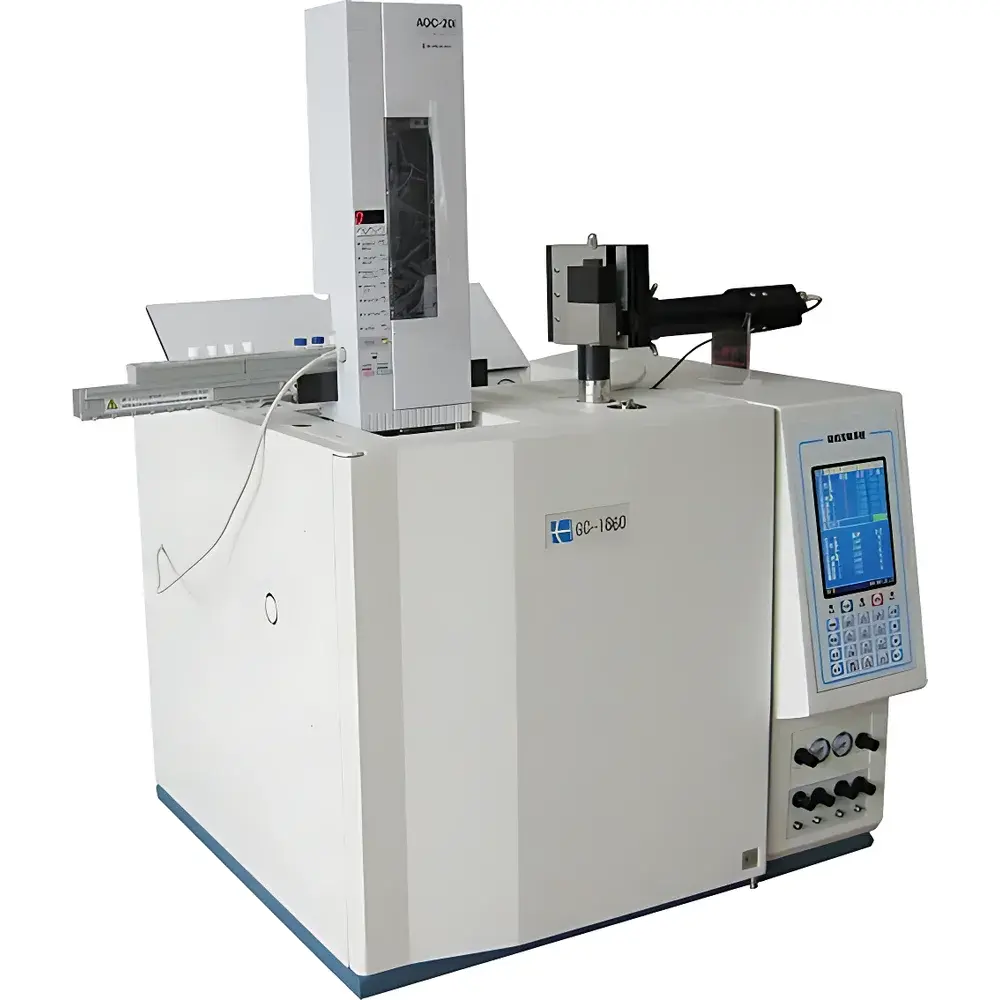
HOGON GC-1860 Intelligent Networked Gas Chromatograph
| Brand | HOGON |
|---|---|
| Origin | Shanghai, China |
| Manufacturer Type | Direct Manufacturer |
| Instrument Type | Laboratory Gas Chromatograph |
| Model | GC-1860 |
| Temperature Control Range | 8 °C above ambient to 450 °C (1 °C increment, ±0.1 °C accuracy) |
| Ramp Rate | 0.1–39 °C/min (standard), 0.1–80 °C/min (high-speed) |
| Cooling Rate | ~6 min (450 °C → 50 °C) |
| Carrier Gas Flow Control | 0–1200 mL/min (7 programmable segments) |
| Carrier Gas Pressure Control | 0–970 kPa (7 programmable segments) |
| Injector Max Temp | 450 °C |
| Injector Pressure Range | 0–970 kPa |
| Injector Total Flow Range | 0–1200 mL/min |
Overview
The HOGON GC-1860 Intelligent Networked Gas Chromatograph is a microprocessor-controlled, Ethernet-enabled analytical platform engineered for high-reproducibility separation and quantification of volatile and semi-volatile organic compounds. Based on classical gas chromatographic principles—partitioning of analytes between a mobile gas phase (carrier gas) and a stationary liquid or polymer phase coated inside a capillary or packed column—the GC-1860 delivers robust performance in routine QC, environmental monitoring, pharmaceutical impurity profiling, and petrochemical analysis. Its architecture integrates six independent temperature zones (oven, up to three injectors, and up to three detectors), 16-step programmable temperature ramping, and near-ambient oven control (down to 5 °C above ambient), enabling precise thermal management for complex multi-component separations. Unlike legacy standalone GC systems, the GC-1860 embeds IEEE 802.3-compliant 10/100 MBase-T Ethernet connectivity as standard, permitting full bidirectional instrument control, real-time data streaming, and centralized fleet management across distributed laboratory or industrial environments.
Key Features
- Full microcomputer-based control with Ethernet interface supporting remote operation, firmware updates, and diagnostic telemetry via TCP/IP—enabling centralized supervision of up to 255 instruments from a single workstation.
- Six independently programmable temperature zones with ±0.1 °C stability and 1 °C resolution; oven ramp rates configurable from 0.1 to 80 °C/min (high-speed variant).
- Integrated digital signal acquisition with embedded chromatography data system (CDS); analog-to-digital conversion and Ethernet packetization occur onboard—eliminating external ADC boxes or USB dependency.
- Modular detector support: simultaneous installation of up to three detectors (FID, TCD, ECD, FPD, or NPD) with dedicated power supplies and signal conditioning circuits.
- Advanced gas control architecture: optional electronic pressure/flow controllers (EPC/EFC) for nitrogen, hydrogen, air, helium, and argon—supporting constant flow, constant pressure, and split/splitless modes across four independent gas programs.
- Intelligent self-diagnostic system with real-time fault localization, overtemperature cut-off protection per zone, and non-volatile memory for method parameters and calibration constants—even after power loss.
- Large-format 320 × 240 pixel color LCD display with localized Chinese language interface (optional resistive touchscreen); intuitive menu navigation designed for rapid operator onboarding without extensive training.
Sample Compatibility & Compliance
The GC-1860 accommodates diverse sample introduction methods—including packed column, split/splitless capillary, gas sampling valves, headspace autosamplers, thermal desorbers, and pyrolyzers—ensuring adaptability across solid, liquid, and gaseous matrices. Its injector temperature range (up to 450 °C) and pressure control (0–970 kPa) support thermally labile and high-boiling compounds. The system complies with core regulatory expectations for analytical instrumentation: method parameter audit trails, electronic signature-ready data handling (when paired with compliant CDS software), and hardware-level safeguards aligned with GLP and GMP principles. While not pre-certified to FDA 21 CFR Part 11 out-of-the-box, its deterministic Ethernet communication, timestamped event logging, and write-protected method storage provide foundational traceability required for validation under ISO/IEC 17025, USP , and ASTM D3612/D6300 frameworks.
Software & Data Management
Data acquisition and processing are performed using HOGON’s proprietary GC Navigator™ software suite—compatible with Windows 10/11 and supporting raw data export in standard formats (e.g., .cdf, .csv, .txt). The software implements peak integration algorithms compliant with ICH Q2(R2) guidelines, supports multi-level user access control (administrator, analyst, reviewer), and maintains immutable records of all acquisition events, method changes, and calibration actions. When deployed in networked mode, raw chromatograms and metadata are streamed directly to a central server via TCP socket or HTTP POST—enabling cross-site data aggregation for trend analysis, batch release review, or regulatory submission. Optional integration with LIMS platforms is supported through configurable ODBC drivers and RESTful API endpoints.
Applications
The GC-1860 serves as a primary analytical tool in regulated and non-regulated laboratories requiring reliable, scalable chromatographic analysis. Key application domains include residual solvent testing per ICH Q3C in pharmaceutical manufacturing; hydrocarbon speciation in fuels per ASTM D1319/D6730; pesticide residue screening in food matrices per EU SANTE/11312/2021; VOC emissions monitoring in indoor air (EPA TO-17); and monomer purity assessment in polymer synthesis. Its networked architecture is particularly valuable in contract testing organizations managing geographically dispersed client sites, municipal environmental labs coordinating regional water quality surveillance, and national regulatory agencies performing remote oversight of compliance-driven analyses (e.g., drug stability testing, food adulterant detection).
FAQ
Does the GC-1860 support FDA 21 CFR Part 11 compliance?
The hardware provides essential prerequisites—electronic audit trails, secure user authentication, and tamper-evident data storage—but formal Part 11 compliance requires validated software configuration, procedural controls, and documented risk assessment per your organization’s quality system.
Can the instrument operate unattended for extended periods?
Yes—equipped with EPC/EFC, auto-shutdown on fault detection, and scheduled run sequences, the GC-1860 is suitable for overnight or weekend unattended operation when integrated with compatible autosamplers and environmental monitoring.
What detector configurations are factory-supported?
All combinations of FID, TCD, ECD, FPD, and NPD are supported; dual-FID + TCD and triple-FID setups are commonly deployed for parallel method validation or multi-analyte workflows.
Is remote firmware update capability available over the Internet?
Yes—via authenticated HTTPS session initiated from the host PC, provided firewall policies permit inbound port 80/443 traffic to the instrument’s static or DHCP-assigned IP address.
What is the maximum number of temperature program steps supported?
The column oven supports up to 16 ramp/hold steps per method, with independent programming for all six temperature zones.






