
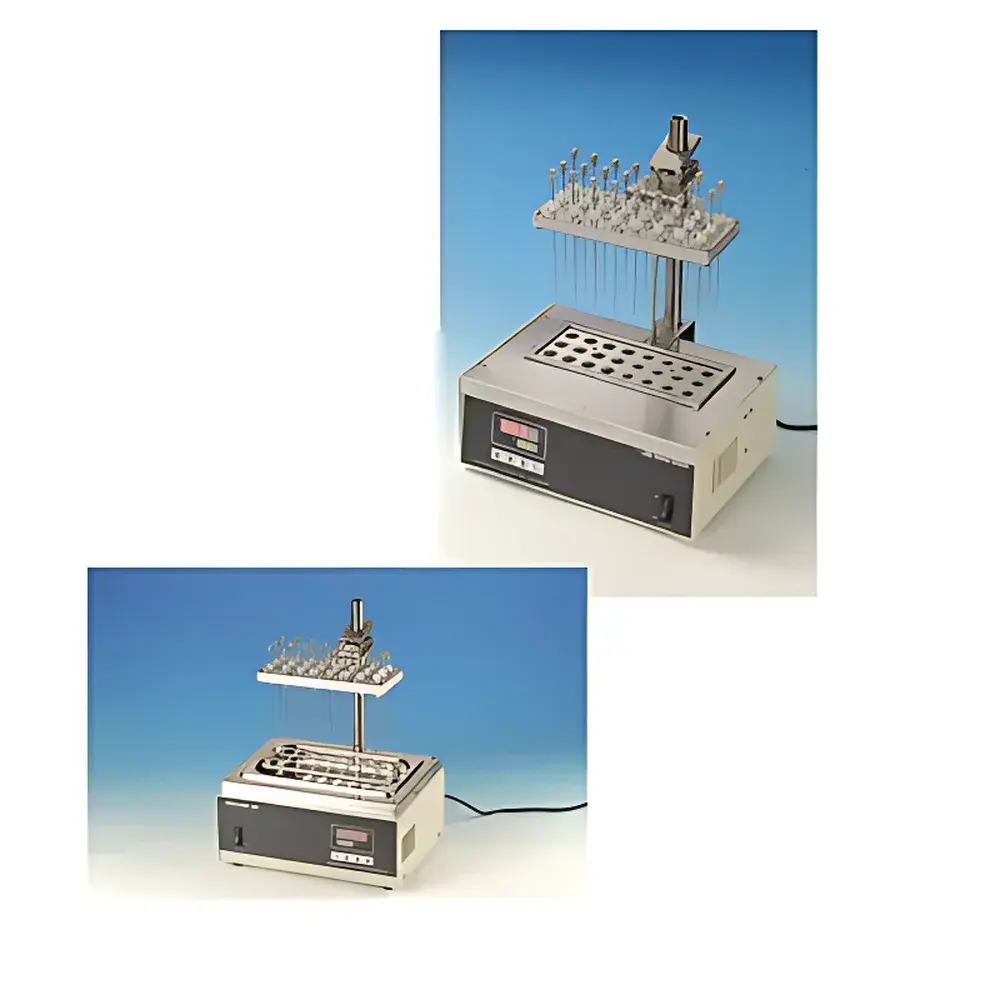
HOGON HGC-96A Dry-Block Nitrogen Evaporator
| Brand | HOGON |
|---|---|
| Origin | Shanghai, China |
| Manufacturer Type | Direct Manufacturer |
| Product Category | Domestic (PRC-Made) |
| Model | HGC-96A |
| Heating Method | Dry-Block Heating |
| Temperature Range | Ambient to 150 °C |
| Temperature Uniformity | ±1 °C |
| Sample Tube Diameters Supported | 15 mm, 17 mm, 21 mm (custom bore diameters available upon request) |
| Gas Flow Rate | 0–100 L/min |
| Throughput Capacity | 12 / 24 / 48 / 96 positions |
| Heating Power | 500 W |
Overview
The HOGON HGC-96A is a precision-engineered dry-block nitrogen evaporator designed for high-throughput, inert-gas-assisted solvent removal in analytical laboratories. It operates on the principle of controlled nitrogen gas sweep across heated sample surfaces—accelerating solvent volatilization while minimizing thermal degradation and oxidation of thermally labile analytes. Unlike rotary evaporation or vacuum concentration systems, the HGC-96A delivers targeted, low-pressure, oxygen-free concentration without requiring complex vacuum infrastructure or condensation traps. Its dry-block architecture eliminates water bath maintenance, cross-contamination risk, and temperature lag, enabling rapid thermal equilibration and superior positional uniformity across all sample wells. The instrument is widely deployed in environmental analysis (e.g., EPA Method 525.3), food safety testing (AOAC 2007.01), clinical toxicology, and pharmaceutical QC workflows where reproducible, scalable, and GLP-compliant sample preparation is essential.
Key Features
- Dry-block heating system with aluminum alloy heating blocks engineered for thermal homogeneity and corrosion resistance; surface-treated with electrophoretic coating for chemical inertness.
- PID-controlled digital temperature regulation (4-digit LED display) with adjustable ramp rate, over-temperature cutoff, and real-time deviation monitoring (±1 °C accuracy across full range: ambient to 150 °C).
- Modular gas distribution manifold with independently controllable needle valves per channel—enabling selective activation of individual or grouped sample positions without flow redistribution.
- Height-adjustable gas delivery head accommodates varying tube lengths (e.g., 10–150 mm); stainless steel (316-grade) gas nozzles resist solvent erosion and ensure consistent laminar flow profile.
- Scalable configuration support: interchangeable heating blocks for 12-, 24-, 48-, or 96-position formats; standard bore diameters (15 mm, 17 mm, 21 mm) with OEM customization available for non-standard vial geometries (e.g., GC vials, crimp-top tubes, microcentrifuge formats).
- High-capacity gas flow control (0–100 L/min total), compatible with laboratory-grade nitrogen generators or compressed gas manifolds; integrated pressure relief and flow stabilization circuitry prevent surging during multi-channel operation.
Sample Compatibility & Compliance
The HGC-96A accommodates a broad spectrum of sample containers—including borosilicate glass test tubes, polypropylene centrifuge tubes, and autosampler vials—across volume ranges from 0.5 mL to 15 mL. All wetted materials contacting solvents (gas nozzles, block bores, mounting hardware) are constructed from 316 stainless steel, anodized aluminum, or chemically resistant polymer coatings, ensuring compatibility with acetonitrile, methanol, ethyl acetate, hexane, and chlorinated solvents. The system meets structural and operational requirements referenced in ISO/IEC 17025:2017 for calibration traceability of temperature and flow parameters. While not intrinsically certified for hazardous locations, its design supports integration into fume hood environments compliant with ANSI Z9.5 and EN 14175 standards. Documentation packages include factory calibration certificates (temperature uniformity mapping per ICH Q5C Annex), material compliance declarations (RoHS, REACH), and electrical safety certification (IEC 61010-1).
Software & Data Management
The HGC-96A operates as a standalone benchtop instrument with embedded firmware—no external PC or proprietary software required for routine operation. All temperature setpoints, dwell times, and gas flow profiles are stored locally in non-volatile memory with timestamped audit logs (accessible via front-panel navigation). Optional RS-232 or USB-to-serial interface enables integration with LIMS or ELN platforms for automated run logging and electronic record retention. When deployed in regulated environments (e.g., FDA-regulated labs), the instrument supports 21 CFR Part 11-compliant data capture when paired with validated third-party acquisition software—providing user authentication, electronic signatures, and immutable audit trails for temperature excursions, power events, and parameter changes.
Applications
- Routine concentration of pesticide residues in soil/water extracts prior to GC-MS analysis (EPA 8081B, EN 15662).
- Pre-concentration of mycotoxins (aflatoxin B1, ochratoxin A) from cereal matrices following QuEChERS extraction.
- Parallel processing of plasma/urine samples in forensic toxicology screening workflows (e.g., amphetamines, benzodiazepines).
- Removal of dichloromethane or ethyl acetate after solid-phase extraction (SPE) of pharmaceutical impurities per ICH Q3A(R2).
- High-throughput drying of DNA/RNA eluates post-column purification in molecular diagnostics labs.
FAQ
What is the maximum recommended operating temperature for continuous use?
The HGC-96A is rated for sustained operation up to 150 °C; however, prolonged exposure above 120 °C may accelerate thermal aging of silicone O-rings or polymer seals in auxiliary accessories—consult the accessory compatibility matrix before extended high-temperature runs.
Can the instrument be used with gases other than nitrogen?
Yes—argon and helium are compatible; avoid oxidizing or reactive gases (e.g., air, oxygen, chlorine) due to safety and material compatibility constraints.
Is validation support documentation available for GMP environments?
HOGON provides IQ/OQ protocol templates, temperature mapping reports, and calibration traceability statements aligned with ASTM E2877-22 and USP guidelines; site-specific PQ must be performed by the end user.
How is gas flow calibrated and verified?
Each unit undergoes factory calibration using NIST-traceable mass flow meters; users may verify flow per channel using a calibrated rotameter or thermal mass flow sensor at the nozzle outlet.
Are replacement heating blocks available for custom tube sizes?
Yes—custom-machined blocks for diameters from 8 mm to 30 mm are offered with lead times of 4–6 weeks; minimum order quantity applies.



