
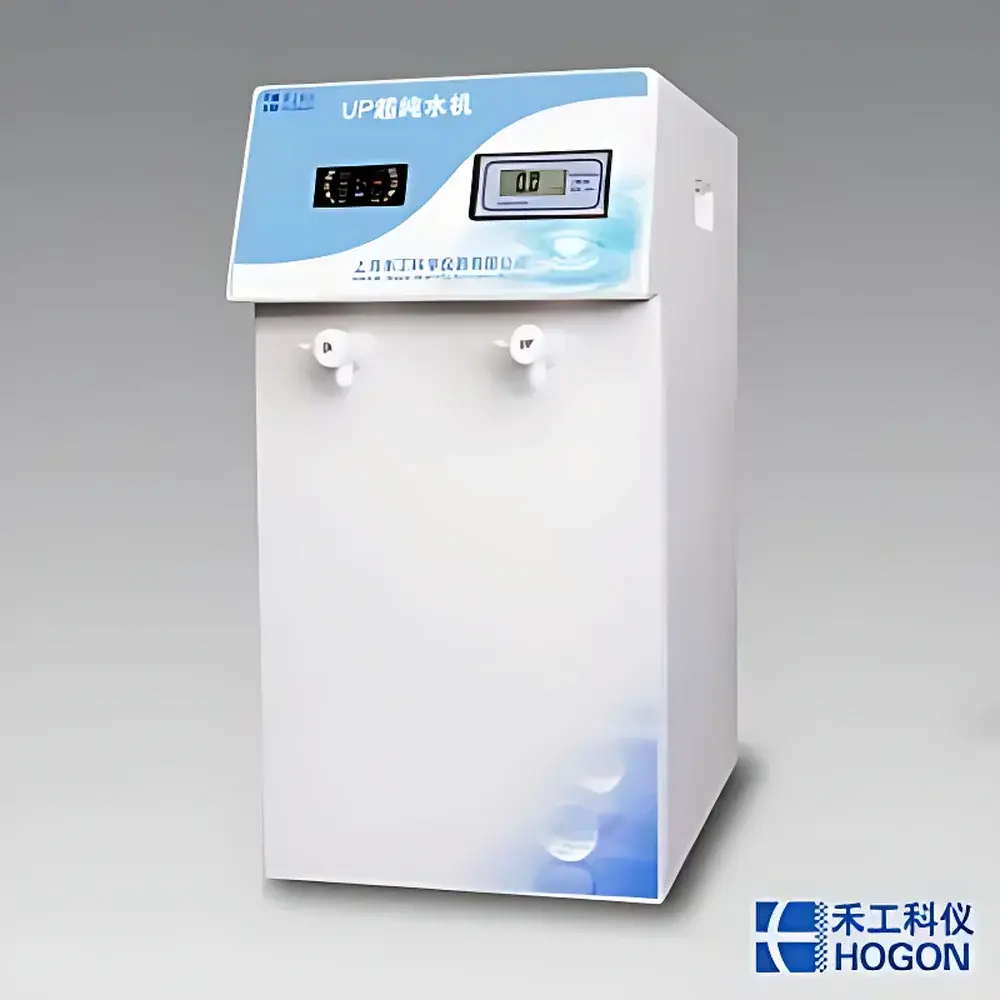
HOGON HUP Series Ultra Pure Water System (Municipal Tap Water Feed)
| Brand | HOGON |
|---|---|
| Origin | Shanghai, China |
| Manufacturer Type | Direct Manufacturer |
| Product Category | Domestic |
| Model | HUP Series |
| Purified Water Grade | Type I Ultrapure Water |
| Resistivity | 18.2 MΩ·cm @ 25 °C |
| Heavy Metals & Soluble Silica | <0.1 ppb |
| Total Organic Carbon (TOC) | <5 ppb |
| Microbial Count / Endotoxins | <0.001 EU/mL |
| Particles (>0.1 � | m): <1 particles/mL |
Overview
The HOGON HUP Series Ultra Pure Water System is a dual-output, laboratory-grade water purification platform engineered for consistent production of Type I ultrapure water (ASTM D1193-20, ISO 3696:1987 Class 1, CLSI EP22-A2 compliant) from municipal tap water feed. It employs a multi-stage purification architecture integrating pretreatment, reverse osmosis (RO), and post-RO polishing modules—including ion exchange, dual-wavelength (254/185 nm) UV photooxidation, optional ultrafiltration (UF), and 0.2 μm terminal filtration—to achieve stringent physicochemical and biological specifications required for sensitive analytical applications such as HPLC, LC-MS, ICP-MS, cell culture, molecular biology, and trace elemental analysis. The system’s core design prioritizes operational reliability, membrane longevity, and real-time water quality assurance through integrated pressure monitoring, programmable RO membrane flush cycles, and continuous resistivity-based conductivity tracking.
Key Features
- Microprocessor-controlled operation with backlit LCD interface displaying real-time status: RO production, ultrapure water generation, tank fullness, low-water alarm, maintenance alerts, and system fault diagnostics.
- Integrated dual-pressure monitoring—feed water pressure and RO membrane operating pressure—with manual adjustment capability to optimize flux and extend RO membrane service life under variable inlet water conditions (e.g., seasonal TDS or hardness fluctuations).
- Dual-wavelength UV lamp (254 nm germicidal + 185 nm TOC oxidation) installed in-line post-polishing to reduce microbial load and oxidize residual organics below 5 ppb TOC.
- Optional UF module (MWCO 5,000 Da) for endotoxin and particle removal—validated for <0.001 EU/mL endotoxin retention—enabling applications requiring pyrogen-free water (e.g., injectables R&D, stem cell media preparation).
- Modular, quick-connect fluidic architecture using sanitary-grade PEEK and PVDF tubing; all critical consumables—including RO membranes, mixed-bed ion exchange cartridges, UV sleeves, and 0.2 μm final filters—are standardized and field-replaceable without tools.
- GLP-compliant safety design: non-conductive polymer housing, overpressure/low-pressure cut-off protection, automatic power recovery after outage, and audible/visual alarms for abnormal operating states.
Sample Compatibility & Compliance
The HUP Series accepts municipal tap water with TDS ≤200 ppm, temperature range 5–45 °C, and inlet pressure 1.0–3.5 kg/cm² (100–350 kPa). For source waters exceeding 200 ppm TDS or >150 ppm CaCO₃ hardness, an external softener is recommended to prevent RO scaling. All wetted materials comply with USP Class VI biocompatibility standards. The system meets ISO 9001-certified manufacturing requirements and supports audit-ready documentation for GLP/GMP environments. Optional data logging and electronic signature capabilities align with FDA 21 CFR Part 11 readiness when integrated with validated third-party LIMS platforms.
Software & Data Management
While the base HUP Series operates via embedded firmware without cloud connectivity, its resistivity sensor outputs analog 4–20 mA signals compatible with building management systems (BMS) or SCADA interfaces. Optional RS485 Modbus RTU communication enables integration into centralized lab infrastructure monitoring. On-device LCD displays live resistivity (MΩ·cm), TOC trend estimates (via UV absorbance correlation), and cumulative runtime for each purification stage. Calibration logs, maintenance timestamps, and alarm history are stored internally for ≥12 months and exportable via USB for QA record retention per ISO/IEC 17025 clause 7.7.
Applications
- HPLC and UHPLC mobile phase preparation where silica dissolution and baseline drift must be minimized.
- ICP-MS sample introduction and diluent preparation requiring sub-ppt metal contamination control.
- Cell culture media formulation and sterile filtration processes demanding endotoxin-free (<0.001 EU/mL) and low-TOC water.
- PCR, qRT-PCR, and next-generation sequencing workflows sensitive to nuclease or DNase activity.
- Atomic absorption spectroscopy (AAS) and graphite furnace AAS calibration standard dilution.
- Pharmaceutical stability testing and excipient solubility studies governed by USP Water for Pharmaceutical Purposes.
FAQ
What feed water quality is required for optimal RO membrane performance?
Municipal tap water with TDS ≤200 ppm, free chlorine <0.5 ppm, and hardness <150 ppm CaCO₃ is recommended. External softening or dechlorination is advised for high-hardness or high-chlorine sources.
Can the system produce both RO water and ultrapure water simultaneously?
Yes—the dual-output configuration provides independent, metered flow paths: one for RO permeate (2–10 μS/cm) and one for polished ultrapure water (18.2 MΩ·cm), each with dedicated dispensing valves.
How often must consumables be replaced?
Typical service intervals: PP/carbon prefilter every 6 months; RO membrane every 2–3 years (dependent on feed water quality); ultrapure polishing cartridge every 6–12 months; UV lamp annually; UF membrane every 18–24 months under continuous use.
Is the system suitable for GMP-regulated environments?
The HUP Series supports GMP compliance through configurable audit trails, calibration traceability, and mechanical interlocks—though formal validation (IQ/OQ/PQ) requires site-specific protocol execution per Annex 15 and EU GMP guidelines.
Does the system meet ASTM Type I water specifications?
Yes—resistivity ≥18.2 MΩ·cm at 25 °C, TOC <5 ppb, bacteria <1 CFU/mL, particles 0.1 μm), and endotoxin <0.001 EU/mL satisfy ASTM D1193-20 Type I criteria when operated within specified feed and maintenance parameters.



