
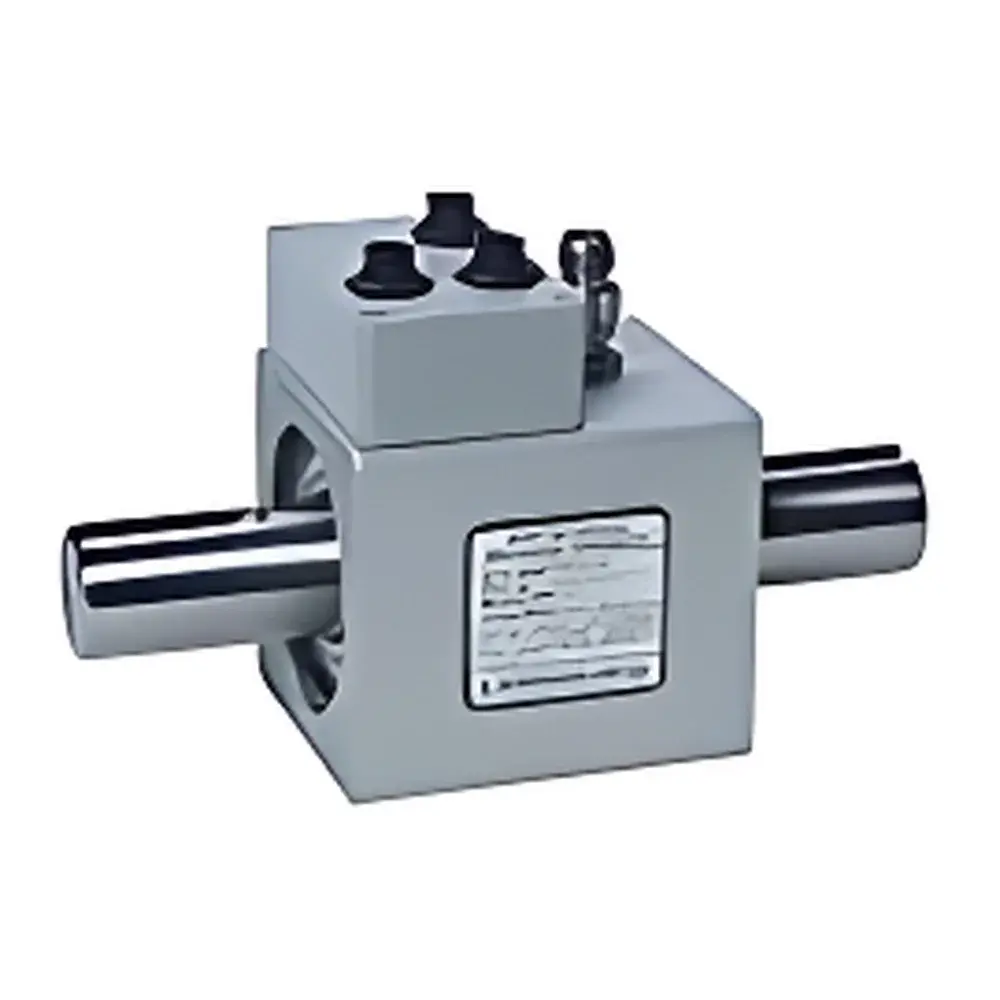
Honeywell 482 Non-Contact Digital DC Torque Sensor Series
| Origin | USA |
|---|---|
| Manufacturer Type | Authorized Distributor |
| Import Status | Imported |
| Model | 482 |
| Quotation | Available upon Request |
| Torque Range | 2.83 N·m to 1130 N·m |
| Analog Output | ±5 V DC or ±10 V DC (user-selectable) |
| Digital Interface | RS232C |
| Combined Accuracy (nonlinearity + hysteresis + nonrepeatability) | ±0.2% FS (Code N) / ±0.15% FS (Code C) |
| Rotational Effect on Zero | ±0.05% FS (Code N) / ±0.025% FS (Code C) |
| Thermal Zero Drift | ±0.007% FS/°F (Code N) / ±0.003% FS/°F (Code C) |
| Thermal Span Drift | ±0.007% reading/°F (Code N) / ±0.003% reading/°F (Code C) |
| Temperature Compensation Range | +75 to +150 °F |
| Operating Temperature Range | +32 to +175 °F |
| Nominal Overrange Capacity | 30% FS |
| Bessel Filter Cutoff Frequencies | 0.1–200 Hz (11 steps: 1–2–5 sequence) |
| System Resolution | 0.02% FS (±10 V) / 0.04% FS (±5 V) |
| Supply Voltage | 10–15 V DC @ 200 mA nominal |
Overview
The Honeywell 482 Non-Contact Digital DC Torque Sensor Series is a high-fidelity, strain-gauge-based transduction system engineered for precision static and quasi-static torque measurement in demanding industrial, laboratory, and production environments. Unlike conventional slip-ring or potentiometric torque sensors, the 482 employs non-contact signal transfer—typically via inductive coupling or RF telemetry—eliminating mechanical wear, electrical noise from brush contact, and long-term calibration drift associated with rotating interfaces. Its core measurement principle relies on Wheatstone bridge-configured foil strain gauges bonded directly to a torsionally loaded shaft element; torque-induced shear strain is converted into a proportional millivolt-level differential output, amplified and digitized within the sensor housing. The integrated analog-to-digital conversion, digital signal conditioning, and microcontroller-based firmware ensure stable zero point retention, minimal thermal influence, and high reproducibility across ambient temperature gradients. Designed for integration into test benches, motor dynamometers, gearbox validation rigs, and robotic joint characterization systems, the 482 delivers metrologically traceable performance compliant with ISO 376:2011 (calibration of force-measuring instruments) and aligned with ASTM E250-22 (standard practices for calibration of transducers used in structural testing).
Key Features
- Two performance grades: Code N (±0.2% FS combined error) and Code C (±0.15% FS), enabling cost-optimized selection based on application-critical uncertainty budgets
- Non-contact signal transmission architecture ensures infinite rotational life, zero maintenance, and immunity to EMI from adjacent variable-frequency drives or switching power supplies
- Wide operating temperature range (+32 to +175 °F) with compensated thermal drift coefficients—critical for engine test cells and climate-controlled manufacturing lines
- Eleven user-selectable Bessel-response low-pass filters (0.1–200 Hz in 1–2–5 decade steps) preserve phase linearity and suppress aliasing without introducing overshoot or group delay distortion
- No mechanical potentiometers or tactile switches: all configuration parameters—including null offset, full-scale scaling, engineering units, and filter settings—are stored in non-volatile EEPROM memory
- Simultaneous dual-output capability: analog (±5 V or ±10 V DC, field-selectable) for real-time PLC or DAQ acquisition, plus RS232C serial interface for bidirectional configuration and high-resolution torque reporting in user-defined units
- Robust mechanical design supports both floating (in-line shaft coupling) and foot-mounted installation via integral base plate, accommodating axial misalignment up to ±0.005 in and angular misalignment ≤ 0.25°
Sample Compatibility & Compliance
The 482 series accommodates solid and hollow shaft configurations across its torque range (2.83–1130 N·m), with standard bore diameters ranging from 12 mm to 75 mm depending on model variant. It is compatible with ferromagnetic and non-magnetic drive train components, including stainless steel, aluminum, and titanium shafts—provided torsional stiffness meets minimum rigidity requirements per ISO 17025:2017 Annex A.3. Calibration certificates are provided traceable to NIST standards, and the sensor complies with IEC 61000-6-2 (immunity) and IEC 61000-6-4 (emissions) for industrial environments. For regulated industries, firmware supports audit-trail logging of configuration changes, satisfying FDA 21 CFR Part 11 requirements when paired with validated host software. All models meet IP50 ingress protection and operate reliably under continuous duty at rated capacity.
Software & Data Management
A Windows-compatible configuration and data acquisition utility is included, supporting Windows 10/11 (64-bit) and requiring .NET Framework 4.8. The software enables real-time torque visualization, time-synchronized multi-channel plotting (including analog input synchronization), and export to CSV, MATLAB (.mat), or HDF5 formats. Users may define custom unit conversions (e.g., N·m → lbf·ft → kgf·cm) without recalibration, configure RS232 baud rates (9600–115200), assign ASCII command macros, and generate automated calibration reports compliant with ISO/IEC 17025 clause 7.8.2. Data streams include timestamped torque values, status flags (overrange, thermal warning, communication timeout), and internal diagnostics (bridge voltage, temperature sensor reading). The software architecture supports integration via COM object or TCP/IP socket interface for LabVIEW, Python (pySerial), or MATLAB Instrument Control Toolbox applications.
Applications
- Electric motor and inverter efficiency mapping across speed-torque quadrants
- Automotive transmission and e-axle NVH (noise, vibration, harshness) testing
- Robotics joint torque feedback for adaptive control and safety-limit enforcement (ISO/TS 15066)
- Industrial pump and compressor performance validation per API RP 11S1
- Academic research in tribology, bearing friction loss quantification, and clutch engagement dynamics
- Quality assurance in aerospace actuator final test stands (AS9100 Rev D, clause 8.5.1)
FAQ
What is the difference between Code N and Code C accuracy specifications?
Code N denotes standard performance grade with ±0.2% full-scale combined error (nonlinearity, hysteresis, nonrepeatability); Code C represents enhanced-grade calibration with tighter tolerance of ±0.15% FS, achieved through extended thermal soak and multi-point verification across the compensated temperature range.
Can the 482 be used in vacuum or explosive atmospheres?
No—the 482 is rated for ambient industrial environments only (IP50, non-hazardous location). It is not intrinsically safe, explosion-proof, or vacuum-rated. Custom variants with specialized housings require OEM collaboration and separate certification.
Is firmware upgrade supported in-field?
Yes—firmware updates are delivered via RS232 using the provided utility and require no hardware modification. Version history and update logs are retained in non-volatile memory for GLP/GMP traceability.
Does the sensor support dynamic torque measurement at high frequencies?
The 482 is optimized for static and low-frequency quasi-static measurements (bandwidth ≤ 200 Hz). For transient events exceeding 500 Hz (e.g., impact torque, combustion pulses), a dedicated dynamic torque sensor with piezoelectric sensing is recommended.
How is thermal compensation implemented?
Internal temperature sensors feed real-time data to the onboard microcontroller, which applies polynomial correction coefficients (stored during factory calibration) to both zero and span outputs—ensuring stability within specified thermal drift limits across +75 to +150 °F.



