
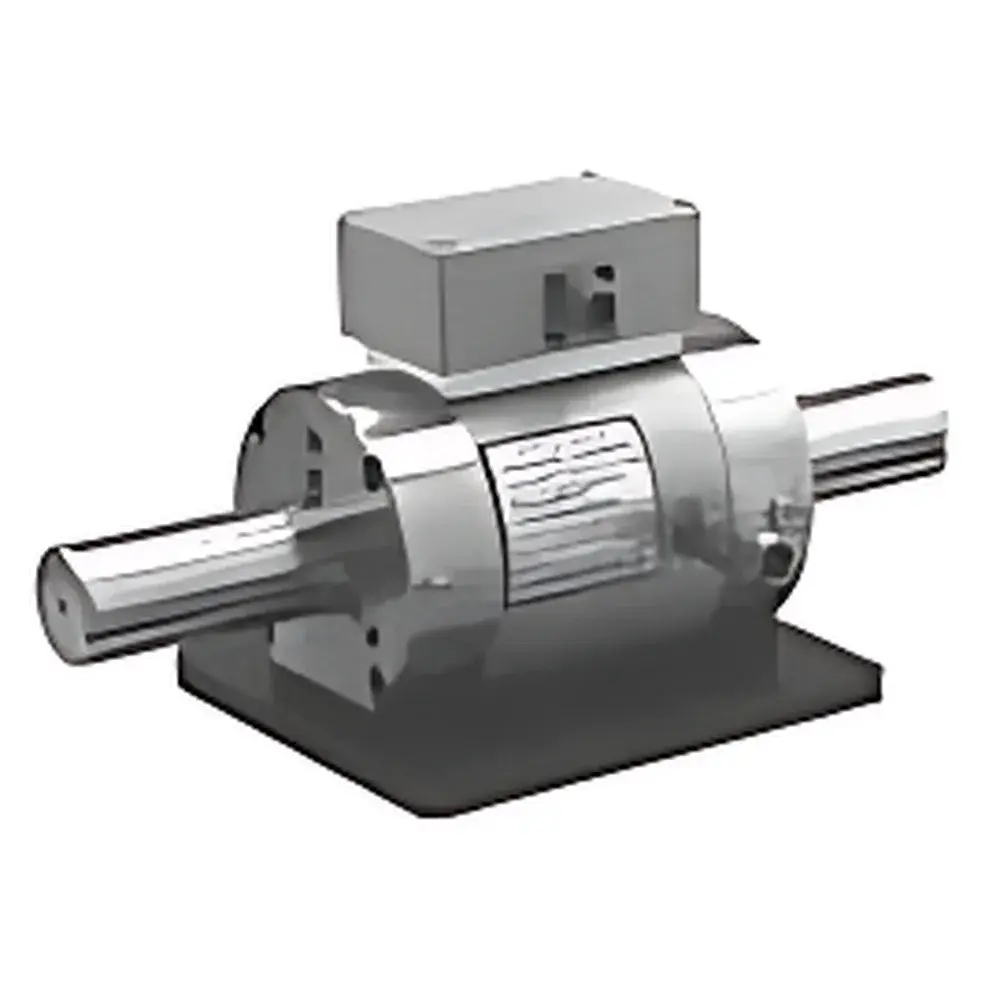
Honeywell 790 Series Non-Contact Dual-Range DC Torque Sensor
| Origin | USA |
|---|---|
| Manufacturer Type | Authorized Distributor |
| Origin Category | Imported |
| Model | 790 |
| Pricing | Upon Request |
| Torque Range (Flange-Mounted) | 22.6–678,000 N·m |
| Torque Range (Shaft-Mounted) | 4.52–452,000 N·m |
| Speed Range (Flange-Mounted) | 0 to ±8,000 rpm |
| Speed Range (Shaft-Mounted) | 0 to ±15,000 rpm |
| Frequency Response | 0–500 Hz |
| Output Signal | ±5 V or ±10 V (bi-directional, dual-range) |
| Supply Voltage | 10.5–24 VDC (standard), 18–24 VDC (option L) |
| Current Consumption | 100 mA (nominal) |
| Zero & Span Adjustment Range | ±5% of range (nominal) |
| Combined Error (nonlinearity + hysteresis + nonrepeatability) | ≤±0.15% (low range), ≤±0.12% (high range) |
| Temperature Effect on Zero | ≤±0.0025% / °F (low range), ≤±0.001% / °F (high range) |
| Compensated Temperature Range | +75 to +175 °F |
| Operating Temperature Range | −25 to +185 °F |
| Storage Temperature Range | −65 to +225 °F |
| Output Noise (rms) | 0.10% of range @ 500 Hz, 0.02% @ 1 Hz |
| Measurement Bandwidth | DC–500 Hz (high-frequency output), DC–1 Hz (low-frequency output), simultaneously available |
| Minimum Resistive Load | 10 kΩ |
| Maximum Capacitive Load | 0.05 µF |
| Source Impedance | <1 Ω |
| Overrange Capability | ±33% of range |
Overview
The Honeywell 790 Series Non-Contact Dual-Range DC Torque Sensor is engineered for high-fidelity static and dynamic torque measurement in demanding industrial powertrain applications—particularly where peak-to-average torque ratios are extreme. Unlike conventional strain-gauge-based torquemeters requiring oversizing to accommodate transient overloads, the 790 employs a patented non-contact rotary transformer architecture to isolate sensing elements from rotating shafts while preserving signal integrity across two independent, calibrated measurement ranges. This design eliminates mechanical wear, electrical noise from slip rings or brushes, and sensitivity to contamination—making it suitable for continuous operation in diesel engine test beds, compressor drives, marine propulsion systems, and IGBT-driven variable-frequency motor testing. The sensor operates on the principle of Wheatstone bridge strain gage excitation and signal transmission via contactless electromagnetic coupling, ensuring long-term stability and traceable metrological performance compliant with NIST-traceable calibration protocols at 75 °F. Its dual-range architecture enables simultaneous high-resolution measurement of low steady-state torque (e.g., idle friction losses) and high-magnitude transient events (e.g., combustion spikes, start-up inertia, torsional resonance), without range-switching latency or recalibration downtime.
Key Features
- Non-contact rotary transformer interface eliminates slip rings, brushes, and radio-frequency transmitters—ensuring maintenance-free operation over >100 million revolutions.
- Dual independent output ranges (low and high) with fully bi-directional ±5 V or ±10 V analog outputs, each featuring identical electrical characteristics and simultaneous availability.
- Robust non-ferrite transformer core design resistant to thermal shock, mechanical impact, and cracking—unlike legacy ferrite-based units prone to microfracture under vibration.
- EMI-hardened circuitry with RFI shielding, low-source-impedance outputs (<1 Ω), and differential signal conditioning optimized for environments with high dv/dt noise from IGBT inverters and PWM drives.
- Temperature-compensated electronics covering +75 to +175 °F, with guaranteed combined error ≤±0.12% of range (high range) and ≤±0.15% (low range), verified per ASTM E74 and ISO 376 methodologies.
- Zero and span fine-tuning capability (±5% nominal range) enables field calibration verification without disassembly; calibration error traceable to NIST standards at 75 °F is ≤±0.04% of range.
Sample Compatibility & Compliance
The 790 sensor supports both flange-mounted and shaft-mounted configurations, accommodating torque measurement in rotating assemblies up to 678,000 N·m (flange) or 452,000 N·m (shaft), with speed capabilities up to ±15,000 rpm. It complies with electromagnetic compatibility requirements per EN 61000-6-2 (immunity) and EN 61000-6-4 (emissions), and meets mechanical environmental testing standards per MIL-STD-810G for shock, vibration, and thermal cycling. While not intrinsically rated for hazardous locations, its sealed construction and absence of sparking components enable deployment in diesel service environments meeting SAE J1939 and ISO 8528-3 durability criteria. All calibration documentation adheres to ISO/IEC 17025 requirements for accredited torque calibration laboratories, supporting GLP/GMP audit readiness when integrated into validated test systems.
Software & Data Management
The 790 operates as a self-contained analog transducer requiring no embedded firmware or digital configuration. Its analog outputs interface directly with industry-standard data acquisition systems (e.g., National Instruments PXI, HBM Catman, Dewesoft X) supporting high-speed sampling up to 10 kHz. Dual-range outputs allow synchronized capture of low-noise steady-state data (via 1 Hz bandwidth path) and high-fidelity transient waveforms (via 500 Hz path), enabling post-acquisition cross-range correlation and event-triggered analysis. For FDA-regulated applications, the sensor’s analog nature avoids software validation burdens associated with smart sensors; however, when integrated into Part 11-compliant DAQ platforms, full audit trails—including zero/span adjustments, calibration dates, and operator IDs—can be maintained per 21 CFR Part 11 Annex 11 guidelines.
Applications
- Diesel and natural gas engine dynamometer testing, especially for single-cylinder and high-inertia reciprocating units exhibiting large torque transients during firing events.
- Torsional vibration analysis in gearboxes, couplings, and driveline components under cyclic loading conditions.
- Performance validation of electric traction motors and inverter-driven compressors where rapid torque reversal and high dv/dt noise are present.
- Marine propulsion system certification per IMO Tier III emission compliance protocols requiring precise shaft power determination.
- Research-grade characterization of clutch engagement dynamics, brake torque decay, and bearing friction loss under controlled thermal conditions.
FAQ
Is the 790 sensor compatible with existing analog DAQ systems?
Yes—the ±5 V or ±10 V outputs are fully compatible with standard voltage-input modules; no signal conditioning or isolation amplifiers are required.
Does the sensor require periodic recalibration?
Per ISO 9001 and Honeywell’s recommended practice, annual calibration is advised; however, its non-contact architecture and thermal compensation minimize drift, typically holding within specification for 18–24 months in stable environments.
Can the 790 measure static torque only, or does it support dynamic events?
It is explicitly designed for both: its 500 Hz bandwidth and low phase lag (<0.5° at 100 Hz) ensure accurate capture of torsional oscillations, combustion pulses, and step-response events.
What is the minimum measurable torque in the low range?
The lower limit depends on model-specific range selection; typical low-range full-scale values begin at 22.6 N·m (flange) or 4.52 N·m (shaft), with resolution limited by system noise floor (0.02% rms at 1 Hz).
How is EMI immunity achieved without active filtering?
Through galvanic isolation via rotary transformers, low-impedance outputs, shielded internal routing, and differential signal referencing—eliminating ground loops and common-mode pickup inherent in slip-ring architectures.



