
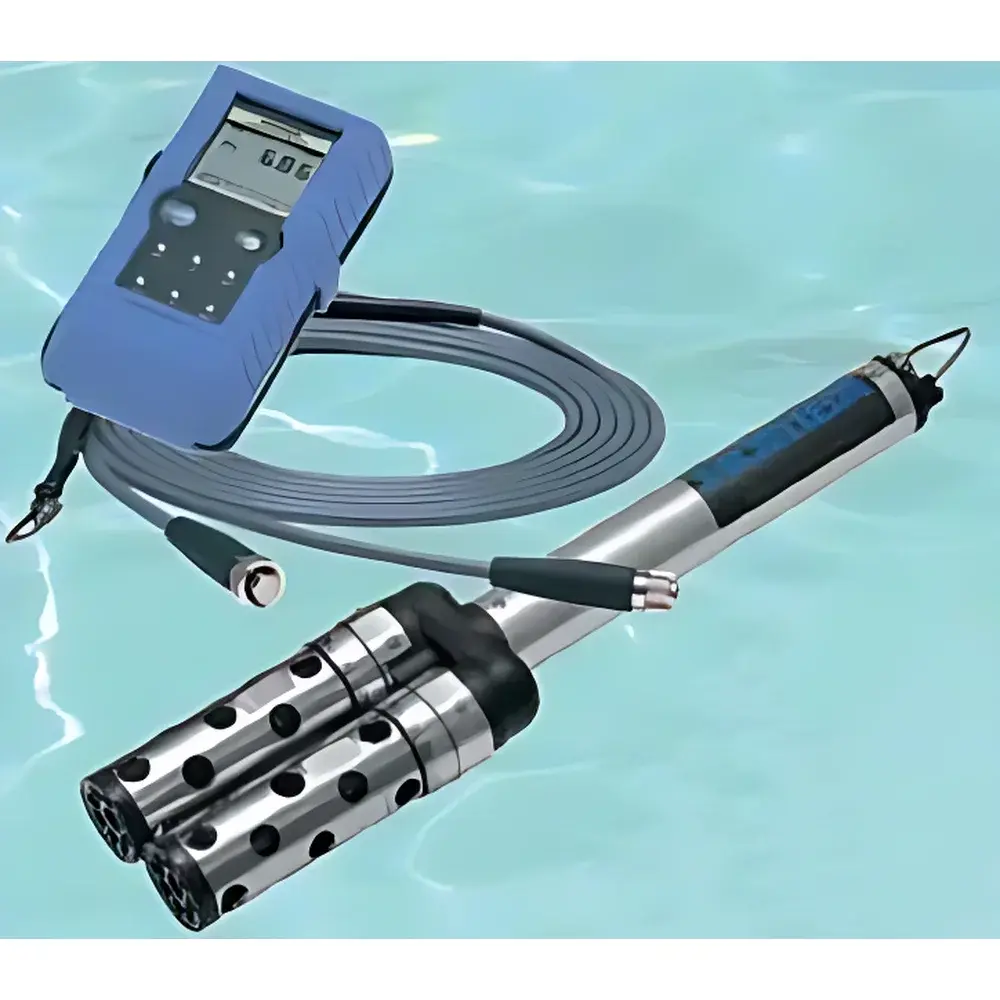
HORIBA W-20XD Intelligent Multi-Parameter Water Quality Monitor
| Brand | HORIBA |
|---|---|
| Origin | Japan |
| Model | W-20XD |
| Instrument Type | Online Water Quality Analyzer |
| IP Rating | IP67 (Control Unit) |
| Operating Depth | Up to 100 m |
| Data Logging Duration | 30 days (2880 records, 15-min interval) |
| Measured Parameters | pH, Dissolved Oxygen (DO), Electrical Conductivity (EC), Salinity, Total Dissolved Solids (TDS), Seawater Specific Gravity (δt), Turbidity, Water Depth (Pressure), Temperature, Oxidation-Reduction Potential (ORP), Nitrate, Chloride, Calcium, Fluoride, Potassium, Ammonia |
| pH Range | 0–14 |
| DO Range | 0–19.99 mg/L |
| EC Range | 0–9.99 S/m |
| Turbidity Range | 0–800 NTU |
| Temperature Range | 0–55 °C |
| Sensor Principle | Glass Electrode (pH), Membrane Galvanic Cell (DO), AC 4-Electrode (EC), Pressure Transducer (Depth), Thermistor (Temperature), Platinum Electrode (ORP), Ion-Selective Electrodes (ISEs) |
Overview
The HORIBA W-20XD Intelligent Multi-Parameter Water Quality Monitor is an autonomous, submersible online monitoring system engineered for long-term, unattended deployment in diverse aquatic environments—from coastal seawater and deep reservoirs to groundwater wells, municipal wastewater outfalls, agricultural irrigation channels, and aquaculture ponds. Built on HORIBA’s legacy of precision electrochemical and optical sensing, the W-20XD employs rigorously validated measurement principles including glass electrode potentiometry (pH), membrane-based galvanic cell amperometry (dissolved oxygen), AC four-electrode conductivity (electrical conductivity, salinity, TDS, seawater specific gravity), nephelometric turbidity detection (90° light scattering), piezoresistive pressure transduction (water depth), and thermistor-based temperature compensation. All parameters are simultaneously acquired, temperature-compensated in real time, and stored onboard without external power or data cables—enabling true “deploy-and-forget” operation for up to 30 days at depths reaching 100 meters.
Key Features
- Autonomous 30-day data logging with internal non-volatile memory (2880 records at 15-minute intervals)
- Submersible probe rated for continuous operation at 100 m water depth; pressure-resistant housing with IP67-rated control unit
- Simultaneous real-time measurement of up to 13 parameters: pH, DO, EC, salinity, TDS, δt (seawater specific gravity), turbidity, depth, temperature, ORP, and six ion species (NO₃⁻, Cl⁻, Ca²⁺, F⁻, K⁺, NH₃)
- No external cabling required during deployment—probe operates independently after initial configuration and calibration
- Onboard automatic temperature compensation across all electrochemical and optical sensors per ISO 5814, ASTM D888, and USP
- Field-replaceable, modular sensor cartridges with traceable calibration certificates compliant with ISO/IEC 17025 requirements
- Robust mechanical design featuring shock-absorbing protective guard for sensor array, optimized for high-turbidity and biofouling-prone environments
Sample Compatibility & Compliance
The W-20XD is validated for use in freshwater, brackish water, estuarine systems, and full-strength seawater (up to 40 ppt salinity). Its sensor suite meets performance criteria defined in key regulatory and standardization frameworks: pH accuracy (±0.1 pH) aligns with EPA Method 150.1 and ISO 10523; dissolved oxygen measurements satisfy ASTM D888 Class II specifications; conductivity and salinity outputs conform to UNESCO Practical Salinity Scale (PSS-78) and ISO 7888. The system supports GLP-compliant data integrity through timestamped, tamper-evident logging and optional encrypted remote data retrieval via GSM/GPRS or LoRaWAN. All firmware and calibration protocols adhere to FDA 21 CFR Part 11 requirements for electronic records and signatures when used in regulated environmental monitoring programs.
Software & Data Management
Data acquisition, configuration, and post-deployment analysis are managed via HORIBA’s proprietary WQ-Link software (Windows-compatible), which provides secure USB or Bluetooth interface for setup, zero/span calibration, and memory dump. Raw sensor outputs are stored in CSV and standardized .wqd binary formats, preserving metadata including sensor ID, calibration history, temperature compensation coefficients, and diagnostic flags. Software enables batch export to LIMS platforms and integrates with third-party GIS tools via OGC-compliant WMS/WFS interfaces. Audit trails—including user login, parameter changes, and calibration events—are retained for ≥18 months, supporting ISO 17025 internal audits and regulatory inspections.
Applications
- Long-term ecological monitoring of lakes, rivers, and coastal zones under national water quality assessment programs (e.g., EU WFD, US Clean Water Act Section 305(b))
- Real-time effluent compliance tracking at wastewater treatment plants and industrial discharge points
- Groundwater vulnerability assessment in agricultural catchments using multi-ion profiling (NO₃⁻, Cl⁻, Ca²⁺)
- Marine aquaculture site selection and health monitoring via integrated DO, pH, temperature, and ammonia profiling
- Reservoir stratification studies leveraging synchronized depth-resolved profiles of conductivity, temperature, and turbidity
- Post-disaster rapid response deployments for floodwater contamination screening (e.g., post-hurricane stormwater, post-earthquake well surveys)
FAQ
What is the maximum operational depth for continuous measurement?
The W-20XD probe is rated for uninterrupted operation at depths up to 100 meters, with pressure-compensated sensor electronics and a reinforced titanium alloy housing.
Does the system support automatic calibration in situ?
No—calibration must be performed prior to deployment using certified buffer solutions and standard gases; however, automatic temperature compensation and drift correction algorithms are applied continuously during measurement.
Can ion-selective electrodes (ISEs) be used interchangeably across different water matrices?
Yes, but each ISE requires matrix-specific calibration and pH-range validation (e.g., NH₃ measurement requires pH ≥12; F⁻ is stable only between pH 4–10); HORIBA provides application notes for cross-matrix adaptation.
Is remote data retrieval supported without physical recovery of the probe?
Yes—optional telemetry modules (GSM, LoRaWAN, or satellite) enable encrypted transmission of summary statistics or full datasets at user-defined intervals, subject to local RF licensing.
How is data integrity ensured during extended deployments?
All logged records include CRC-32 checksums, monotonic timestamps from an internal RTC with ±2 ppm stability, and write-once memory architecture preventing overwrites or backdating.
Related Products







