
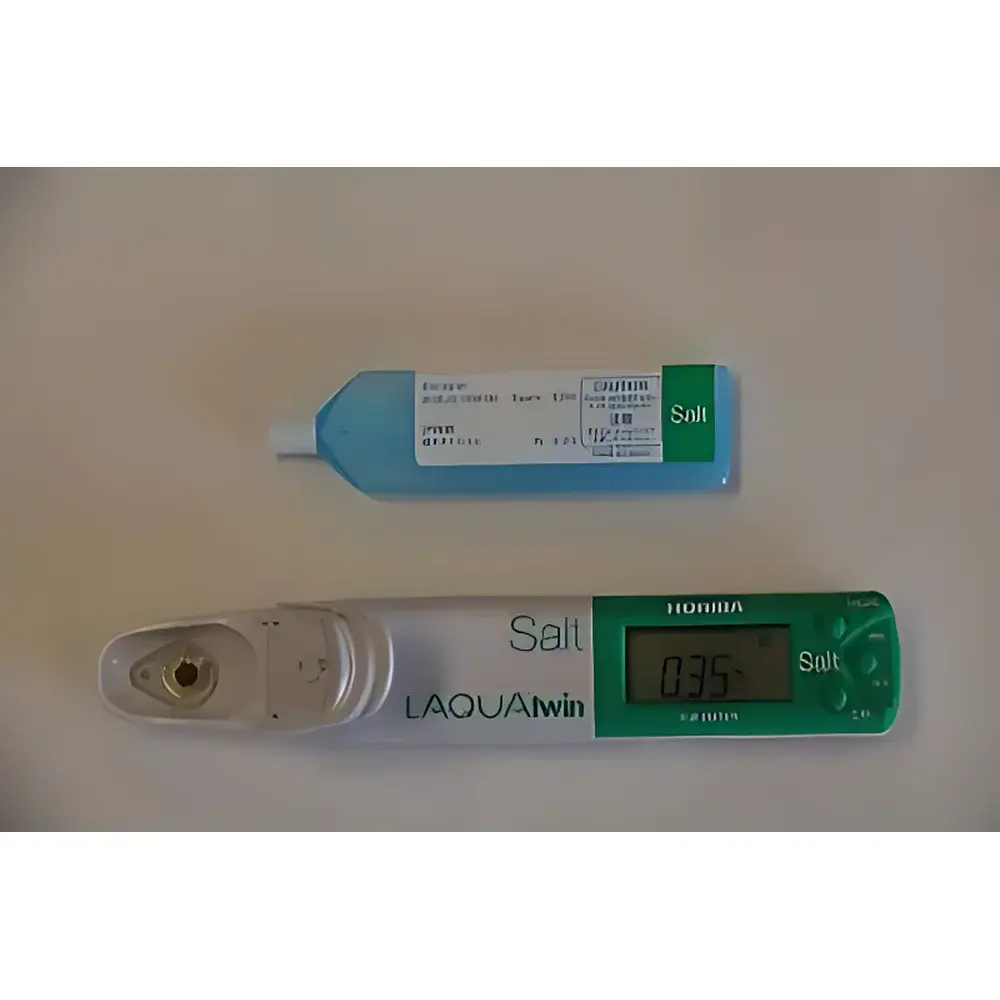
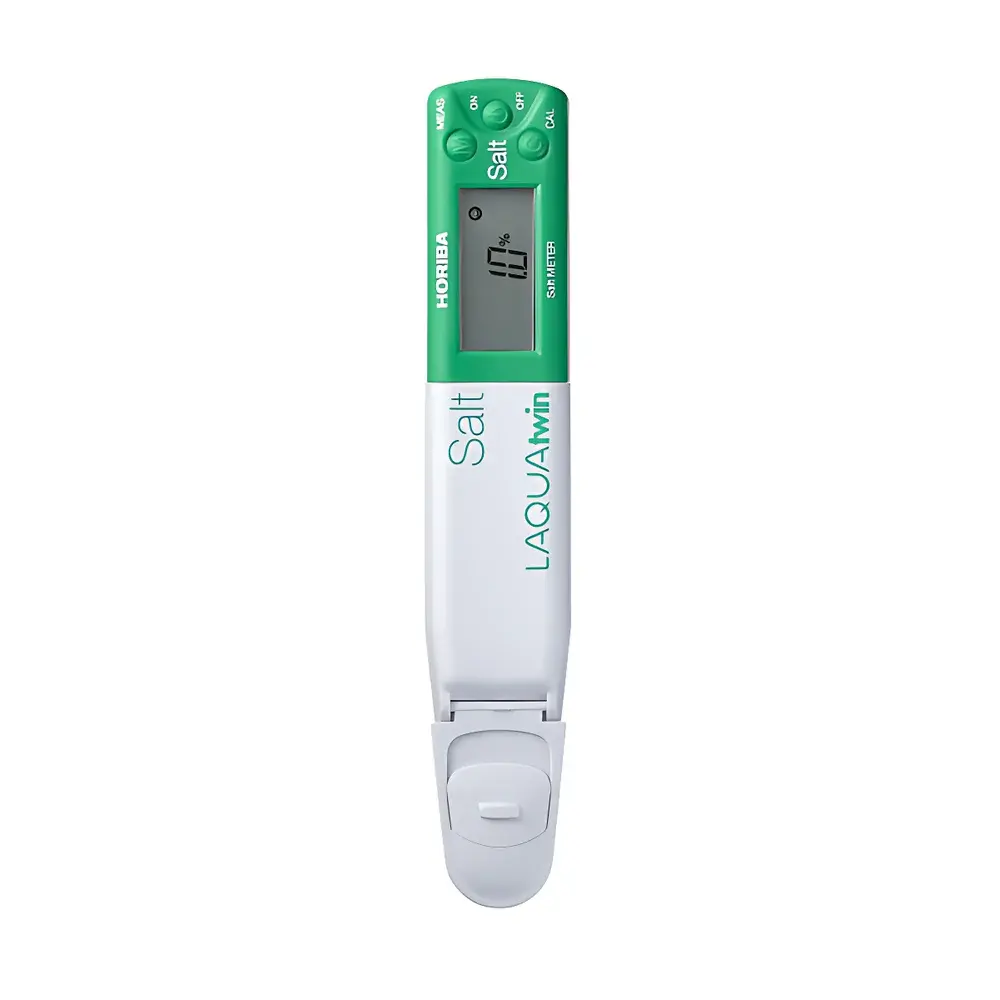
HORIBA B-721 Portable Salinity Meter
| Brand | HORIBA |
|---|---|
| Origin | Japan |
| Model | B-721 |
| Portability | Pen-type |
| Salinity Measurement Range | 0.1–10% (w/w NaCl) |
| Temperature Measurement Range | 5–40 °C |
| Accuracy | ±10% of reading |
| Minimum Resolution | 0.1% |
| Temperature Compensation | Automatic (2%/°C fixed coefficient) |
| IP Rating | IP67 |
| Power Supply | Two CR2032 batteries |
| Dimensions | 164 × 29 × 20 mm (excl. protrusions) |
| Weight | ~50 g (instrument only, batteries excluded) |
| Measurement Principle | Ion-selective electrode (ISE) method for NaCl-specific salinity |
| Sample Volume | 0.05 mL × 2 or ≥0.3 mL |
| Calibration | Two-point calibration with standard NaCl solutions |
| Compliance | Designed for field and lab use under ISO 8665, ASTM D1125, and USP <645> environmental constraints |
Overview
The HORIBA B-721 Portable Salinity Meter is a compact, handheld instrument engineered for rapid, on-site quantification of sodium chloride (NaCl) concentration in aqueous samples using ion-selective electrode (ISE) technology. Unlike conductivity-based salinity estimators, the B-721 employs a dedicated NaCl-selective membrane electrode that responds directly to chloride and sodium ion activity—enabling accurate, matrix-resistant measurement across diverse sample types including seawater, brine solutions, food extracts, aquarium water, and agricultural runoff. Its electrochemical architecture eliminates reliance on empirical TDS conversion factors or density assumptions, delivering traceable salinity values expressed as mass percent (0.1–10% w/w NaCl) with inherent compensation for temperature-induced ionic mobility shifts. The device operates within a defined thermal envelope (5–40 °C), applying a fixed 2%/°C temperature coefficient to maintain measurement consistency without requiring manual input or external thermistor calibration.
Key Features
- Pen-form factor (164 × 29 × 20 mm, ~50 g) optimized for one-handed operation and pocket portability
- IP67-rated enclosure ensuring full protection against dust ingress and immersion in water up to 1 m for 30 minutes
- Two-point calibration protocol using certified NaCl standards (e.g., 1% and 5% w/w), supporting traceable verification per ISO/IEC 17025 laboratory practice
- Auto-hold function stabilizes readings upon signal convergence, minimizing operator-induced variability
- Low sample volume requirement: functional measurement from as little as 0.05 mL × 2 aliquots or a single 0.3 mL volume—ideal for micro-volume or precious samples
- Integrated temperature sensor with automatic compensation algorithm compliant with ASTM D1125 Annex A1 guidelines for salinity reporting
- CR2032 battery power system (2 cells) providing >5,000 measurements per set under typical usage conditions
Sample Compatibility & Compliance
The B-721 demonstrates robust performance across non-viscous, low-turbidity aqueous matrices with total dissolved solids (TDS) ≤ 100,000 ppm and pH 4–10. It is validated for use with natural seawater (3.5% NaCl), industrial brines, hydroponic nutrient solutions, fish hatchery water, and processed food leachates. While not intended for high-protein or highly colloidal suspensions, its ISE design minimizes interference from common cations (K⁺, Ca²⁺, Mg²⁺) and anions (NO₃⁻, SO₄²⁻) at environmentally relevant concentrations. The instrument conforms to electromagnetic compatibility (EMC) requirements per IEC 61326-1 and meets essential safety criteria outlined in IEC 61010-1 for handheld electrical equipment. Its operational specifications align with field-deployment protocols referenced in EPA Method 120.1 and ISO 8665:2021 for portable salinity analyzers used in environmental monitoring programs.
Software & Data Management
As a standalone, microprocessor-controlled meter, the B-721 does not interface with external software or cloud platforms. All data processing—including temperature compensation, calibration slope calculation, and auto-hold triggering—is performed internally using firmware validated during type testing. Measurement history is not stored; each reading is displayed in real time and cleared upon power cycle. This architecture ensures compliance with GLP/GMP environments where audit trails must remain uncompromised by unverified digital logging. For laboratories requiring documentation, users may manually record results alongside calibration certificate numbers, lot-specific standard IDs, and ambient environmental conditions—supporting full traceability under 21 CFR Part 11 when paired with controlled procedural documentation.
Applications
- Marine biology fieldwork: real-time salinity profiling in intertidal zones, estuaries, and coral reef monitoring stations
- Aquaculture management: routine verification of hatchery water salinity to maintain optimal osmoregulatory conditions for larval development
- Food quality control: spot-checking brine concentrations in canned seafood, fermented vegetables, and dairy whey processing
- Environmental compliance: screening discharge effluents for NaCl exceedance relative to local regulatory thresholds (e.g., EU WFD Annex V)
- Educational laboratories: hands-on instruction in electrochemical sensing principles, calibration methodology, and ionic strength effects
- Swimming pool and spa maintenance: rapid verification of salt-chlorinator feed concentrations
FAQ
What measurement principle does the B-721 employ?
It uses a NaCl-specific ion-selective electrode (ISE) based on polymeric membrane technology, detecting activity of both Na⁺ and Cl⁻ ions simultaneously to deliver direct mass-percent salinity values.
Is the B-721 suitable for measuring seawater?
Yes—it is calibrated and validated for natural seawater (typical 3.5% NaCl) and exhibits minimal deviation in standard oceanic matrices per ASTM D1125 test conditions.
Does it require routine electrode maintenance?
The integrated ISE sensor is sealed and non-replaceable; however, periodic cleaning with deionized water and gentle wiping with lint-free tissue is recommended after exposure to high-solute or organic-rich samples.
Can it be used in GMP-regulated environments?
While the device itself lacks electronic audit trail functionality, its deterministic analog signal path, fixed calibration algorithm, and absence of volatile memory make it suitable for GMP-aligned workflows when operated under documented SOPs and calibrated against NIST-traceable standards.
What is the expected service life of the sensor?
Under normal field use (≤5 measurements/day), the ISE maintains specified accuracy for ≥18 months; performance should be verified monthly via two-point calibration check.





