
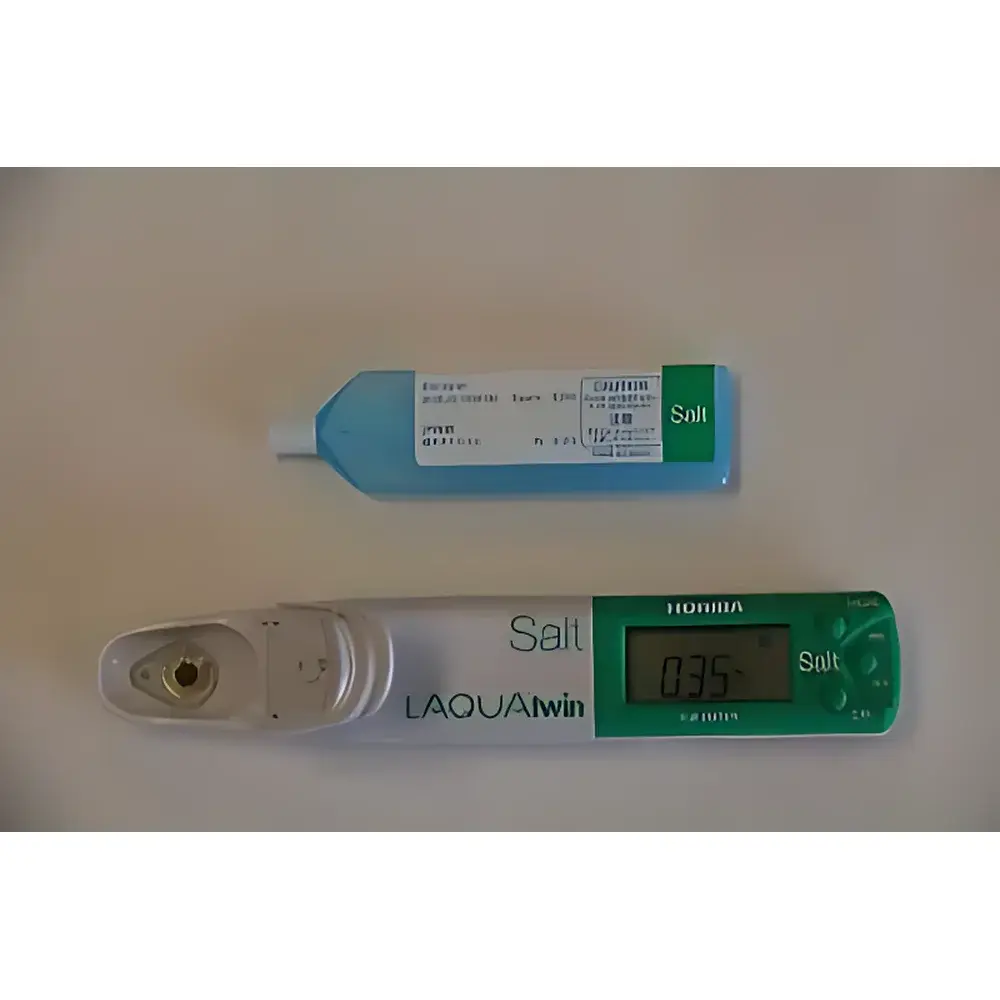

HORIBA B-721 Portable Salt Meter (NaCl Concentration Meter)
| Brand | HORIBA |
|---|---|
| Origin | Japan |
| Model | B-721 |
| Portability | Pen-type |
| Salt Measurement Range | 0.1–10% (w/w NaCl) |
| Temperature Measurement Range | 5–40 °C |
| Accuracy | ±10% of reading |
| Minimum Resolution | 0.1% |
| Temperature Compensation | Automatic (2%/°C fixed coefficient) |
| IP Rating | IP67 |
| Power Supply | Two CR2032 batteries |
| Dimensions | 164 × 29 × 20 mm (excl. protrusions) |
| Weight | ~50 g (instrument only, excl. batteries) |
Overview
The HORIBA B-721 is a compact, handheld salt meter engineered for rapid, on-site quantification of sodium chloride (NaCl) concentration in aqueous solutions using ion-selective electrode (ISE) technology. Unlike optical or conductivity-based salt meters, the B-721 employs a dedicated Na+-selective electrode coupled with a reference electrode to directly measure activity-driven NaCl equivalence—enabling reliable readings even in samples with variable ionic strength or non-NaCl electrolyte interference. Its pen-form factor and ultra-low sample requirement (as little as 0.05 mL × 2 per measurement) make it ideal for field use in food processing lines, aquaculture monitoring, brine management, and quality control labs where space, speed, and minimal sample consumption are critical. The device operates within a defined temperature range (5–40 °C) and applies fixed-temperature compensation (2%/°C), ensuring consistent interpretation across ambient conditions without requiring manual recalibration at each measurement point.
Key Features
- Ion-selective electrode (ISE) measurement principle optimized for NaCl quantification—not inferred from conductivity or refractive index
- Pen-type ergonomic design with IP67-rated housing: fully protected against dust ingress and immersion in water up to 1 m for 30 minutes
- Minimal sample volume requirement: 0.05 mL × 2 (dual-point sampling) or ≥0.3 mL for single-point measurement
- Direct readout in % (w/w NaCl), eliminating need for conversion tables or density corrections during routine use
- Automatic endpoint hold function freezes stable readings for easy recording in noisy or mobile environments
- Two-CR2032 battery power system offering >5,000 measurements per set under typical usage conditions
- Integrated temperature sensor with fixed 2%/°C compensation algorithm compliant with standard saline solution behavior
Sample Compatibility & Compliance
The B-721 is validated for use with clear, low-turbidity aqueous solutions containing dissolved NaCl as the dominant ionic species. It is not recommended for highly viscous, suspended-solid-laden, or strongly oxidizing/reducing matrices without prior filtration or dilution. While not certified to ISO/IEC 17025 for accredited testing, its two-point calibration protocol aligns with general laboratory good practice (GLP) for field-deployable electrochemical instruments. Device construction complies with RoHS Directive 2011/65/EU and REACH Regulation (EC) No. 1907/2006. No regulatory claims are made regarding FDA 21 CFR Part 11 compliance, as the instrument lacks audit-trail-capable data storage or user authentication features.
Software & Data Management
The B-721 operates as a standalone, embedded-system instrument with no onboard memory, USB interface, or Bluetooth connectivity. All measurements are displayed in real time on a high-contrast LCD and must be manually recorded. No proprietary software, drivers, or cloud synchronization is provided or required. This architecture ensures operational simplicity, electromagnetic immunity in industrial settings, and zero risk of firmware-related data corruption—making it suitable for environments where IT infrastructure support is unavailable or restricted. Calibration history and usage logs are maintained externally by the operator in accordance with site-specific SOPs.
Applications
- Food & beverage: Quick verification of brine concentration in pickling, curing, and fermentation processes
- Aquaculture & marine biology: Field assessment of salinity stability in hatcheries, recirculating aquaculture systems (RAS), and coastal monitoring stations
- Water treatment: Spot-checking of de-icing salt solutions, regeneration brines for ion exchange softeners, and reverse osmosis reject streams
- Education & training: Demonstrating ISE fundamentals, calibration procedures, and limitations of direct ion measurement in undergraduate analytical chemistry labs
- Manufacturing QA/QC: In-line verification of salt content in pharmaceutical excipient batches or cosmetic formulations where NaCl serves as tonicity adjuster
FAQ
What measurement principle does the B-721 use?
It utilizes a sodium ion-selective electrode (ISE) paired with a built-in reference electrode to detect Na+ activity and report equivalent NaCl concentration (% w/w) based on Nernstian response.
Can the B-721 measure seawater or high-salinity industrial brines?
Yes, within its specified range of 0.1–10% NaCl; however, accuracy degrades near the upper limit due to activity coefficient nonlinearity—users should verify results against gravimetric standards when operating above 7%.
Does the device require frequent recalibration?
Two-point calibration is recommended before each daily use or after exposure to temperature shifts >5 °C; calibration solutions must match expected sample salinity (e.g., 1% and 5% NaCl standards).
Is temperature compensation adjustable?
No—the compensation coefficient is fixed at 2%/°C, reflecting the average temperature dependence of NaCl activity in dilute-to-moderate solutions per IUPAC-recommended approximations.
How is traceability maintained for field measurements?
Operators must document calibration dates, standard lot numbers, environmental conditions, and raw readings in external logbooks or LIMS-compatible spreadsheets per internal QA protocols.





