
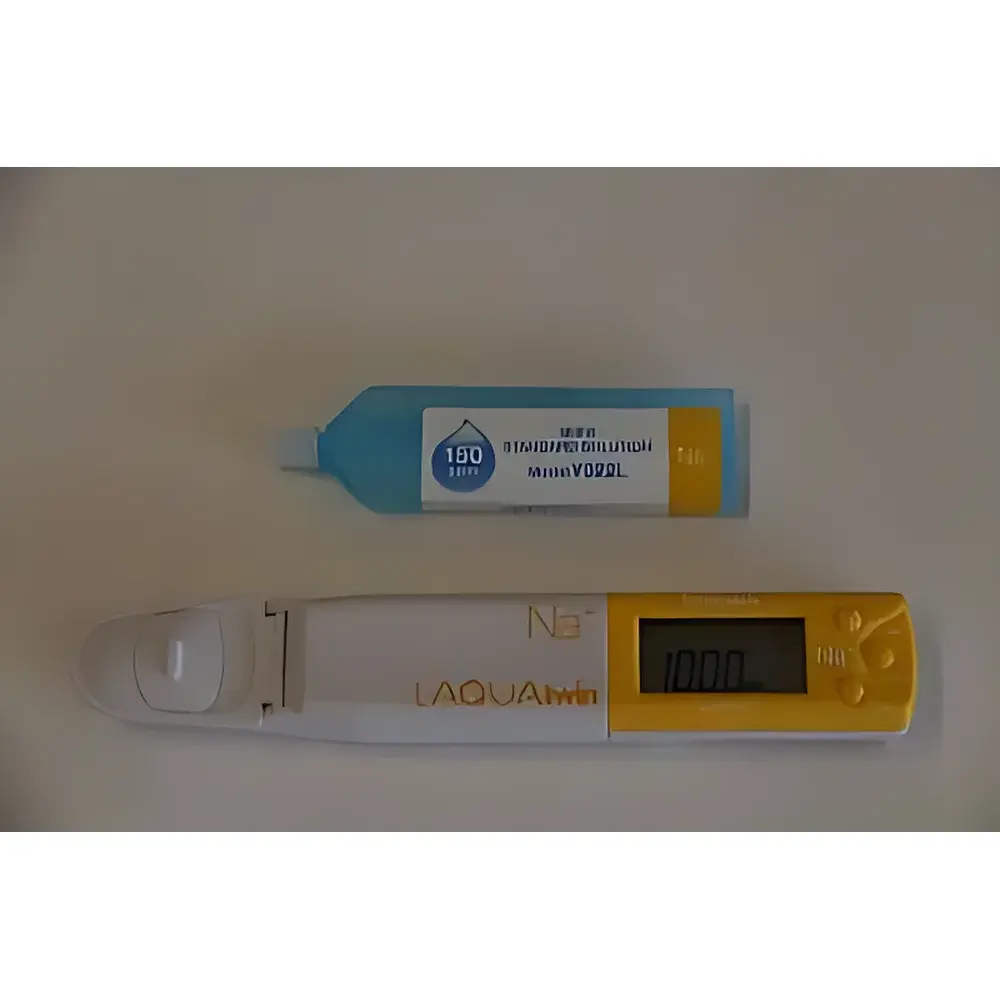
HORIBA B-722 Portable Sodium Ion Meter
| Brand | HORIBA |
|---|---|
| Origin | Japan |
| Model | B-722 |
| Measurement Principle | Ion-Selective Electrode (ISE) Method |
| Measuring Range | 23–2300 ppm (mg/L) / 1.0 × 10⁻³ – 1.0 × 10⁻¹ mol/L |
| Minimum Sample Volume | 0.05 mL × 2 or ≥0.3 mL |
| Calibration | Two-Point Calibration |
| Accuracy | ±10% of reading |
| Temperature Compensation | Automatic (2%/°C fixed coefficient) |
| Auto-Hold Function | Yes |
| Ingress Protection Rating | IP67 |
| Operating Environment | 5–40 °C, RH <85% (non-condensing) |
| Power Supply | Two CR2032 batteries |
| Dimensions (L×W×H) | 164 × 29 × 20 mm (excl. protrusions) |
| Weight | Approx. 50 g (instrument only, excl. batteries) |
Overview
The HORIBA B-722 is a compact, handheld sodium ion meter engineered for rapid, field-deployable quantification of Na⁺ concentration in aqueous samples using solid-state ion-selective electrode (ISE) technology. Unlike potentiometric pH or conductivity meters, the B-722 employs a dedicated sodium-selective membrane electrode that generates a Nernstian potential response proportional to the logarithm of free Na⁺ activity in solution. This principle enables direct, interference-resilient measurement without sample digestion or reagent addition—critical for on-site water quality verification in boiler feedwater, desalination effluent, wastewater treatment streams, and environmental surface water monitoring. Its micro-volume sampling capability (as low as 0.05 mL per measurement, with dual-point validation) minimizes reagent consumption and supports analysis where sample availability is constrained. The device operates within a defined thermodynamic window (5–40 °C), with built-in temperature compensation aligned to the theoretical 2%/°C slope correction for sodium ISEs—ensuring traceable data across variable ambient conditions.
Key Features
- True portable architecture: 164 × 29 × 20 mm footprint and 50 g mass enable one-handed operation and integration into mobile lab kits or field technician tool belts.
- IP67-rated enclosure: Fully sealed against dust ingress and immersion in 1 m of water for up to 30 minutes—validated for use in humid industrial environments, rain-exposed monitoring stations, or riverbank sampling.
- Two-point calibration protocol: Supports bracketing calibration using standard solutions spanning the operational range (e.g., 100 ppm and 1000 ppm Na⁺), minimizing nonlinearity error and enabling traceability to NIST-traceable reference materials.
- Auto-hold stabilization algorithm: Locks the displayed value when signal drift falls below 0.5% per second for ≥2 seconds—reducing operator dependency and improving inter-analyst reproducibility.
- Low-power design: Dual CR2032 coin cells provide ≥2000 measurements per set under typical usage, with auto-shutdown after 10 minutes of inactivity to preserve battery life.
- Direct SI-unit output: Simultaneous display in both mg/L (ppm) and mol/L, facilitating compliance reporting under ISO 5667-3 (water sampling) and ASTM D1129 (standard terminology relating to water).
Sample Compatibility & Compliance
The B-722 is validated for use with freshwater, treated drinking water, low-TDS industrial process water, and brackish effluents—provided total ionic strength remains below 0.1 mol/L to maintain ISE selectivity. High concentrations of potassium (K⁺ > 100 ppm), ammonium (NH₄⁺), or hydrogen ions (pH 12) may induce measurable interference; users are advised to perform matrix-matched calibration when analyzing complex samples. The instrument meets IEC 60529 for IP67 classification and complies with electromagnetic compatibility requirements per EN 61326-1:2013 for laboratory and industrial environments. While not certified for GLP/GMP-regulated release testing, its two-point calibration log, auto-hold timestamping, and stable electrode response support audit-ready documentation under ISO/IEC 17025:2017 Clause 7.8 (reporting of results).
Software & Data Management
The B-722 operates as a standalone instrument with no embedded Bluetooth or USB interface; all data are recorded manually or via external logging systems. However, its consistent output format (numeric value + unit + timestamp on LCD) aligns with paper-based or LIMS-integrated workflows requiring minimal transcription. For laboratories implementing electronic records, the device’s ±10% accuracy specification satisfies preliminary screening thresholds defined in US EPA Method 300.0 (determination of anions by ion chromatography) for sodium pre-screening prior to confirmatory analysis. Calibration history can be maintained in accordance with FDA 21 CFR Part 11 Annex 11 principles via controlled logbooks, ensuring integrity during regulatory inspections.
Applications
- Boiler feedwater monitoring: Rapid detection of sodium breakthrough in mixed-bed deionization systems, indicating resin exhaustion or leakage.
- Desalination plant performance verification: Spot-checking Na⁺ residuals in permeate streams to validate reverse osmosis membrane integrity.
- Environmental field surveys: Quantifying sodium loading in agricultural runoff, road de-icing meltwater, or coastal groundwater intrusion zones.
- Educational laboratories: Teaching core concepts of ion-selective potentiometry, Nernst equation derivation, and calibration curve construction.
- Food & beverage QC: Screening rinse water sodium content in CIP (clean-in-place) validation protocols.
FAQ
What sample volume is required for reliable measurement?
A minimum of 0.05 mL is sufficient for single-point verification; however, dual 0.05 mL aliquots (or one 0.3 mL sample) are recommended for cross-validation and improved statistical confidence.
Can the B-722 measure sodium in high-salinity seawater?
No—the specified range (23–2300 ppm) is optimized for low-to-moderate salinity matrices; seawater (~10,500 ppm Na⁺) exceeds upper detection limits and may saturate the electrode membrane.
Is electrode replacement supported?
Yes—HORIBA supplies compatible sodium ISE sensor modules (part number: 9301-10B) with documented shelf life and conditioning protocols to maintain measurement fidelity over extended service intervals.
Does the instrument store calibration data internally?
No—calibration parameters are not retained upon power-off; users must re-perform two-point calibration before each analytical session to ensure metrological continuity.
How often should the electrode be cleaned and conditioned?
Rinse with deionized water after each use; soak in 100 ppm Na⁺ standard for 30 minutes weekly to stabilize membrane potential and mitigate drift.







