
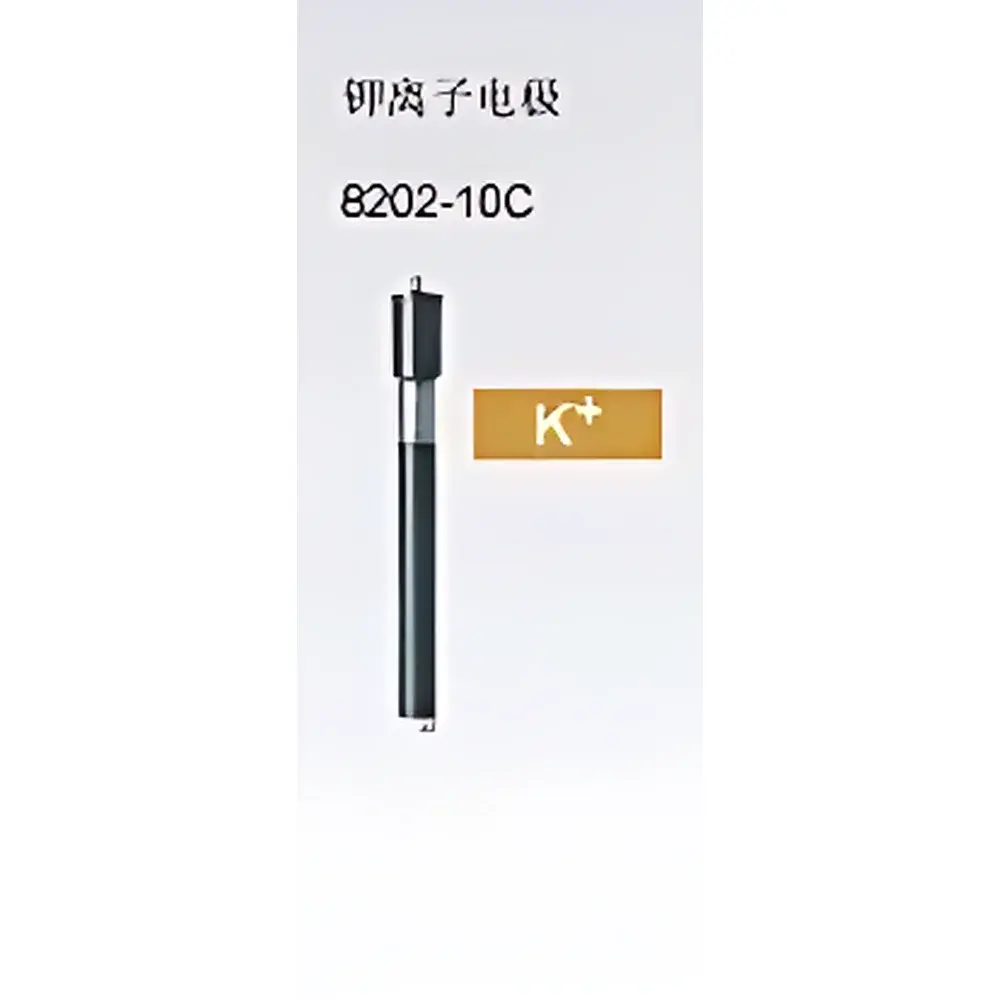
HORIBA 8202-10C Potassium Ion-Selective Electrode
| Brand | HORIBA |
|---|---|
| Origin | Japan |
| Model | 8202-10C |
| Measuring Range | 0.04–39,000 ppm K⁺ |
| Reference Electrode | 2565A |
| Electrode Type | Non-Composite, Replaceable Sensing Element Design |
| Compliance | Designed for ASTM D1293, ISO 10523, and EPA Method 9055B applications |
Overview
The HORIBA 8202-10C is a high-stability, liquid-membrane-type potassium ion-selective electrode engineered for precise potentiometric measurement of K⁺ activity in aqueous environmental and industrial water samples. Based on the principle of selective ion exchange across a valinomycin-doped polyvinyl chloride (PVC) membrane, the electrode generates a Nernstian response (≈59.2 mV per decade change in [K⁺] at 25 °C) with minimal interference from Na⁺, NH₄⁺, Ca²⁺, and Mg²⁺ under controlled pH conditions (pH 4–10). Unlike composite electrodes, the 8202-10C employs a modular architecture—featuring a removable sensing element and separate reference electrode (model 2565A)—enabling independent calibration, maintenance, and extended service life. This design supports rigorous QA/QC protocols required in accredited environmental laboratories performing routine compliance monitoring per U.S. EPA, ISO, and ASTM standards.
Key Features
- Wide dynamic detection range: 0.04 to 39,000 ppm K⁺ (1.0 × 10⁻⁶ to 1.0 M), suitable for natural waters, wastewater effluents, agricultural runoff, and process streams.
- Valinomycin-based PVC membrane ensures high selectivity (log KK,Na ≈ −2.5; log KK,Ca ≈ −4.8) and stable potential output over >12 months with proper storage and conditioning.
- Modular construction allows replacement of the ion-sensitive membrane assembly without discarding the entire electrode body—reducing long-term operational cost and waste.
- Optimized for use with HORIBA’s F-series benchtop analyzers (F-72, F-73, F-74, F-74BW) and D-53 portable meter, supporting automatic temperature compensation (ATC) via integrated Pt1000 sensor interface.
- Robust epoxy-body housing with IP67-rated connector ensures resistance to mechanical shock, humidity, and chemical splashes during field deployment or lab bench use.
Sample Compatibility & Compliance
The 8202-10C is validated for use in low- to medium-ionic-strength matrices including surface water, groundwater, drinking water, and treated wastewater. Samples must be buffered within pH 4–10 to prevent H⁺/OH⁻ interference and avoid precipitation of metal hydroxides that could foul the membrane. For high-salinity samples (e.g., seawater, brines), ionic strength adjustment using total ionic strength adjustment buffer (TISAB) is recommended to maintain activity coefficient consistency. The electrode conforms to performance criteria outlined in ASTM D1293 (electrical conductivity and pH of water), ISO 10523 (water quality — determination of pH), and EPA Method 9055B (potentiometric determination of specific ions). When deployed in GLP- or GMP-regulated environments, its traceable calibration history and compatibility with 21 CFR Part 11-compliant data acquisition systems (e.g., HORIBA LabSolutions software) support audit readiness.
Software & Data Management
When paired with HORIBA’s F-series or D-53 instrumentation, the 8202-10C integrates seamlessly into standardized measurement workflows. Calibration routines support 2- to 5-point standardization using certified K⁺ reference solutions (e.g., 1, 10, 100, 1000 ppm). All measurement data—including mV readings, calculated concentrations, temperature, electrode slope (%Nernst), and offset (mV)—are timestamped and stored internally or exported via USB/RS-232 to compliant LIMS or ELN platforms. Firmware updates and method templates are managed through HORIBA LabSolutions PC software, which provides configurable report generation, statistical trend analysis (e.g., control charts per ISO 8402), and electronic signature capability for regulated users.
Applications
- Regulatory compliance monitoring of potassium in drinking water sources per WHO guidelines and national standards (e.g., China GB 5749-2022, EU Directive 98/83/EC).
- Process control in fertilizer manufacturing, where K⁺ concentration directly correlates with product grade and dissolution kinetics.
- Ecological assessment of freshwater ecosystems, particularly in studies of nutrient loading, algal bloom drivers, and cation balance in soil leachates.
- Wastewater treatment plant influent/effluent profiling to evaluate potassium removal efficiency in biological nutrient removal (BNR) and ion-exchange systems.
- Calibration verification and validation of ICP-OES and ICP-MS methods where K⁺ serves as an internal standard or matrix component.
FAQ
What reference electrode is required for the 8202-10C?
The HORIBA 2565A double-junction reference electrode is mandatory for optimal performance and stability.
Can the 8202-10C be used with the portable D-53 analyzer?
No—the D-53 accepts only composite ion-selective electrodes (e.g., 6582-10C); the 8202-10C requires a separate reference electrode and is compatible exclusively with F-series benchtop instruments.
How often should the electrode be recalibrated?
Daily calibration is recommended for routine regulatory testing; for research applications with stable sample matrices, calibration verification every 2–4 hours is acceptable per ISO/IEC 17025 clause 7.7.
Is the sensing membrane replaceable?
Yes—the 7682 potassium ion-selective membrane cartridge is a field-replaceable component, enabling restoration of full electrochemical performance without electrode replacement.
Does temperature affect measurement accuracy?
Yes—potentiometric response follows the Nernst equation, making temperature compensation essential; all compatible HORIBA analyzers include automatic temperature correction via built-in Pt1000 sensors.
Related Products







