
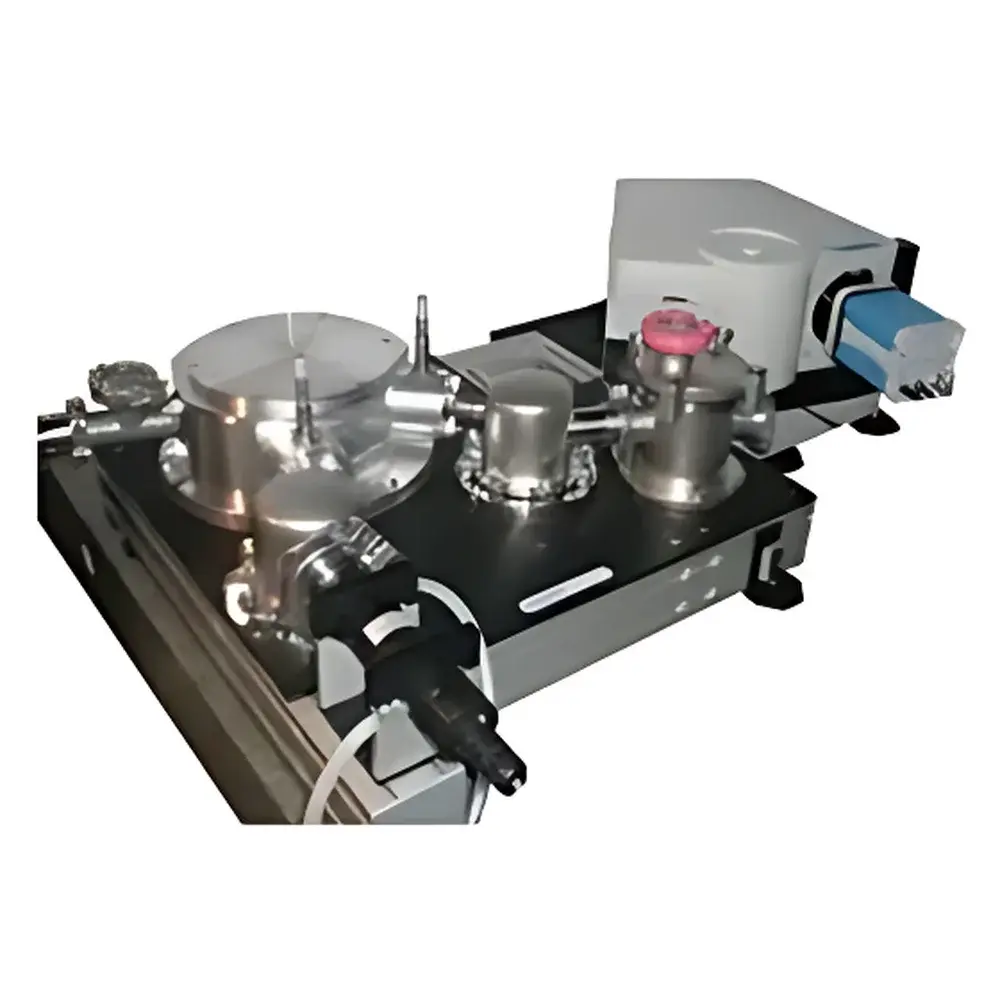
HORIBA H20-IHR320 Multi-Function Vacuum Ultraviolet Fluorescence Spectrometer
| Brand | HORIBA |
|---|---|
| Origin | France |
| Model | H20-IHR320 |
| Dispersion Element | Grating |
| Slit Dimensions (Spectral Bandpass) | 10 µm × 1 mm |
| Spectral Resolution | 0.06 nm |
| Stray Light Level | 1.5 × 10⁻⁴ |
| Wavelength Accuracy | ±0.20 nm |
Overview
The HORIBA H20-IHR320 Multi-Function Vacuum Ultraviolet Fluorescence Spectrometer is a high-performance, modular spectroscopic platform engineered for advanced photoluminescence characterization in the vacuum ultraviolet (VUV) spectral region (120–200 nm). Unlike conventional fluorescence spectrometers limited to UV-Vis-NIR ranges, this system employs a vacuum-compatible optical architecture with optimized VUV-grade coatings, fused silica and MgF₂ optics, and differential pumping capabilities to maintain operational pressure below 10⁻³ Pa—enabling reliable photon detection without atmospheric absorption interference. Its core measurement principle relies on wavelength-selective excitation (via monochromated VUV source) and synchronous emission scanning using dual-detector architecture, supporting both steady-state and time-resolved fluorescence modalities when integrated with pulsed excitation sources. Designed for research laboratories and analytical service centers requiring rigorous materials photophysics characterization, the H20-IHR320 meets the increasing demand for cross-technique spectral correlation—particularly where electronic transitions in wide-bandgap semiconductors, insulating oxides, and rare-earth-doped phosphors reside below 200 nm.
Key Features
- Modular optical design enabling independent configuration of excitation path, sample chamber, and emission detection arm—facilitating rapid reconfiguration for fluorescence, reflectance, transmittance, or laser-induced luminescence measurements
- Vacuum ultraviolet spectral coverage from 120 nm to 200 nm, achieved through a sealed, differential-pumped monochromator housing with VUV-optimized grating and entrance/exit optics
- Dual-detector acquisition mode: high-sensitivity photomultiplier tube (PMT) for low-light quantitative analysis and back-illuminated CCD for rapid spectral mapping and kinetic profiling
- Achromatic off-axis parabolic mirror system with minimized aberration across the VUV range, ensuring >75% throughput efficiency at 125 nm
- High-stability water-cooled deuterium lamp (20 W, 115–400 nm output) coupled with optional tunable synchrotron or laser excitation interfaces
- Integrated sample chamber with standardized flange ports (CF-40, CF-63), accommodating cryogenic stages (4–300 K), multi-position sample holders, and in situ gas/vacuum environment control
Sample Compatibility & Compliance
The H20-IHR320 supports solid-state powders, single crystals, thin films, and coated substrates—including MgF₂, LiF, AlN, ZnO, BN, and rare-earth-doped phosphors such as YAG:Ce and β-SiAlON:Eu. Sample mounting options include conductive copper cold fingers, quartz transmission cells, and reflective sample mounts with calibrated reference standards traceable to NIST SRM 2036 (reflectance) and SRM 2035 (fluorescence quantum yield). The system complies with ISO/IEC 17025 requirements for analytical instrument qualification and supports GLP/GMP documentation workflows via audit-trail-enabled software logging. All vacuum components meet ASTM E595 outgassing specifications for space-qualified instrumentation environments.
Software & Data Management
Control and data acquisition are managed through HORIBA’s LabSpec 6 platform, a Windows-based application certified for FDA 21 CFR Part 11 compliance (electronic signatures, role-based access, immutable audit trails). The software enables synchronized multi-modal acquisition—e.g., simultaneous excitation scan + emission map + reflectance baseline correction—and exports spectra in standardized formats (JCAMP-DX, ASCII, HDF5) compatible with MATLAB, Python (SciPy/NumPy), and OriginLab. Automated calibration routines include wavelength validation using Ne/Ar emission lines and photometric linearity verification via neutral density filters. Raw data files retain full metadata: instrument configuration, vacuum status, detector gain settings, slit width, integration time, and environmental sensor logs (temperature, pressure).
Applications
- Quantitative luminescence quantum yield determination of LED phosphors under VUV excitation (e.g., 147 nm Hg resonance line)
- Band-edge photoluminescence mapping of ultra-wide-bandgap semiconductors (AlN, BN, diamond) for defect-state analysis
- In situ thermal quenching studies of upconversion nanoparticles using integrated cryo-vacuum stages
- Optical coating performance evaluation—including anti-reflection, high-reflection, and beam-splitter stacks—in the VUV regime per ISO 9211-4
- Mineralogical fluorescence fingerprinting of natural fluorite, calcite, and apatite variants for geochemical provenance tracing
- Time-resolved decay kinetics of self-activated luminescence in alkaline-earth aluminates (e.g., SrAl₂O₄:Eu²⁺) using gated PMT acquisition
FAQ
What vacuum level is required for stable operation in the 120–200 nm range?
The system requires base pressure ≤5 × 10⁻⁴ Pa (5 × 10⁻⁶ mbar) in the monochromator and detector chambers, maintained via dual-stage turbomolecular pumping with integrated capacitance manometers and residual gas analyzers.
Can the H20-IHR320 be integrated with external lasers or synchrotron beamlines?
Yes—the sample chamber includes two orthogonal optical ports (Ø25 mm clear aperture) with kinematic mounts and vacuum feedthroughs for fiber-coupled or free-space laser input (e.g., 193 nm ArF excimer or 157 nm F₂ laser), and provisions for beamline coupling per IEC 61547-2 interface standards.
Is stray light correction applied in real time during acquisition?
Stray light compensation is implemented via hardware-based background subtraction using shuttered reference scans and post-acquisition polynomial fitting based on the measured 1.5 × 10⁻⁴ stray light floor specification.
Does the system support absolute intensity calibration?
Yes—traceable absolute radiance calibration is available using NIST-traceable VUV photodiodes (Hamamatsu R11842) and calibrated deuterium lamp standards, with uncertainty ≤3.2% (k=2) across 120–200 nm.
What maintenance intervals are recommended for the VUV grating and detector windows?
Grating cleaning and window inspection are recommended every 12 months under continuous operation; HORIBA provides certified cleanroom re-coating services for MgF₂-coated optics with <0.5 nm RMS surface roughness verification.
Related Products






