
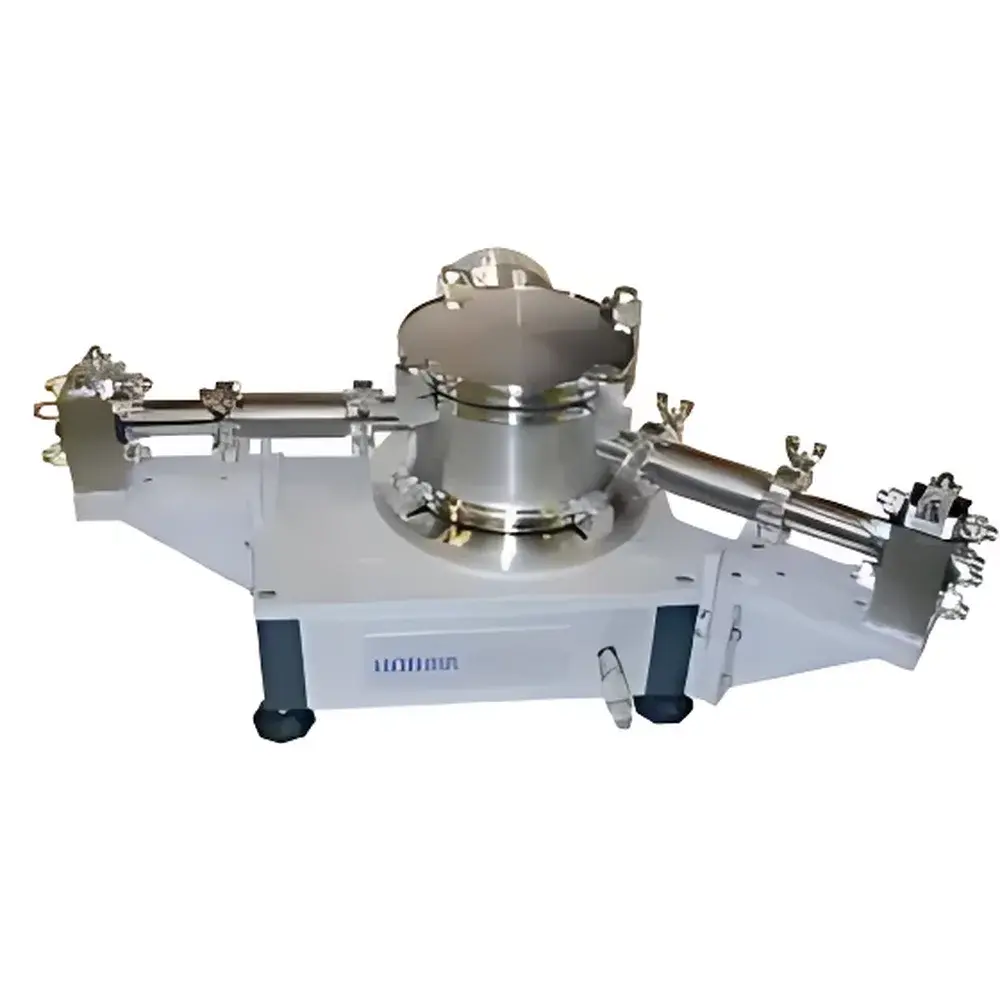
HORIBA Jobin Yvon TGM300 Vacuum Ultraviolet Monochromator
| Brand | HORIBA |
|---|---|
| Origin | France |
| Model | TGM300 |
| Spectral Range | 10–300 nm (configurable via interchangeable gratings) |
| Focal Length | 320 mm |
| f-number | f/10 |
| Optical Design | Monolithic toroidal grating monochromator with HJY aberration-corrected toroidal gratings |
| Vacuum Compatibility | UHV up to 1×10⁻⁹ mbar |
| Grating Options | Three standard gratings (550 gr/mm: 10–50 nm & 15–150 nm |
| 275 gr/mm | 50–300 nm) |
| Resolution | ≤0.4 nm (at 15 nm, using 550 gr/mm grating) |
| Slit Integration | Motorized or manual micrometer-driven entrance/exit slits |
| Grating Exchange | In-vacuum dual-grating turret |
| Optional Accessories | Pre-mirror chamber (2 toroidal mirrors), post-mirror chamber (2 toroidal mirrors), sample chamber (4× Ø25 mm positions), polarization insertion optics, 4 K cryostat, DN100LF vacuum flange, DN40KF vacuum gauge port |
Overview
The HORIBA Jobin Yvon TGM300 is a high-performance vacuum ultraviolet (VUV) monochromator engineered for precision spectral analysis and tunable light generation in the 10–300 nm wavelength range. Based on a monolithic optical architecture featuring proprietary HJY toroidal gratings, the TGM300 eliminates mechanical misalignment and thermal drift while delivering exceptional throughput and long-term stability. Its design adheres to fundamental principles of grazing-incidence VUV spectroscopy, where toroidal geometry corrects both spherical and coma aberrations across the entire spectral band—critical for maintaining spatial coherence and spectral fidelity in ultra-high vacuum (UHV) environments. The instrument operates at base pressures down to 1×10⁻⁹ mbar, enabling compatibility with synchrotron beamlines, laser high-harmonic generation (HHG) sources, and plasma diagnostics setups where residual gas absorption or hydrocarbon contamination would otherwise compromise signal integrity.
Key Features
- Monolithic optical bench with integrated toroidal grating mount—no adjustable optical elements, ensuring intrinsic mechanical and thermal stability
- HJY aberration-corrected toroidal gratings optimized for VUV performance: three interchangeable gratings (550 gr/mm for 10–150 nm; 275 gr/mm for 50–300 nm) mounted on an in-vacuum dual-position turret
- Focal length of 320 mm and f/10 aperture balance resolution, throughput, and compact footprint
- Resolution ≤0.4 nm (measured at 15 nm using 550 gr/mm grating, 100 µm slits)
- UHV-rated construction with DN100LF main vacuum flange and DN40KF gauge port; compatible with turbomolecular pumping systems and bake-out protocols
- Manual or motorized slit control (USB 2.0 interface) with micrometer-actuated entrance and exit slits
- Optional in-vacuum stepper motor for automated wavelength scanning and reproducible positioning
Sample Compatibility & Compliance
The TGM300 supports direct coupling to diverse experimental end-stations—including reflectometry chambers, HHG beamlines, and plasma emission cells—via standardized UHV interfaces. Its optional pre- and post-mirror chambers integrate two toroidal mirrors each, enabling efficient collimation, focusing, and source-sample coupling without breaking vacuum. The sample chamber accommodates up to four Ø25 mm samples and accepts auxiliary modules such as polarization analyzers and 4 K cryogenic stages. All vacuum components comply with ISO-KF and ISO-LF flange standards. The system meets essential requirements for GLP-compliant VUV calibration workflows and is routinely deployed in facilities operating under ISO/IEC 17025-accredited measurement protocols. While not inherently FDA-regulated, its traceable wavelength scale and documented vacuum history support audit readiness for regulated R&D environments requiring 21 CFR Part 11–compatible data provenance (when paired with validated acquisition software).
Software & Data Management
Control and data acquisition are supported through HORIBA’s Synapse™ software suite (Windows-based), which provides native drivers for motorized slits, grating selection, and wavelength scanning. The software logs timestamped metadata—including vacuum pressure, grating ID, slit width, and motor position—with export to CSV and HDF5 formats. Full API access enables integration into LabVIEW, Python (PyVISA), or MATLAB environments for custom automation sequences. Audit trails record all parameter changes and user actions, satisfying basic ALCOA+ (Attributable, Legible, Contemporaneous, Original, Accurate, Complete, Consistent, Enduring, Available) data integrity criteria for research-grade instrumentation.
Applications
- Vacuum ultraviolet reflectometry of multilayer optics (e.g., Mo/Si, Ru/B4C) for EUV lithography development
- Tunable monochromatic illumination for photoemission spectroscopy (PES) and angle-resolved PES (ARPES) experiments
- Characterization of high-order harmonic spectra generated from femtosecond laser–gas interactions
- In situ monitoring of atomic and molecular emission lines in low-temperature plasmas (e.g., fusion edge diagnostics, industrial etch processes)
- Calibration of VUV photodetectors and radiometric standards traceable to NIST or PTB reference sources
- Time-resolved VUV absorption studies of transient species in pulsed discharge or laser-ablation plasmas
FAQ
What vacuum level is required for optimal operation below 50 nm?
Operation below 50 nm requires base pressure ≤1×10⁻⁸ mbar to minimize O₂ and H₂O absorption; the TGM300 achieves 1×10⁻⁹ mbar with appropriate UHV pumping and bake-out.
Can the TGM300 be integrated with a synchrotron beamline?
Yes—the DN100LF flange, UHV compatibility, and in-vacuum grating exchange make it suitable for direct installation on bending magnet or insertion device ports.
Is wavelength calibration traceable to national standards?
Calibration can be performed using well-characterized emission lines (e.g., He I at 58.4 nm, Ne I at 73.6 nm); HORIBA provides factory calibration reports referenced to NIST-traceable VUV line sources.
Does the system support automated data acquisition over extended spectral scans?
Yes—Synapse™ software enables programmable scan routines with synchronized detector readout, slit-width adjustment, and grating switching, with full metadata logging.
Are custom mirror coatings or grating groove densities available?
HORIBA offers application-specific grating fabrication (e.g., blazed profiles, custom groove density) and mirror coating options (e.g., SiC, B4C, Ir) upon request, subject to lead time and qualification testing.






