
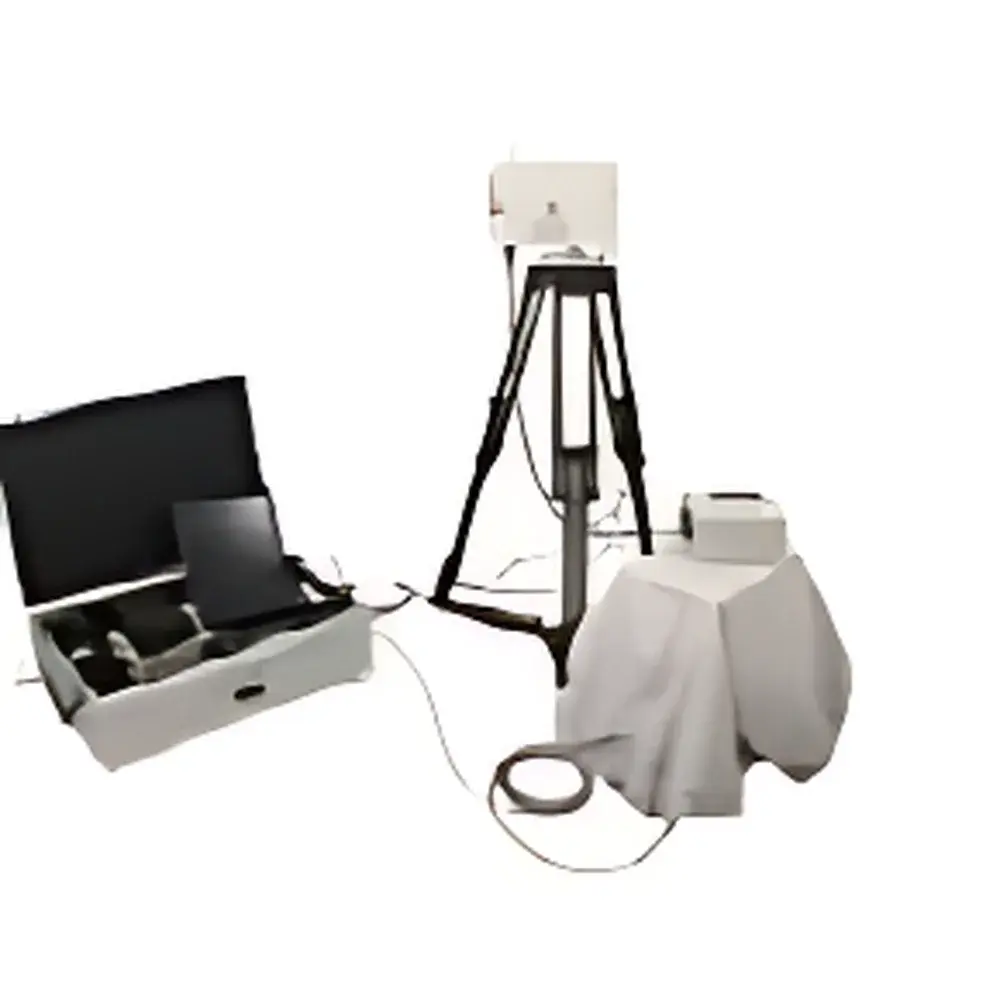
HORIBA HE Portable Micro-Raman Spectrometer
| Brand | HORIBA |
|---|---|
| Origin | France |
| Model | HE |
| Instrument Type | Confocal Micro-Raman Spectrometer |
| Excitation Wavelength Options | 532 nm / 633 nm / 785 nm |
| Spectral Range | 200–3200 cm⁻¹ |
| Detector | 1024 × 256 CCD array, MPP mode |
| Cooling | Peltier-cooled to −70 °C (air-cooled, no water required) |
| Read Noise | < 8 e⁻/pixel |
| Dark Current | < 0.01 e⁻/pixel/s |
| Laser Power Range | 80–300+ mW |
| Power Supply | 220 V, 15 A |
| Software | LabSpec 6 (Windows-compatible) |
Overview
The HORIBA HE Portable Micro-Raman Spectrometer is an industrial-grade, confocal Raman analysis system engineered for robust in-situ and at-line chemical identification and quantification. Based on spontaneous Raman scattering—where monochromatic laser light interacts with molecular vibrations to produce inelastically scattered photons—the HE delivers high-fidelity spectral data without sample preparation or destruction. Its all-solid-state optical architecture eliminates moving parts, ensuring long-term stability and minimal drift in demanding environments such as pharmaceutical manufacturing suites, chemical process lines, or field-deployed quality control labs. Designed specifically for process analytical technology (PAT) compliance, the HE supports real-time monitoring of polymorphic transitions, crystallinity, active pharmaceutical ingredient (API) concentration, and reaction kinetics with spectral resolution sufficient to resolve narrow Raman bands (< 4 cm⁻¹ FWHM typical).
Key Features
- Patented holographic concave grating optics delivering broad spectral coverage (200–3200 cm⁻¹) with high throughput and stray-light suppression
- SuperHead™ fiber-coupled probe interface offering dual operational modes: visual alignment (via integrated CMOS camera) and confocal spatial filtering (with adjustable pinhole and objective coupling)
- Multi-probe capability—up to four independent fiber probes can be connected simultaneously to a single HE unit, enabling parallel sampling from multiple process points or heterogeneous sample zones
- Air-cooled Peltier detector stage maintaining stable −70 °C operation without external chillers or water lines—critical for continuous 24/7 deployment in regulated facilities
- Modular laser engine platform supporting 532 nm (visible), 633 nm (red), and 785 nm (NIR) excitation wavelengths, each optimized for specific sample classes (e.g., 785 nm for fluorescence-suppressed analysis of organics and APIs)
- Configurable optical interfaces including 40 mm focal-length collimators, 10× and 50× long-working-distance microscope objectives, and immersion-ready probe housings for liquid-phase or reactor-wall measurements
Sample Compatibility & Compliance
The HE spectrometer accommodates solids, powders, slurries, gels, and transparent or semi-transparent liquids—including aqueous solutions and organic solvents—without dilution or matrix modification. Its confocal geometry provides inherent depth discrimination (axial resolution ~1–2 µm with 50× objective), enabling layer-by-layer analysis of coated tablets, polymer laminates, or battery electrode cross-sections. From a regulatory perspective, the system is compatible with FDA 21 CFR Part 11 requirements when deployed with LabSpec 6’s audit-trail-enabled workflow modules. It supports IQ/OQ documentation packages aligned with ASTM E1840 and ISO/IEC 17025 standards, and its hardware design meets IEC 61326-1 for electromagnetic compatibility in industrial settings. All firmware and software revisions are version-controlled and traceable per GMP/GLP documentation protocols.
Software & Data Management
LabSpec 6 software serves as the unified control and analysis environment for the HE platform. It provides instrument calibration management (wavelength and intensity), automated background subtraction, cosmic ray removal, peak fitting using Voigt or pseudo-Voigt functions, and multivariate chemometric tools including PCA, PLS regression, and SIMCA classification. Raw spectra are stored in vendor-neutral .spc format; processed results export to CSV, PDF, or XML for integration into LIMS or MES systems. The software supports user-defined SOP templates with parameter locking, electronic signatures, and time-stamped audit logs—fully compliant with ALCOA+ data integrity principles. Remote monitoring and diagnostic capabilities are available via secure HTTPS API endpoints for centralized fleet management across distributed production sites.
Applications
- Real-time monitoring of crystallization endpoints and polymorph conversion during API synthesis
- In-line verification of blend uniformity in solid-dosage manufacturing (per USP <1120>)
- Identification of counterfeit or substandard pharmaceuticals through spectral library matching (e.g., against USP Reference Standards or in-house databases)
- Characterization of carbon nanomaterials (graphene, CNTs) via D/G band ratio analysis
- Reaction progress tracking in continuous flow reactors using fiber-optic probes mounted directly on tubing manifolds
- Forensic material identification—including explosives residues, pigments, and polymers—in customs or law enforcement field operations
FAQ
Is the HE spectrometer suitable for use in explosive atmospheres (ATEX/IECEx)?
Yes—when equipped with optional intrinsically safe (IS) certified fiber probes and configured with Class I, Division 2 compliant power supplies, the HE meets ATEX Directive 2014/34/EU and IEC 60079-0 requirements.
Can the HE perform quantitative analysis without external calibration standards?
Quantitative accuracy requires initial calibration using reference materials traceable to NIST SRMs; however, once calibrated, the system achieves repeatability of ±2% RSD for concentration measurements under controlled thermal and optical conditions.
What is the typical measurement time per spectrum in process mode?
Acquisition times range from 100 ms to 5 s depending on laser power, signal-to-noise requirements, and spectral binning—enabling sub-second feedback loops when integrated with PLC-based control systems.
Does HORIBA provide validation support for regulated industries?
Yes—HORIBA offers IQ/OQ/PQ protocol templates, URS review services, and on-site commissioning support aligned with Annex 15 and GAMP 5 guidelines.
How is spectral calibration maintained over extended operation?
The HE incorporates an internal neon-argon reference lamp for automatic wavelength calibration before each measurement sequence, ensuring long-term spectral fidelity without manual intervention.




