
HORIBA Scientific FluoroCube Time-Resolved Fluorescence Spectrometer
| Brand | HORIBA |
|---|---|
| Origin | United Kingdom |
| Manufacturer Type | Authorized Distributor |
| Import Status | Imported |
| Model | FluoroCube |
| Price Range | USD 65,000 – 130,000 (FOB) |
| Dispersive Element | Grating |
| Slit Width (Spectral Bandpass) | 1–32 nm |
| Spectral Resolution | 1 nm |
| Sensitivity | >3000:1 (Signal-to-Noise Ratio) |
| Wavelength Accuracy | ±0.05 nm |
Overview
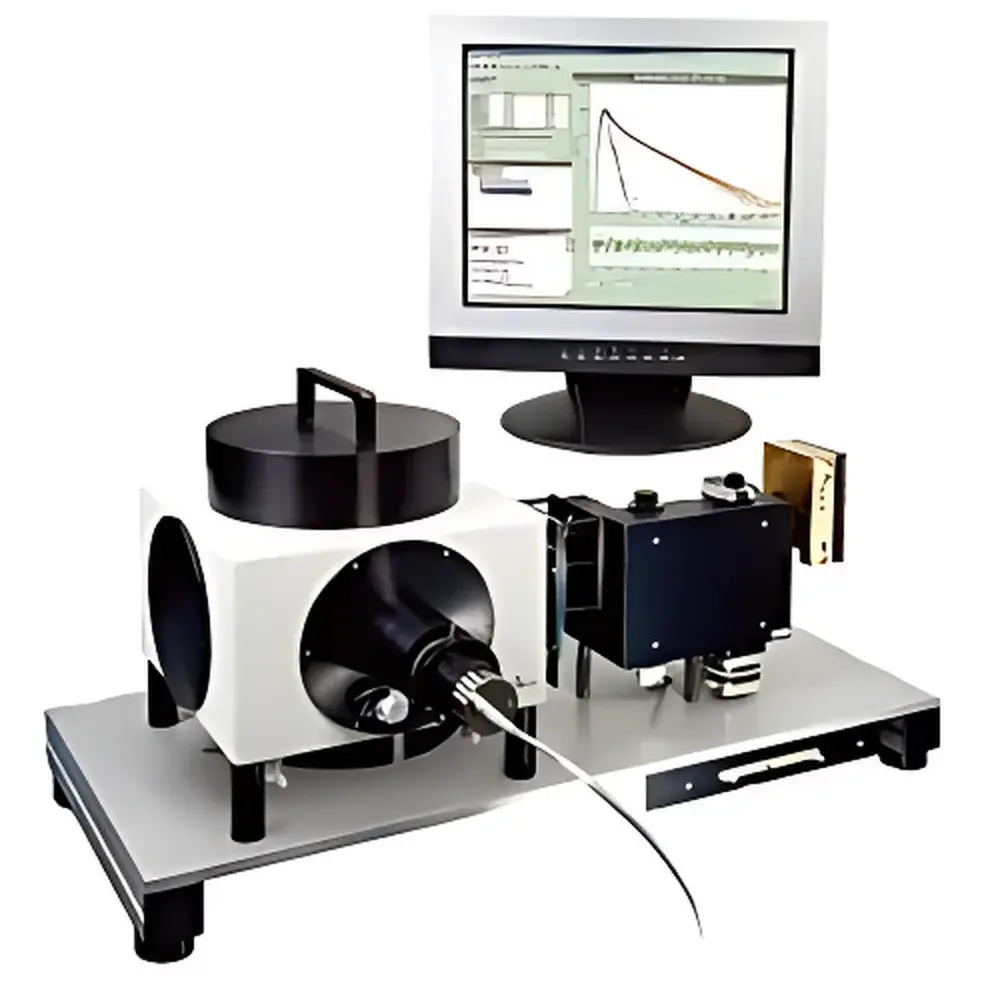
The HORIBA Scientific FluoroCube is a research-grade time-resolved fluorescence spectrometer engineered for high-precision measurement of fluorescence decay kinetics across an exceptionally broad temporal range—from picoseconds to seconds. Based on time-correlated single-photon counting (TCSPC), the system captures photon arrival times relative to pulsed excitation with sub-nanosecond timing resolution, enabling quantitative analysis of excited-state dynamics in molecular and nanoscale systems. Designed around modular architecture, the FluoroCube integrates compact solid-state excitation sources (NanoLED/SpectraLED), high-efficiency photon detection modules (PPD series), and flexible optical routing—allowing seamless adaptation to diverse sample geometries and experimental constraints. Its TCSPC electronics are factory-calibrated and require no user-based timing correction, ensuring intrinsic accuracy in lifetime determination without iterative instrument alignment.
Key Features
- Ultra-wide lifetime coverage: 10 ps to >10 s, scalable via selection of excitation source (LEDs, flash lamps, or microsecond Xe lamps) and detector configuration
- Configurable excitation pathways: Filter-based wavelength selection (standard) or optional Seya-Namioka monochromators (200–800 nm) with synchronized slit control (1–32 nm)
- Photon detection module (PPD) with standard spectral response from 185–650 nm; upgradable to 850 nm (PPD-850C) or 900 nm (PPD-900C) using safety-interlocked sample chamber lid
- Integrated liquid-circulating temperature-controlled sample holder for thermal stabilization during kinetic measurements
- Automated polarization optics option for anisotropy decay analysis and spin-dependent lifetime studies
- Full PC-based operation with intuitive GUI; supports remote scripting (Python/LabVIEW APIs) for integration into automated workflows
Sample Compatibility & Compliance
The FluoroCube accommodates liquid, solid, thin-film, and powder samples via interchangeable holders—including low-fluorescence quartz cuvettes, solid-sample stages, cryogenic accessories (down to 77 K), and NIR-compatible mounts. All optical components comply with ISO 9001 manufacturing standards, and the system meets CE/UKCA electromagnetic compatibility (EMC) requirements. For regulated environments, data acquisition and analysis adhere to ALCOA+ principles; audit trails, electronic signatures, and instrument qualification protocols (IQ/OQ/PQ) are supported through optional GLP/GMP-compliant software packages aligned with FDA 21 CFR Part 11 expectations.
Software & Data Management
FluoroCube operates with HORIBA’s SymPhoTime software—a modular platform for TCSPC data acquisition, multi-exponential decay fitting (including global analysis, convolution with instrument response function), and advanced modeling (e.g., Förster resonance energy transfer, FRET efficiency mapping). Raw photon arrival timestamps are stored in HDF5 format for long-term archival integrity. Export options include ASCII, CSV, and MATLAB-compatible structures. The software supports batch processing, parameter locking for method validation, and report generation compliant with ISO/IEC 17025 documentation requirements.
Applications
- Photophysics of organic fluorophores, quantum dots, and lanthanide complexes
- Protein conformational dynamics and folding/unfolding kinetics via tryptophan lifetime analysis
- Time-resolved fluorescence anisotropy for rotational diffusion and binding assays
- Phosphorescence lifetime mapping in OLED materials and metal–organic frameworks (MOFs)
- Environmental sensing: dissolved organic matter (DOM) characterization in aqueous matrices
- Pharmaceutical stability studies: degradation pathway identification via lifetime shifts under thermal/photo stress
FAQ
What is the minimum detectable lifetime with the standard FluoroCube configuration?
The system achieves <10 ps instrumental response function (IRF) width when paired with NanoLED excitation and PPD-650 detection—enabling reliable resolution of lifetimes ≥25 ps after deconvolution.
Can the FluoroCube be upgraded for near-infrared detection beyond 850 nm?
Yes—NIR extension modules (e.g., InGaAs detectors up to ~1700 nm) are available as field-installable options, requiring recalibration of the TCSPC timing chain and optical path alignment.
Is the software validated for use in GxP-regulated laboratories?
SymPhoTime offers optional 21 CFR Part 11 compliance packs, including role-based access control, electronic signature enforcement, and full audit trail logging for all acquisition and analysis events.
How does the FluoroCube handle scattered light interference in turbid samples?
The system supports time-gated detection and background subtraction algorithms embedded in SymPhoTime, along with optional low-fluorescence filter sets optimized for Raman suppression and Rayleigh scattering rejection.
Are calibration certificates traceable to NIST standards provided with delivery?
Each instrument ships with a factory-issued calibration report referencing NIST-traceable wavelength and timing standards; on-site calibration verification services are available upon request.






