
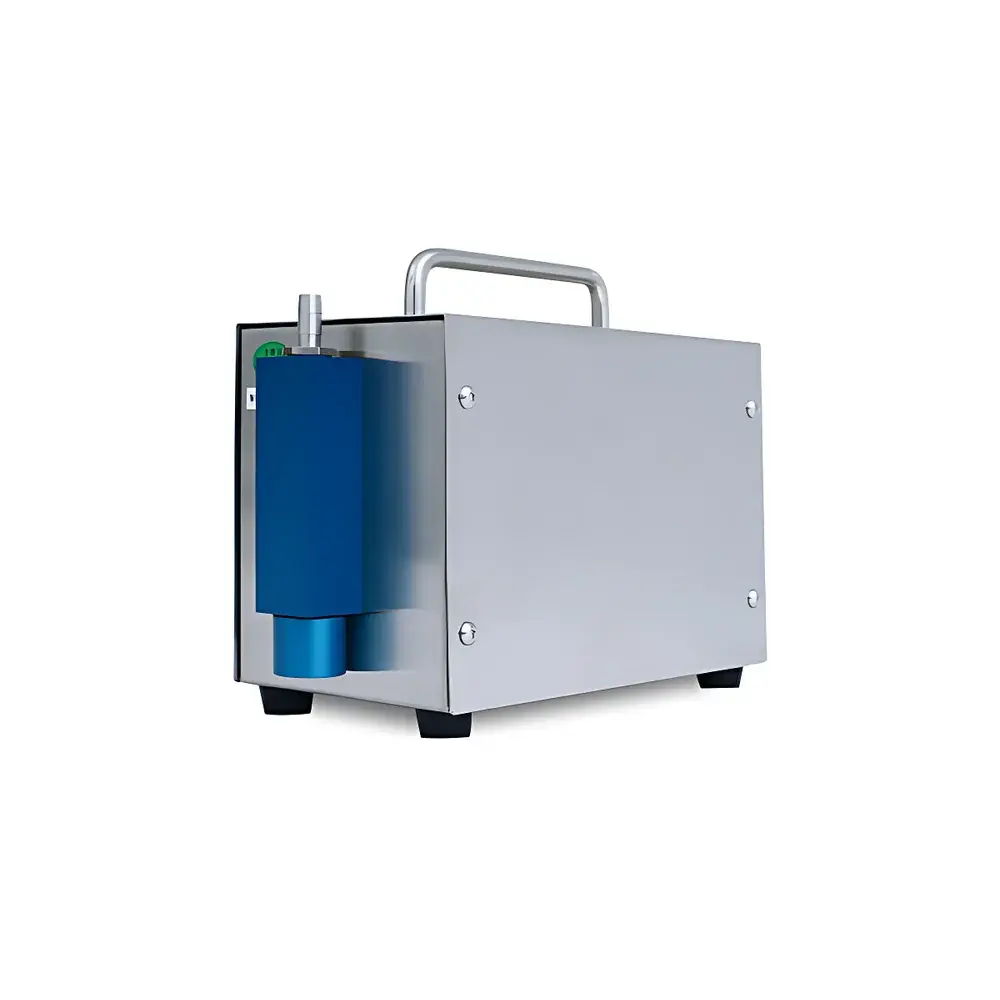
HRH-DIL860 Aerosol Diluter
| Brand | HRH |
|---|---|
| Origin | Beijing, China |
| Manufacturer Type | Authorized Distributor |
| Country of Manufacture | China |
| Model | HRH-DIL860 |
| Dilution Ratio | Up to 1:100 |
| Power Requirement | None |
| Dimensions (L×W×H) | 280 mm × 123 mm × 195 mm |
| Construction Material | SUS304 Stainless Steel |
| Inlet/Outlet Tubing | 8 mm ID × 12 mm OD Silicone Tubing |
| Compliance | Designed for ISO 27891-compliant aerosol measurement workflows |
| Sample Compatibility | Compatible with TSI, Palas, Grimm, and other mainstream aerosol spectrometers and particle counters |
Overview
The HRH-DIL860 Aerosol Diluter is a passive, precision-engineered flow-splitting device designed to enable accurate size-resolved aerosol characterization in high-concentration environments. It operates on the principle of laminar capillary分流 (split-flow dilution), where a defined fraction of the total aerosol-laden airflow is drawn through a calibrated stainless-steel capillary tube, while the remainder bypasses through a HEPA-filtered path. The two streams—capillary-derived and filtered bypass—are then recombined in a static mixing chamber to produce a homogenized, quantitatively diluted aerosol output. This method ensures stable, repeatable dilution ratios without reliance on active components such as pumps or electronic controllers. The device is optimized for integration upstream of condensation particle counters (CPCs), optical particle sizers (OPS), scanning mobility particle sizers (SMPS), and aerodynamic particle sizers (APS), supporting compliance with ISO 27891 (Aerosol measurement — Calibration of aerosol diluters) and facilitating adherence to GLP-aligned measurement protocols.
Key Features
- Passive operation: No external power supply required — ideal for field deployments, mobile labs, and battery-constrained setups.
- Compact, robust mechanical architecture: Precision-machined SUS304 stainless steel housing ensures chemical resistance, structural integrity, and long-term dimensional stability under repeated thermal and pressure cycling.
- Fixed-ratio dilution: Achieves up to 1:100 dilution factor with <±3% uncertainty (typical) across its operational flow range (standard configuration supports 0.5–2.0 L/min total inlet flow).
- Modular interface design: Includes standardized 8 mm ID quick-connect ports and optional adapter kits for seamless coupling to TSI 3772/3776 CPCs, Palas U-SMPS/U-SMPS+, Grimm 1.108/1.109 spectrometers, and equivalent instruments.
- Low diffusion loss design: Capillary geometry and internal mixing volume are engineered to minimize particle losses for diameters ≥10 nm, preserving size distribution fidelity per ISO 20988 and ASTM D6620 guidelines.
Sample Compatibility & Compliance
The HRH-DIL860 is validated for use with polydisperse liquid and solid aerosols—including NaCl, DEHS, PSL, and ambient particulate matter—in concentration ranges spanning 10⁴–10⁷ particles/cm³. Its inert stainless-steel wetted path and HEPA-filtered bypass prevent cross-contamination and adsorption artifacts. The device conforms to functional requirements outlined in ISO 27891 Annex B for passive diluters and supports traceable calibration when paired with NIST-traceable reference aerosols. While not a certified metrological standard itself, it is routinely deployed in laboratories operating under ISO/IEC 17025-accredited quality systems and supports audit readiness for FDA 21 CFR Part 11–aligned data workflows when integrated with compliant data acquisition software.
Software & Data Management
As a hardware-only passive diluter, the HRH-DIL860 does not include embedded firmware or digital interfaces. However, its fixed dilution ratio enables direct integration into instrument control ecosystems: dilution-corrected particle number concentrations and size distributions are automatically calculated by host instruments (e.g., TSI Aerosol Instrument Manager, Palas DiSCmini Software, Grimm GRIMM Lab Suite) upon user-defined ratio input. All calibration records, maintenance logs, and interface configurations can be documented within laboratory information management systems (LIMS) or electronic lab notebooks (ELN) to satisfy GLP/GMP documentation requirements. Traceability is maintained via serial-numbered unit certification sheets provided with each shipment.
Applications
- Pre-dilution of combustion-generated aerosols (e.g., engine exhaust, biomass burning) prior to SMPS or APS analysis.
- Conditioning high-concentration workplace aerosols (e.g., pharmaceutical powder handling, nanomaterial synthesis lines) for real-time monitoring with portable spectrometers.
- Calibration support for aerosol generation systems — enabling verification of output concentration linearity across multiple orders of magnitude.
- Field-based ambient air quality studies requiring rapid deployment and zero-power operation in remote or off-grid locations.
- Reference-grade intercomparison campaigns between national metrology institutes and environmental monitoring networks.
FAQ
Does the HRH-DIL860 require calibration before first use?
Yes — users must verify the nominal dilution ratio using a reference particle counter and monodisperse test aerosol (e.g., 100 nm PSL) per ISO 27891 Section 7. A certificate of conformance is supplied; field recalibration is recommended every 6 months or after mechanical impact.
Can it be used with corrosive or hygroscopic aerosols?
The SUS304 construction provides broad compatibility with acidic, basic, and moderately hygroscopic aerosols; however, prolonged exposure to concentrated HCl, HF, or saturated salt solutions is not advised without post-use cleaning and drying protocols.
Is backpressure compensation built into the design?
No — the device assumes constant total inlet flow. Users must ensure upstream flow control (e.g., mass flow controller or critical orifice) to maintain specified dilution accuracy; pressure drop across the unit is ≤1.2 kPa at 1.5 L/min.
What is the minimum detectable particle size after dilution?
The lower detection limit remains governed by the downstream instrument’s sensitivity (e.g., 2.5 nm for TSI 3776 CPC); the diluter itself introduces no additional size-dependent bias above 10 nm under laminar flow conditions.







