
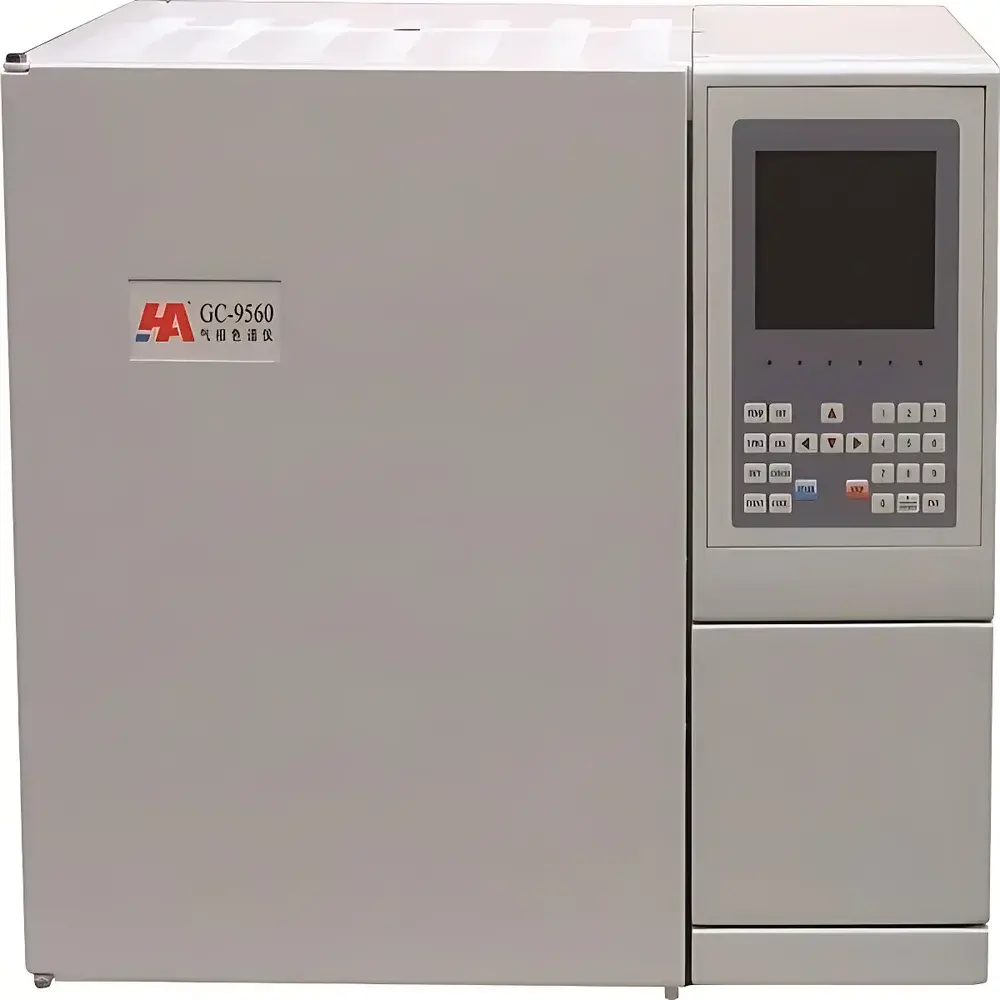
HuaiAi GC-9560-HG Helium Ionization Gas Chromatograph
| Brand | HuaiAi |
|---|---|
| Origin | Shanghai, China |
| Manufacturer Type | Direct Manufacturer |
| Region of Origin | Domestic (China) |
| Model | GC-9560-HG |
| Instrument Type | Laboratory Gas Chromatograph |
| Application Field | Ultra-High-Purity (UHP) Gas Analysis |
| Oven Temperature Range | +8 °C to 400 °C |
| Heating Rate | 1–40 °C/min |
| Cooling Rate | ~7 min (from 400 °C to 50 °C) |
| Carrier Gas Flow Range & Control | 0–1200 mL/min |
| Carrier Gas Pressure Range & Control | 0–500 kPa |
| Injector Max Operating Temperature | 400 °C |
| Injector Pressure Setting Range | 0–500 kPa |
| Injector Total Flow Setting Range | 0–1200 mL/min |
| Detection Principle | Pulsed Discharge Helium Ionization (PDHID) |
| Detection Limit | ≤1.0×10⁻¹⁰ g/mL (for organic compounds) |
| H₂ | 5 ppb, O₂/Ar: 10 ppb, N₂: 10 ppb, CH₄: 5 ppb, CO: 25 ppb, CO₂: 5 ppb |
| Temperature Control Precision | ±0.1 °C (eight independent zones) |
| Programmed Temperature Ramping | 8-step |
| Data Acquisition | 20 Hz, 24-bit A/D, dynamic range 10⁶ |
| Compliance | GB/T 28726–2012, GB/T 3634.2–2011, GB/T 14599–2008, GB/T 8979–2008, GB/T 4842–2006, GB/T 4844–2011, GB/T 17873–1999, GB/T 5829–2006, GB/T 5828–2006, HG/T 3633–1999, GB 10621–2006, GB/T 23938–2009, GB/T 28125.1–2011 |
Overview
The HuaiAi GC-9560-HG is a dedicated laboratory gas chromatograph engineered for ultra-trace impurity analysis in ultra-high-purity (UHP) industrial and specialty gases. It employs pulsed discharge helium ionization detection (PDHID), a non-destructive, universal detection principle highly sensitive to permanent gases and hydrocarbons without requiring radioactive sources. Unlike conventional thermal conductivity (TCD) or flame ionization (FID) detectors, PDHID delivers sub-ppb detection limits across a broad spectrum of analytes—including H₂, O₂ (resolved from Ar via selective column chemistry), N₂, CH₄, CO, CO₂, and C₁–C₄ hydrocarbons—making it the reference method for compliance with national standards governing UHP gas certification in China.
Key Features
- Eight independently controlled temperature zones with ±0.1 °C stability, enabling precise thermal management of the oven, dual injectors, detector, and auxiliary modules (e.g., oxygen reduction reactor, helium purifier).
- Programmable 8-stage temperature ramping (1–40 °C/min) and rapid cooling (<7 min from 400 °C to 50 °C), supporting high-throughput analysis of complex multi-component gas matrices.
- Integrated center-cut and back-flush configuration with zero-dead-volume sampling valves, eliminating carryover and ensuring quantitative transfer of ppb-level impurities.
- Dedicated helium purification system (rated to 1000 psi) capable of removing H₂, O₂, N₂, CO, CO₂, CH₄, H₂O, NO, NH₃, and CF₄ to ≤10 ppb residual concentration—critical for achieving baseline stability and detector longevity.
- Pulsed discharge helium ionization detector (PDHID) featuring low base noise (≤0.1 mV), minimal drift (≤0.5 mV/30 min), and documented detection limits down to 5 ppb for H₂ and CH₄, validated per GB/T 28726–2012.
- Full hardware reverse control via GC-9560 V4.0 chromatography workstation: RS232/USB interface, 24-bit A/D conversion, 20 Hz sampling rate, ±1 µV resolution, and linear response <±0.1% across six orders of magnitude.
Sample Compatibility & Compliance
The GC-9560-HG is explicitly designed and validated for analysis of high-purity and ultra-high-purity grades of hydrogen, oxygen, nitrogen, argon, helium, neon, krypton, xenon, carbon dioxide, and methane. Its method performance meets or exceeds requirements specified in multiple Chinese national standards, including GB/T 3634.2–2011 (hydrogen), GB/T 14599–2008 (oxygen), GB/T 8979–2008 (nitrogen), GB/T 4842–2006 (argon), GB/T 4844–2011 (helium), GB/T 17873–1999 (neon), GB/T 5829–2006 (krypton), GB/T 5828–2006 (xenon), and GB/T 23938–2009 (CO₂). The instrument’s architecture supports GLP-compliant operation: audit-trail-enabled data acquisition, electronic signature support in workstation software, and full traceability of method parameters, calibration records, and raw signal files—facilitating regulatory readiness for ISO/IEC 17025-accredited laboratories.
Software & Data Management
The GC-9560 V4.0 workstation provides complete instrument control, real-time signal monitoring, peak integration, calibration curve generation (linear, quadratic, or multi-point), and report export in PDF, CSV, and XML formats. All acquisition parameters—including temperature programs, valve timing sequences, detector settings, and flow/pressure profiles—are stored as editable method files with version timestamps. Raw data files retain full 24-bit fidelity and support post-run reprocessing with adjustable baselines, peak width thresholds, and retention time locking. The software complies with basic data integrity principles aligned with FDA 21 CFR Part 11 expectations (user authentication, activity logging, and immutable archive mode), though formal Part 11 validation requires site-specific IQ/OQ/PQ documentation.
Applications
- Quality release testing of UHP bulk and cylinder gases for semiconductor manufacturing, fiber optics, and photovoltaic production.
- Monitoring trace contaminants in on-site gas generation systems (e.g., PSA nitrogen, membrane helium recovery units).
- Verification of purity specifications for medical-grade gases (ISO 8573-1 Class 1 compressed air, USP ).
- Analysis of process gases in ammonia synthesis, methanol reforming, and hydrogen fuel cell feedstock qualification.
- Environmental monitoring of greenhouse gases (CH₄, CO₂, N₂O) at sub-ppb ambient levels using preconcentration interfaces.
FAQ
What detection principle does the GC-9560-HG use, and why is it preferred for UHP gas analysis?
It utilizes pulsed discharge helium ionization detection (PDHID), which generates metastable helium species that ionize nearly all organic and inorganic compounds with high and uniform sensitivity—without radioactive materials or combustion gases. This enables reliable quantification of permanent gases and hydrocarbons at sub-ppb levels in helium-rich matrices.
Does the system support automated calibration and sequence running?
Yes—the V4.0 workstation supports scheduled injection sequences, auto-calibration via internal standard or external standard addition, and pass/fail logic against user-defined specification limits.
Is the helium purifier integrated or external?
The helium purifier is a modular, externally mounted unit connected via stainless-steel tubing and pressure-rated fittings; it is supplied as part of the standard configuration and operates continuously during analysis.
Can the GC-9560-HG analyze corrosive or reactive gases such as Cl₂ or NH₃?
No—this instrument is optimized for inert and non-corrosive UHP gases. Reactive or halogenated species require specialized passivated flow paths, corrosion-resistant valves, and alternative detection strategies not included in the GC-9560-HG configuration.
What maintenance intervals are recommended for the PDHID detector?
Under normal UHP helium carrier conditions, the PDHID electrode assembly requires inspection every 6–12 months; replacement frequency depends on total operational hours and exposure to moisture or high-concentration impurities. Detailed maintenance logs are supported within the V4.0 software.






