
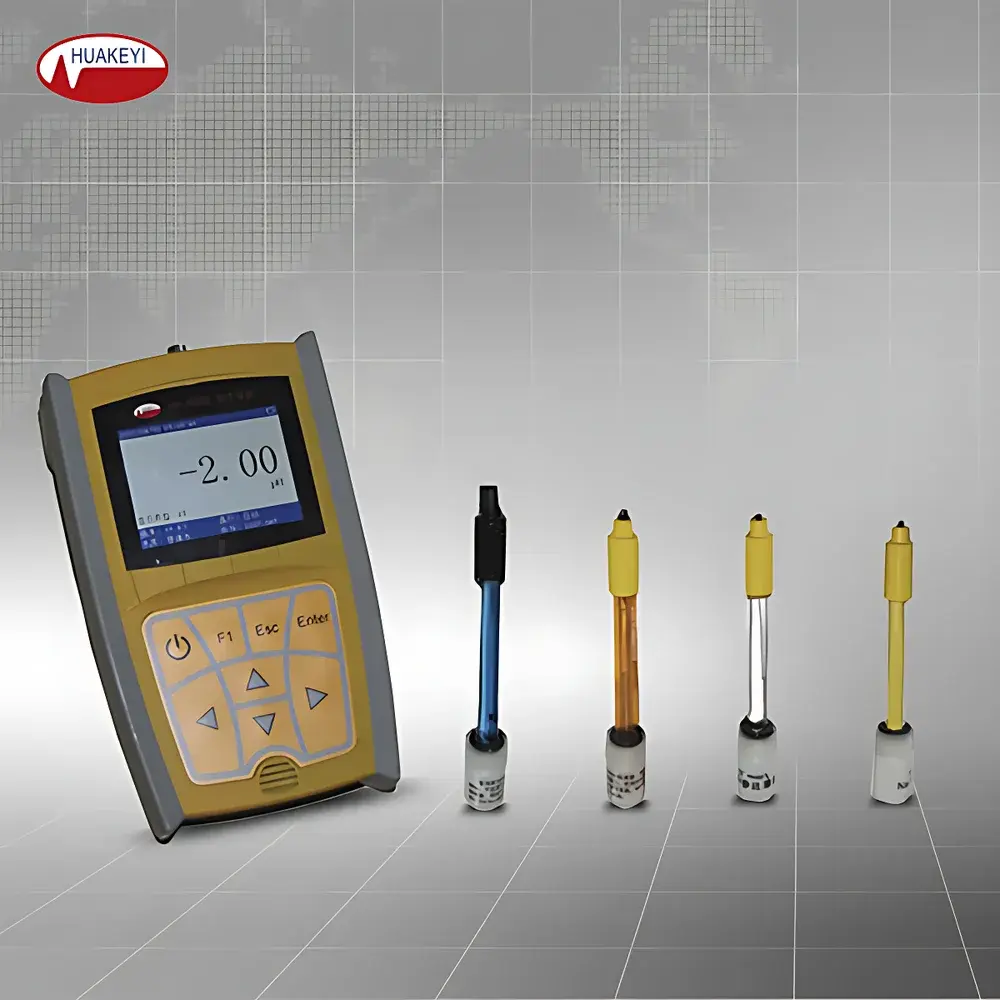
Huake Instrument HK-2301 Portable Multi-Parameter Water Quality Analyzer
| Brand | Huake Instrument |
|---|---|
| Model | HK-2301 |
| Type | Portable / Handheld Water Quality Analyzer |
| Measurement Parameters | pH, ORP, Conductivity, TDS, Salinity, Temperature |
| Display | 3.5-inch color LCD |
| pH Range | 0.00–14.00 |
| pH Resolution | 0.01 |
| pH Accuracy | ±0.02 |
| ORP Range | −2000 to +2000 mV |
| ORP Resolution | 0.01 mV |
| ORP Accuracy | ±1% FS |
| Conductivity Range | 0.00–20.00 mS/cm (with selectable cell constants K = 0.01, 0.1, 1.0, 10.0 cm⁻¹) |
| TDS Range | 0.00–80.0 g/L (based on 0.5–0.8 conversion factor) |
| Salinity Range | 0.00–80.0 ppt |
| Temperature Range | 0.0–99.9 °C |
| Temp. Resolution | 0.1 °C |
| Temp. Accuracy | ±0.5 °C |
| Temperature Compensation | Automatic (0.0–60.0 °C), adjustable coefficient (0.0–60.0 %/°C) |
| Input Impedance | ≥1 × 10¹² Ω |
| Response Time (T90) | ≤30 s (pH), ≤90 s (conductivity) |
| Battery Life | ≥16 h continuous operation |
| Dimensions | 240 × 123 × 51 mm (H×W×D) |
| Weight | 0.5 kg |
| Operating Environment | 5–45 °C, ≤93% RH (non-condensing) |
| Storage Temperature | −25 to +55 °C (electrodes stored separately above 0 °C) |
Overview
The Huake Instrument HK-2301 Portable Multi-Parameter Water Quality Analyzer is an engineered field-deployable instrument designed for simultaneous, real-time measurement of critical water quality parameters—including pH, oxidation-reduction potential (ORP), electrical conductivity, total dissolved solids (TDS), salinity, and temperature. Built upon a 32-bit embedded microcontroller architecture with surface-mount technology (SMT), the HK-2301 delivers laboratory-grade reliability in a handheld form factor optimized for on-site environmental monitoring, process verification, and routine QA/QC applications. Its measurement methodology adheres to standardized electrochemical principles: pH and ORP are determined via potentiometric detection using high-impedance reference and sensing electrodes; conductivity is measured using AC four-electrode or two-electrode methods (depending on selected cell constant), with automatic temperature compensation based on PT1000 thermistor input. The analyzer supports multiple electrode configurations (K = 0.01, 0.1, 1.0, and 10.0 cm⁻¹), enabling accurate quantification across ultra-pure water (e.g., boiler feedwater, semiconductor rinse water) to highly conductive brines and industrial effluents.
Key Features
- 32-bit embedded MCU platform with low-power SMT circuitry for enhanced stability and long-term calibration retention
- Bilingual (English/Chinese) graphical user interface with intuitive menu navigation and context-sensitive prompts
- Auto-stabilization algorithm that detects signal equilibrium (T90) and triggers measurement confirmation—reducing operator dependency
- Flexible data logging: supports manual trigger, time-scheduled, and continuous recording modes; up to 2,000 data sets stored internally
- USB interface compliant with USB 2.0 standards for seamless data export to Windows-based PCs; compatible with CSV and Excel-ready output formats
- Rechargeable 3.6 V Li-ion battery system rated for ≥16 hours of continuous field operation under typical usage conditions
- Ruggedized housing (IP65-rated ingress protection) with ergonomic grip and anti-slip rubberized finish for secure handling in wet or dusty environments
Sample Compatibility & Compliance
The HK-2301 is validated for aqueous samples within the operational temperature range of 5–50 °C and conductivity range spanning 0.01 µS/cm (with K=0.01 cell) to 200 mS/cm (with K=10.0 cell). It complies with fundamental metrological requirements outlined in ISO 7888 (conductivity), ISO 10523 (pH), and ASTM D1125 (electrical conductivity of water). While not certified to IEC 61000-4 electromagnetic immunity standards out-of-the-box, its design incorporates filtering and shielding consistent with Class B industrial equipment per CISPR 11. For regulated environments—such as pharmaceutical water systems or municipal drinking water validation—the instrument supports audit-ready data traceability when paired with optional timestamp-enabled logging and external PC-based review software. It meets general GLP documentation expectations for field instruments used in non-GMP but quality-assured workflows (e.g., university research, utility pre-screening, academic teaching labs).
Software & Data Management
Data acquisition and post-processing are facilitated through Huake’s proprietary HK-Link desktop application (Windows 10/11 compatible), which provides encrypted local storage, configurable report templates (PDF/CSV), and batch calibration history tracking. All measurements include embedded metadata: date/time stamp, electrode ID (if encoded), temperature at measurement, and user-defined site/location tags. The software enforces basic 21 CFR Part 11–aligned controls—including electronic signature prompts for calibration events and immutable log files—with optional password-protected administrator mode. Raw data exports retain full precision (e.g., pH 7.243, conductivity 142.86 µS/cm), preserving analytical integrity for secondary statistical analysis or integration into LIMS platforms via API-compatible CSV ingestion.
Applications
- Field verification of source water, distribution system endpoints, and wastewater discharge compliance (e.g., EPA Method 120.1, APHA 4500-H⁺)
- Process water monitoring in power generation (condensate, demineralizer effluent), food & beverage production (CIP rinse validation), and semiconductor manufacturing (DI water resistivity trending)
- Educational use in undergraduate chemistry and environmental science laboratories for hands-on sensor calibration, buffer standardization, and multi-parameter correlation studies
- Research-grade profiling of freshwater ecosystems, estuarine gradients, and aquaculture ponds where portability and rapid parameter cross-checking are essential
- Emergency response deployment during contamination incidents—enabling immediate triage of pH excursions, redox anomalies, or salinity spikes
FAQ
What electrode configurations are supported for conductivity measurement?
The HK-2301 accepts interchangeable conductivity cells with cell constants of K = 0.01, 0.1, 1.0, and 10.0 cm⁻¹. Each is supplied with matched calibration solutions traceable to NIST SRM 3194 (KCl standards).
Does the instrument support automatic temperature compensation for all parameters?
Yes—temperature is measured continuously via integrated PT1000 sensor and applied automatically to pH, ORP, and conductivity calculations. The compensation coefficient for conductivity is user-adjustable between 0.0–60.0 %/°C.
Can measurement data be exported without proprietary software?
Yes—via USB mass-storage mode, the device appears as a removable drive; logged data files (.csv) are human-readable and require no special drivers or licenses.
Is the HK-2301 suitable for drinking water compliance testing per WHO or EPA guidelines?
It meets technical performance thresholds for field screening per WHO Guidelines for Drinking-water Quality (4th ed.) Annex 2 and EPA 150.1, though final regulatory acceptance depends on local accreditation of the testing protocol and analyst certification.
How often does the instrument require calibration verification?
Calibration verification is recommended before each field deployment or daily for high-precision applications; full multi-point calibration is advised every 7–14 days depending on usage frequency and sample matrix aggressiveness.







