
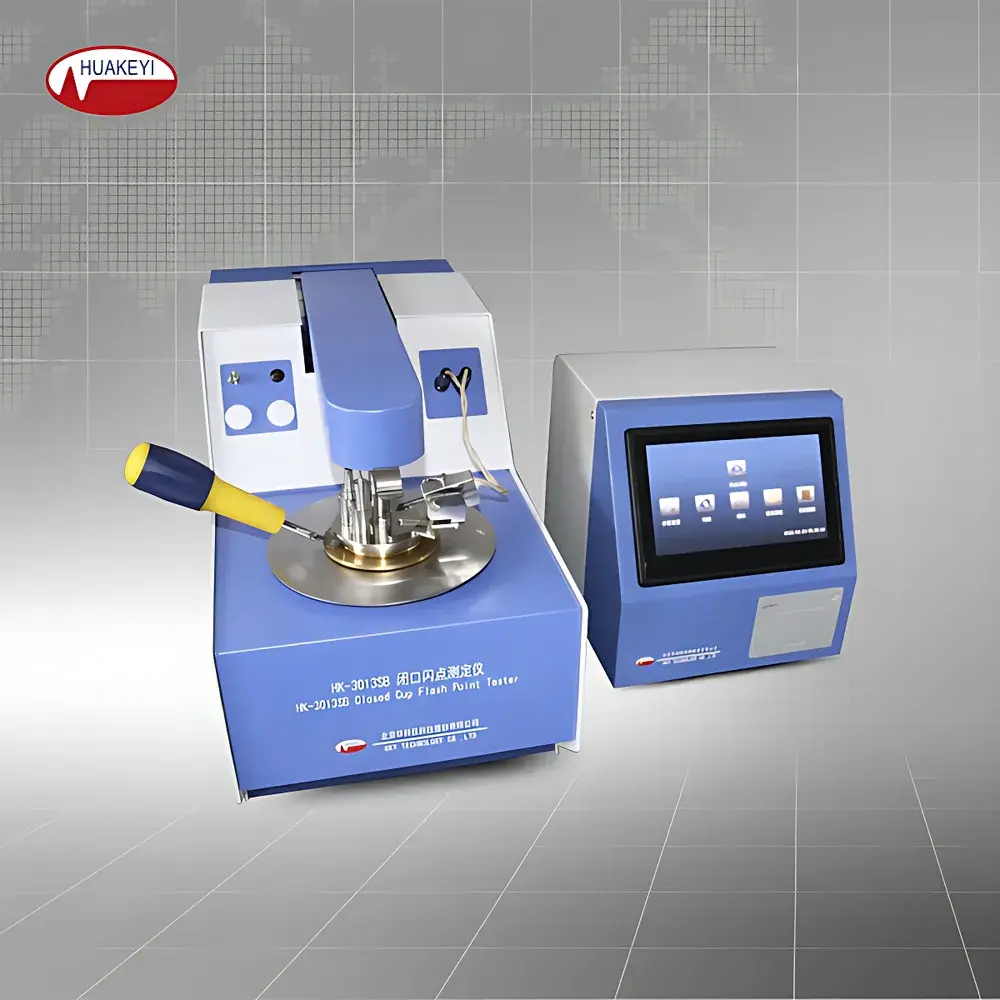
Huake Instrument HK-3013SB Closed Cup Flash Point Tester
| Brand | Huake Instrument |
|---|---|
| Origin | Beijing, China |
| Model | HK-3013SB |
| Detection Method | Closed Cup (ASTM D93 / ISO 2719 / GB/T 261) |
| Temperature Range | Ambient to 400 °C |
| Accuracy | ±1 °C (FP ≤ 110 °C), ±2 °C (FP > 110 °C) |
| Repeatability | 2 °C (FP ≤ 110 °C), 4 °C (FP > 110 °C) |
| Reproducibility | ≤10 °C |
| Resolution | 0.1 °C |
| Heating Rate | Step A: 5–6 °C/min |
| Step B | 1.0–1.5 °C/min |
| Ignition | Automatic electronic ignition (silicon nitride igniter) |
| Cooling | Forced-air cooling |
| Power Supply | AC (170–264) V, 50/60 Hz or AC (120±10%) V, 60±1 Hz (configurable at order) |
| Power Consumption | ≤300 W |
| Dimensions (Controller) | 270 × 170 × 130 mm, ~2.0 kg |
| (Test Unit) | 480 × 245 × 280 mm, ~18.0 kg |
| Data Storage | 1000 test records with date-based retrieval |
| Interfaces | RJ45 (LAN for LIMS integration & firmware update), USB (software update & data export) |
| Compliance | Designed to meet ASTM D93, ISO 2719, and GB/T 261 requirements for closed-cup flash point determination |
Overview
The Huake Instrument HK-3013SB Closed Cup Flash Point Tester is a precision-engineered analytical instrument designed for the standardized determination of the closed-cup flash point of petroleum products and related liquids in accordance with internationally recognized test methods—including ASTM D93 (Standard Test Method for Flash Point by Pensky-Martens Closed Cup Tester), ISO 2719 (Petroleum Products — Determination of Flash Point — Pensky-Martens Closed Cup Method), and Chinese national standard GB/T 261. It operates on the principle of controlled heating within a sealed test cup, followed by periodic introduction of an ignition source to detect the lowest temperature at which vapors above the sample ignite momentarily under specified atmospheric conditions. The HK-3013SB is specifically optimized for samples with flash points exceeding 40 °C, including distillate fuels, unused lubricating oils, solvents, and other non-aqueous hydrocarbon-based liquids.
Key Features
- 7-inch true-color TFT touchscreen (640 × 480 resolution) with bilingual UI (English/Chinese) and context-sensitive help menus for intuitive operation and reduced training time;
- Real-time graphical display of temperature vs. time curves during testing, enabling visual verification of heating rate compliance per ASTM D93 Annex A1 (Step A) or Annex A2 (Step B);
- Integrated safety architecture: automatic heating termination upon temperature overshoot, gas shutoff at test completion, and hardware-enforced interlocks preventing ignition during unsafe thermal conditions;
- High-stability silicon nitride electronic igniter—designed to emulate flame characteristics of a standard pilot flame while delivering superior repeatability (>10,000 cycles rated lifetime) and eliminating manual flame alignment;
- Optional catalytic gas ignition module (configured at order) for enhanced sensitivity in low-volatility samples, fully automated without operator intervention;
- Self-diagnostic firmware with real-time fault logging, error-code-driven troubleshooting prompts, and hardware status monitoring (igniter continuity, fan RPM, thermocouple integrity);
- Onboard absolute pressure sensor (range: 98.0–104.7 kPa) enabling automatic atmospheric pressure compensation—no manual input required for altitude or barometric variation;
- Dual communication interfaces: RJ45 Ethernet port supporting TCP/IP-based LIMS integration (e.g., LabVantage, Thermo SampleManager) and remote firmware updates; USB 2.0 host port for secure data export (CSV format) and local software revision control;
- Embedded thermal printer compliant with GLP documentation requirements—supports timestamped, traceable hardcopy output with configurable auto-print triggers;
- Robust mechanical design: stainless-steel test chamber, PID-controlled heating element with thermal shielding, and brushless DC stirring motor ensuring uniform sample temperature distribution.
Sample Compatibility & Compliance
The HK-3013SB is validated for use with transparent and opaque liquid samples meeting the viscosity and volatility criteria defined in ASTM D93 Section 5. It accommodates standard Pensky-Martens test cups (45–50 mL capacity) and supports both new and used lubricants, diesel fuel, kerosene, transformer oil, and synthetic esters. All operational parameters—including heating ramp profiles, stir speed, ignition timing, and pressure correction algorithms—are programmatically aligned with the procedural constraints of ASTM D93, ISO 2719, and GB/T 261. The system’s firmware implements audit-trail functionality per FDA 21 CFR Part 11 requirements when connected to a validated LIMS environment, recording user ID, test start/stop timestamps, parameter modifications, and final result signatures. Calibration verification is supported via NIST-traceable reference standards (e.g., n-decane, xylene).
Software & Data Management
Firmware v3.2+ provides structured data handling compliant with laboratory quality management systems. Each test record includes: sample ID, operator ID, ambient pressure & temperature, observed flash point, method step used (A/B), ignition event count, and pass/fail flag per repeatability thresholds. Stored records (up to 1000 entries) are indexed by ISO 8601-formatted date/time stamps and retrievable via touchscreen calendar navigation or alphanumeric search. Exported CSV files contain UTF-8 encoding and header rows compatible with Excel, JMP, and statistical process control (SPC) platforms. Firmware updates are cryptographically signed and installed via USB or network push—no physical access to internal memory required. Optional password-protected administrator mode enables configuration lockdown for regulated environments operating under ISO/IEC 17025 or GMP Annex 11.
Applications
- Quality control laboratories verifying flash point conformity of refinery intermediates and finished fuels prior to shipment;
- Lubricant formulation R&D teams assessing thermal stability and volatility trade-offs across base oil blends;
- Third-party testing facilities performing accredited flash point determinations for regulatory submission (EPA, REACH, CNCA);
- University research labs studying ignition kinetics of bio-derived hydrocarbons and alternative aviation fuels;
- Maintenance depots conducting field-deployable flash point screening of in-service turbine and hydraulic oils to detect fuel dilution or oxidation byproducts.
FAQ
What flash point standards does the HK-3013SB support?
It is fully compliant with ASTM D93 (Methods A and B), ISO 2719, and GB/T 261. Method selection is configurable via touchscreen interface.
Is external calibration required before first use?
No—factory calibration using NIST-traceable references is performed prior to shipment. Users should verify performance annually using certified check standards per ISO/IEC 17025 Clause 6.5.
Can the instrument operate unattended overnight?
Yes—automatic test sequencing, thermal cutoffs, and gas shutoff ensure safe unattended operation. However, ambient lab conditions must comply with specified temperature, humidity, and ventilation requirements.
How is data integrity ensured during network transmission to LIMS?
RJ45 communication employs TLS 1.2 encryption and message authentication codes (MACs) for payload integrity. Each transmitted result includes digital signature and UTC timestamp synchronized via NTP.
What maintenance intervals are recommended?
Daily: wipe cup and igniter tip with lint-free cloth; Weekly: inspect fan intake filter and stir shaft seal; Annually: full thermocouple verification and pressure sensor recalibration by authorized service center.






