
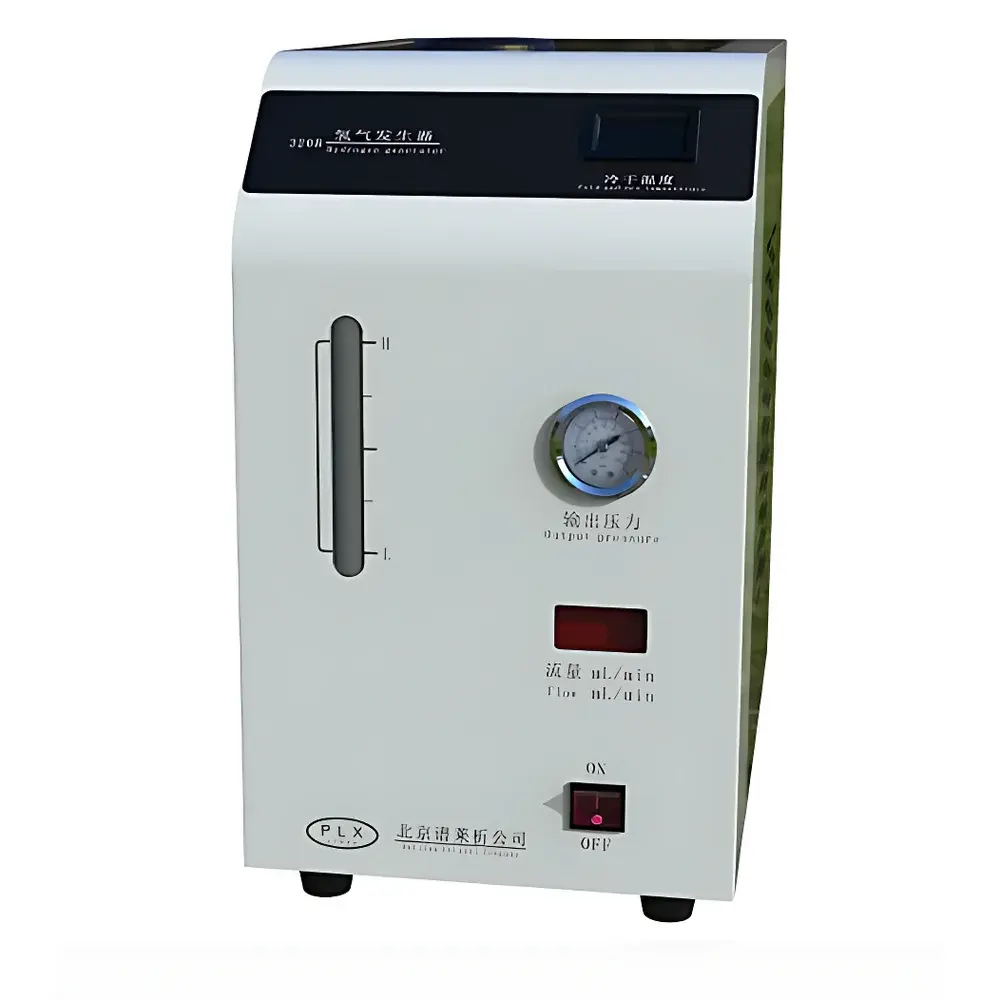
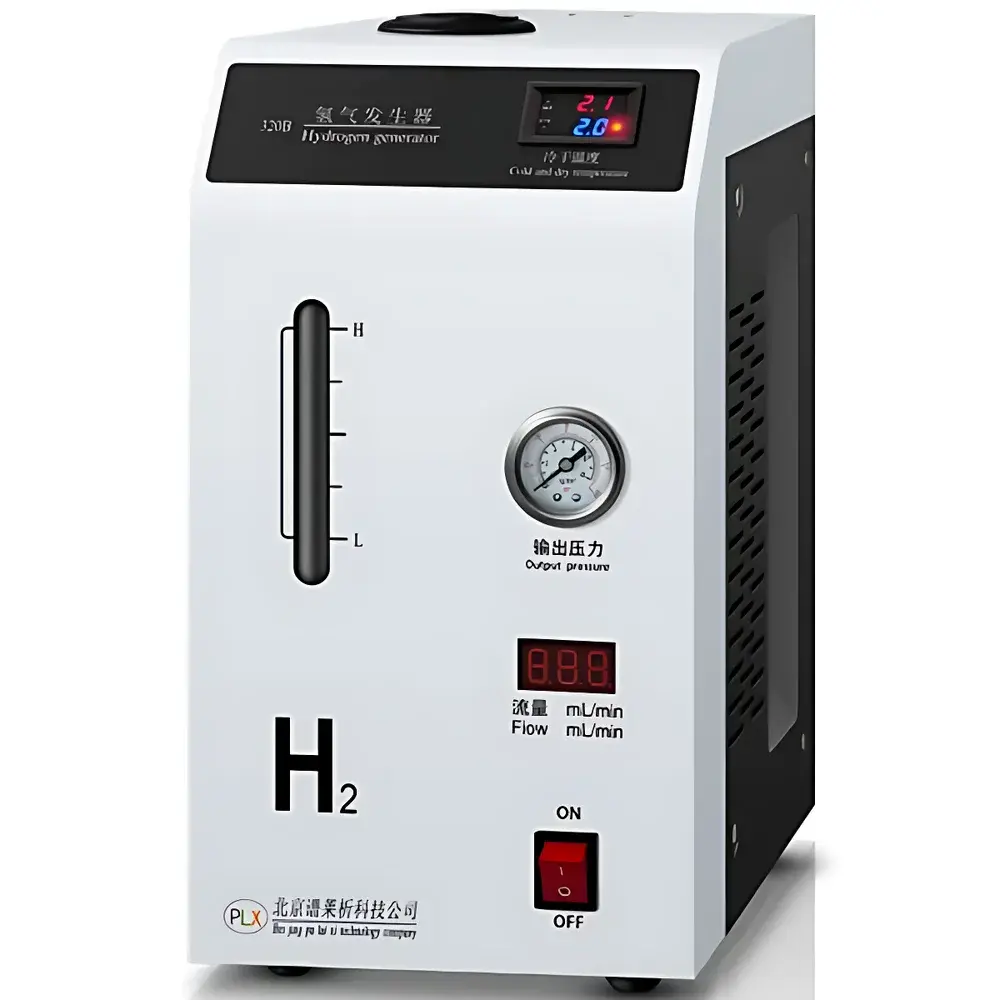
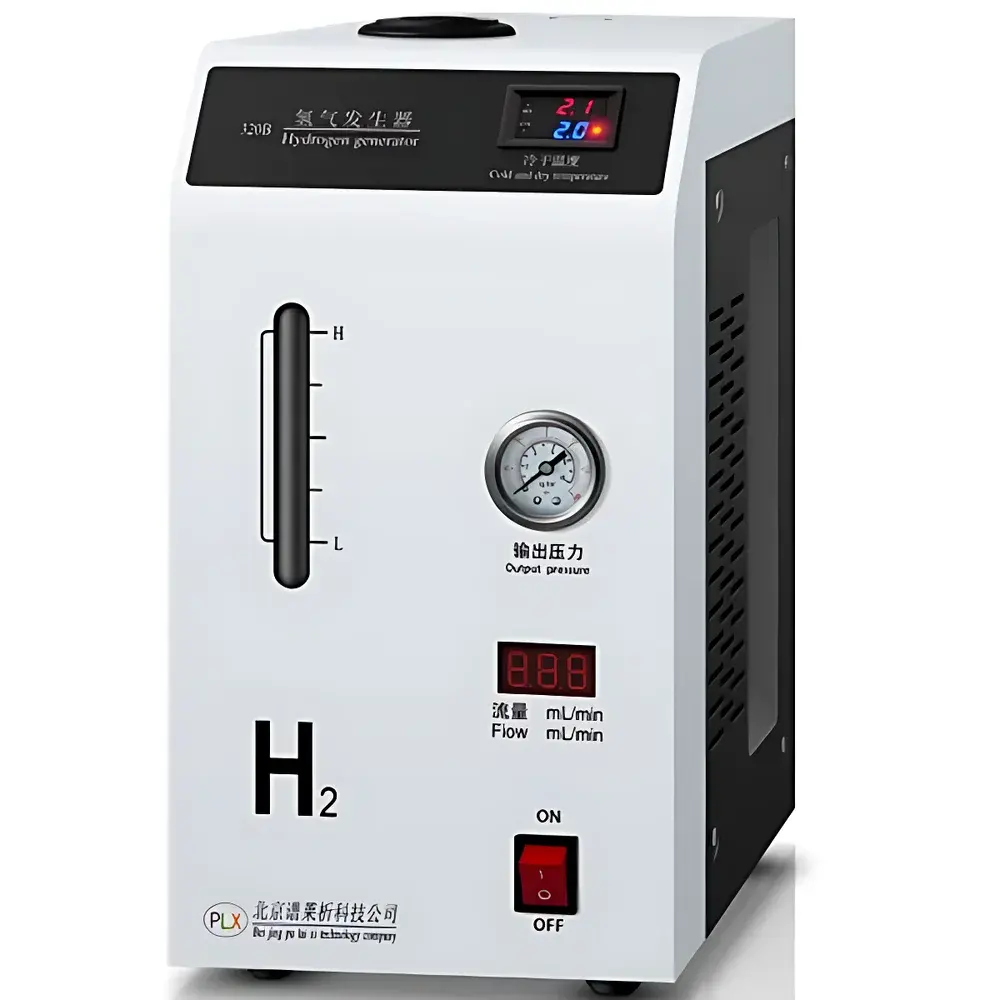
Huayisanpu 320B/520B High-Purity Hydrogen Generator
| Brand | Beijing Huayisanpu |
|---|---|
| Origin | Beijing, China |
| Model | 320B / 520B |
| Output Flow Rate | 0–300 mL/min (320B) / 0–500 mL/min (520B) |
| Output Pressure | 0.4 MPa |
| Hydrogen Purity | 99.999% |
| Power Consumption | 150 W (320B) / 180 W (520B) |
| Dimensions (L×W×H) | 370 × 220 × 360 mm |
| Input Voltage | 220 V ±10%, 50 Hz |
| Water Requirement | Deionized or Distilled Water |
| Cooling Method | Semiconductor-based Cooling |
| Moisture Removal | Stacked Tubular Condensation System |
| Maintenance Mode | Auto-refill, Non-backflow Electrolyte Design |
| Compliance | Designed for ISO/IEC 17025-compliant lab environments |
Overview
The Huayisanpu 320B and 520B Hydrogen Generators are membrane-separated, water-electrolysis-based gas generation systems engineered for continuous, on-demand production of high-purity hydrogen in analytical laboratory settings. These instruments utilize PEM (Proton Exchange Membrane) electrolysis technology—where deionized water is catalytically split into hydrogen and oxygen at a solid polymer electrolyte membrane—to deliver consistent, ultra-high-purity H₂ without the need for compressed gas cylinders. With purity certified at ≥99.999% (5.0 grade), the output meets stringent requirements for carrier and fuel gas applications in gas chromatography (GC), GC-MS, and hydrogenation reactors. The modular design integrates thermal management via semiconductor cooling and multi-stage condensation-based moisture removal, eliminating reliance on desiccants such as color-changing silica gel and enabling extended unattended operation.
Key Features
- On-demand hydrogen generation with immediate start-up: Pressing the power switch initiates electrolysis within seconds; stable output flow is achieved without warm-up delay.
- Dual-model scalability: The 320B delivers up to 300 mL/min, while the 520B supports higher-throughput applications up to 500 mL/min—both maintaining constant pressure at 0.4 MPa (4 bar).
- Intelligent fluid management: Integrated auto-refill system monitors electrolyte level and replenishes distilled or deionized water automatically, minimizing manual intervention.
- Non-backflow electrolyte architecture: A patented check-valve and capillary barrier design prevents reverse migration of KOH solution into the gas stream, ensuring long-term stability and protecting downstream instrumentation.
- Passive thermal regulation: Semiconductor-based cooling combined with optimized heat dissipation pathways extends electrolyzer stack lifetime and maintains consistent cell voltage under variable load conditions.
- Multi-stage moisture abatement: Overlapping stainless steel condenser tubing enables progressive dew point reduction through thermally induced phase separation—achieving <−40 °C dew point without consumable desiccants.
Sample Compatibility & Compliance
The 320B/520B series is compatible with all standard GC inlet types (split/splitless, PTV, cool-on-column) and supports both carrier gas (e.g., in TCD or FID detectors) and fuel gas (e.g., for FID, NPD, or HID) applications. It complies with general safety requirements outlined in IEC 61010-1 for laboratory electrical equipment. While not CE-marked for EU deployment, its operational parameters align with ASTM D7217–22 (Standard Practice for Gas Generation in Chromatographic Analysis) and support audit readiness for ISO/IEC 17025-accredited laboratories. The absence of high-pressure storage and use of low-concentration aqueous electrolyte (KOH < 30 wt%) reduces hazard classification per GHS criteria. For regulated environments, the generator’s stable output profile supports integration into 21 CFR Part 11-compliant data acquisition systems when paired with validated digital interfaces.
Software & Data Management
The 320B/520B operates as a standalone hardware unit with no embedded microcontroller or firmware-based user interface. All monitoring and control are executed via front-panel LED digital displays showing real-time flow rate (in mL/min) and system status indicators (power, water level, temperature). No proprietary software, drivers, or cloud connectivity are required—ensuring compatibility with legacy GC workstations and air-gapped analytical networks. For labs implementing centralized gas monitoring, analog 0–10 V or 4–20 mA output signals (optional add-on module) can be interfaced with PLCs or SCADA systems for remote alarm triggering and usage logging. Audit trails are maintained manually via logbooks or integrated into LIMS via external flow meter timestamps.
Applications
- Carrier gas source for capillary GC and GC-MS systems requiring consistent, low-moisture H₂ with minimal baseline drift.
- Fuel gas supply for flame ionization detectors (FID), nitrogen-phosphorus detectors (NPD), and helium ionization detectors (HID), where purity directly impacts signal-to-noise ratio and detector longevity.
- Hydrogenation reaction feed in small-scale catalytic synthesis setups, including Parr reactors and flow chemistry modules.
- Calibration gas blending systems where precise, pulse-free flow control is essential for dynamic dilution standards.
- Research laboratories performing isotopic labeling studies or hydride generation atomic absorption spectroscopy (HG-AAS), where background contamination must be minimized.
FAQ
What type of water must be used for optimal performance?
Deionized or distilled water with resistivity ≥18.2 MΩ·cm is required. Tap water or softened water will cause rapid electrode fouling and void the warranty.
Can this generator be used with multiple GC instruments simultaneously?
Yes, provided total demand remains within rated flow (300 or 500 mL/min) and pressure drop across the distribution manifold does not exceed 0.4 MPa. A calibrated flow splitter with individual shut-off valves is recommended.
Is routine maintenance required beyond water refills?
No scheduled maintenance is needed. The stacked condenser and semiconductor cooler eliminate consumables. Annual visual inspection of tubing integrity and electrical connections is advised per ISO/IEC 17025 preventive maintenance protocols.
Does the unit include pressure regulation for downstream instruments?
Yes, an integrated precision pressure regulator maintains constant 0.4 MPa output, with optional external dual-stage regulators available for applications requiring finer setpoint control.
How is safety ensured during extended unattended operation?
The system features over-temperature cutoff, low-water-level shutoff, and non-return electrolyte valves—all certified to IEC 61010-1 Class II insulation standards. No hydrogen accumulation occurs due to zero internal storage volume.



