
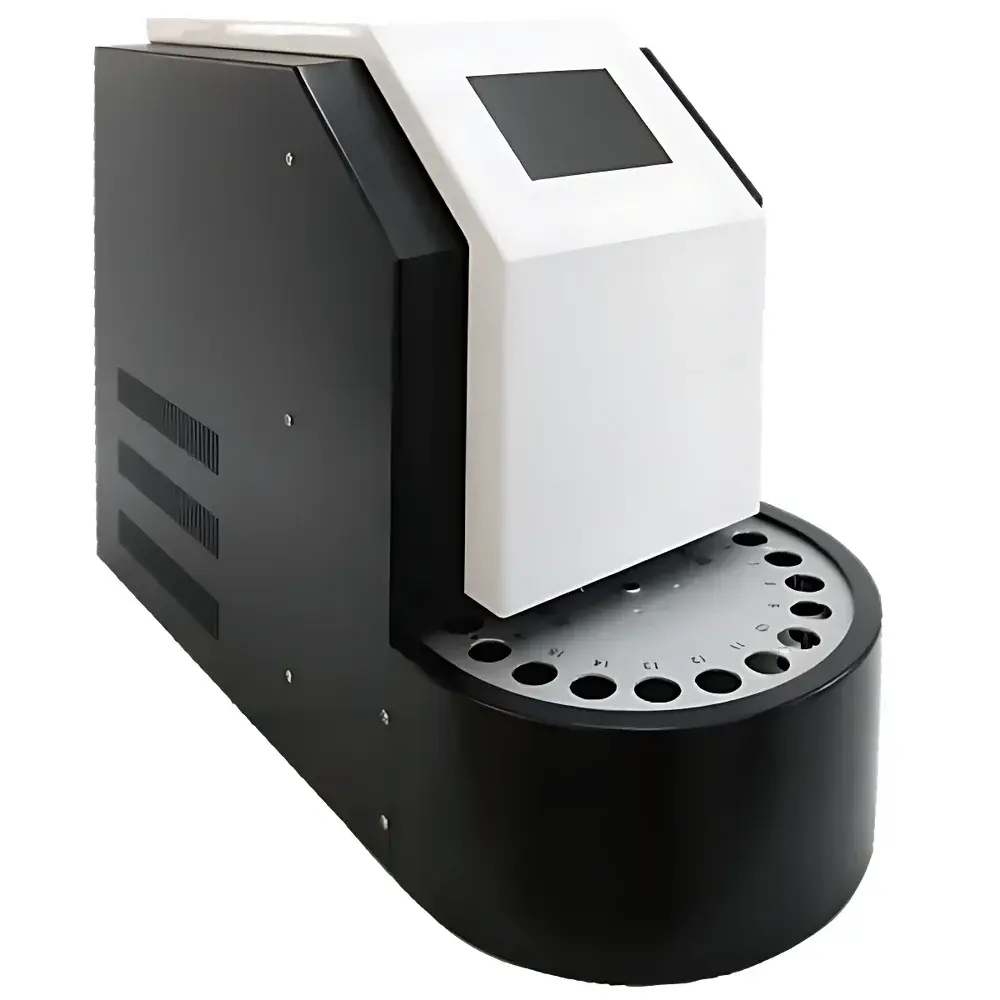
Huayisanpu ADHS-8890B Semi-Automatic Purge and Trap Sampler
| Brand | Beijing Huayisanpu |
|---|---|
| Origin | Beijing, China |
| Manufacturer Type | Authorized Distributor |
| Product Category | Domestic |
| Model | ADHS-8890B |
| Instrument Type | Water & Soil Integrated Purge-and-Trap System |
| Sample Tray Capacity | 20 positions |
| Injection Precision | RSD < 10% |
| Trap Temperature Range | Ambient to 380 °C |
| Purge Vial Heating Range | Ambient to 250 °C |
| Vial Cooling Range | 4–10 °C |
| Cold Trap (Desorption) Range | Ambient to –40 °C |
| Water Removal Trap Range | Ambient to –30 °C |
| Desorption Ramp Rate | >250 °C/min (low-voltage safe design) |
| Transfer Line & Valve Block Temp | Ambient to 250 °C |
| Carrier Gas Pressure Regulation | 0–0.4 MPa |
| Purge Flow Rate | 0–500 mL/min |
| Trap Tube Materials | Stainless steel / Quartz / Fused silica capillary (customizable) |
| Adsorbent Options | Custom-fill available |
| Programmable External Events | 7 channels |
| Timing Resolution | 0.1–99 min (timing accuracy <0.1%) |
| Pneumatic Actuation Pressure | <0.4 MPa |
| System Pressure Rating | >0.4 MPa |
| Analytical Repeatability (GC-coupled) | RSD < 2.5% |
| Power Consumption | <1000 VA |
| Trigger Signal Latency | <2 s |
| Dimensions (H×W×D) | 500 × 400 × 650 mm |
| Weight | ~40 kg |
Overview
The Huayisanpu ADHS-8890B Semi-Automatic Purge and Trap Sampler is a robust, laboratory-engineered sample introduction system designed for trace-level volatile organic compound (VOC) analysis in aqueous and solid matrices—primarily water, soil, sediment, and sludge samples. It operates on the principle of dynamic headspace extraction: inert gas (typically helium or nitrogen) continuously purges VOCs from a heated or chilled sample vial; the evolved analytes are then transferred via heated transfer lines to a cryogenically cooled trap (typically –40 °C), where they are concentrated and focused. Following purge completion, the trap is rapidly heated (>250 °C/min) to thermally desorb the analytes into a gas chromatograph (GC) or GC–MS system for separation and detection. This methodology conforms to U.S. EPA Methods 502.2, 524.2, 624, 8260D, and ISO 15681-2 for environmental VOC monitoring, supporting regulatory compliance in wastewater, drinking water, and contaminated site assessment workflows.
Key Features
- 20-position sample carousel with programmable vial handling, enabling unattended batch processing of heterogeneous sample types (e.g., 10 mL, 20 mL, or 30 mL EPA vials—custom configurations available)
- Independent thermal control across six critical zones: sample vial heater (ambient–250 °C, ±0.5 °C), cold trap (ambient––40 °C, ±1 °C), water removal trap (ambient––30 °C, ±1 °C), desorption zone (ambient–380 °C, ±0.5 °C), transfer line/valve block (ambient–250 °C, ±1 °C), and optional desiccant trap (ambient–150 °C, ±1 °C)
- Low-voltage rapid-heating architecture ensures safe, stable trap desorption with ramp rates exceeding 250 °C/min—critical for sharp, solvent-free analyte band focusing
- Full pneumatic actuation with adjustable pressure regulation (0–0.4 MPa) and integrated flow metering (0–500 mL/min purge flow, digitally indicated)
- Seven programmable external event outputs for synchronization with GC oven timing, detector triggering, or auxiliary lab equipment (e.g., autosampler start, data acquisition initiation)
- High-integrity gas path: all wetted surfaces constructed from electropolished stainless steel or inert quartz/fused silica; system rated for >0.4 MPa operational pressure
- Modular trap configuration: interchangeable stainless steel, quartz, or fused silica trap tubes; customizable adsorbent packing (e.g., Tenax TA, Carbopack B/C, Carboxen series) to match target analyte volatility and polarity
Sample Compatibility & Compliance
The ADHS-8890B supports direct analysis of liquid-phase samples (groundwater, surface water, leachates) and solid-phase samples (soil, sediment, tissue homogenates) following EPA-approved preparation protocols (e.g., Method 5035A for solids). Its integrated vial cooling module (4–10 °C) minimizes analyte loss during storage and loading—especially critical for highly volatile compounds (e.g., vinyl chloride, chloromethane). The instrument’s temperature stability (±0.5 °C in vial heating; ±1 °C in cryogenic trapping) and precise timing resolution (<0.1% error over 0.1–99 min intervals) ensure method reproducibility aligned with GLP and ISO/IEC 17025 requirements. While not pre-certified to 21 CFR Part 11, its digital trigger interface and deterministic event sequencing support integration into validated LIMS/GC data systems with appropriate audit-trail configuration.
Software & Data Management
Operation is controlled via an embedded industrial-grade microprocessor with front-panel keypad and LCD display. All method parameters—including purge time, trap hold duration, desorption temperature profile, backflush sequences, and multi-step valve actuation—are stored as editable methods. Trigger signal output (TTL-compatible, <2 s latency) enables tight synchronization with GC oven ramp initiation and detector data acquisition. No proprietary PC software is required; however, the device supports RS-232 or optional Ethernet communication for remote monitoring and logging via third-party SCADA or chromatography data systems (CDS). Method files can be exported/imported via USB flash drive for cross-laboratory standardization.
Applications
- Regulatory environmental testing: EPA 524.2 (drinking water), 8260D (groundwater and soil), and ISO 15681-2 (water quality) VOC screening
- Industrial hygiene monitoring: workplace air condensates, process water effluents, and landfill leachate characterization
- Forensic and pharmaceutical QC: residual solvent analysis in APIs and excipients per ICH Q3C guidelines
- Research applications: kinetic studies of VOC partitioning, sorption/desorption behavior in porous media, and method development for emerging contaminants (e.g., PFAS precursors, halogenated ethers)
- Multi-matrix validation: parallel analysis of spiked water and soil extracts to assess matrix effect compensation strategies
FAQ
What sample vial formats are supported?
Standard 20 mL EPA vials are accommodated; 10 mL and 30 mL formats are available upon request with custom carousel inserts.
Can the ADHS-8890B be used with GC–MS systems?
Yes—the rapid desorption kinetics and low-dead-volume transfer path minimize peak broadening and ensure compatibility with both single-quadrupole and triple-quadrupole MS detectors.
Is cryogenic liquid nitrogen required for cold trapping?
No—the system employs thermoelectric (Peltier) cooling for the main trap and water removal stage, eliminating consumables and improving operational safety.
How is moisture management handled during soil analysis?
The dual-trap architecture allows sequential use of a dedicated water-removal trap (–30 °C) upstream of the primary analytical trap, significantly reducing water-induced column degradation and detector saturation.
What maintenance is required for long-term reliability?
Routine tasks include quarterly trap bake-out (380 °C under carrier gas flow), annual calibration of temperature sensors using NIST-traceable probes, and periodic inspection of pneumatic seals and transfer line integrity.
Related Products





