
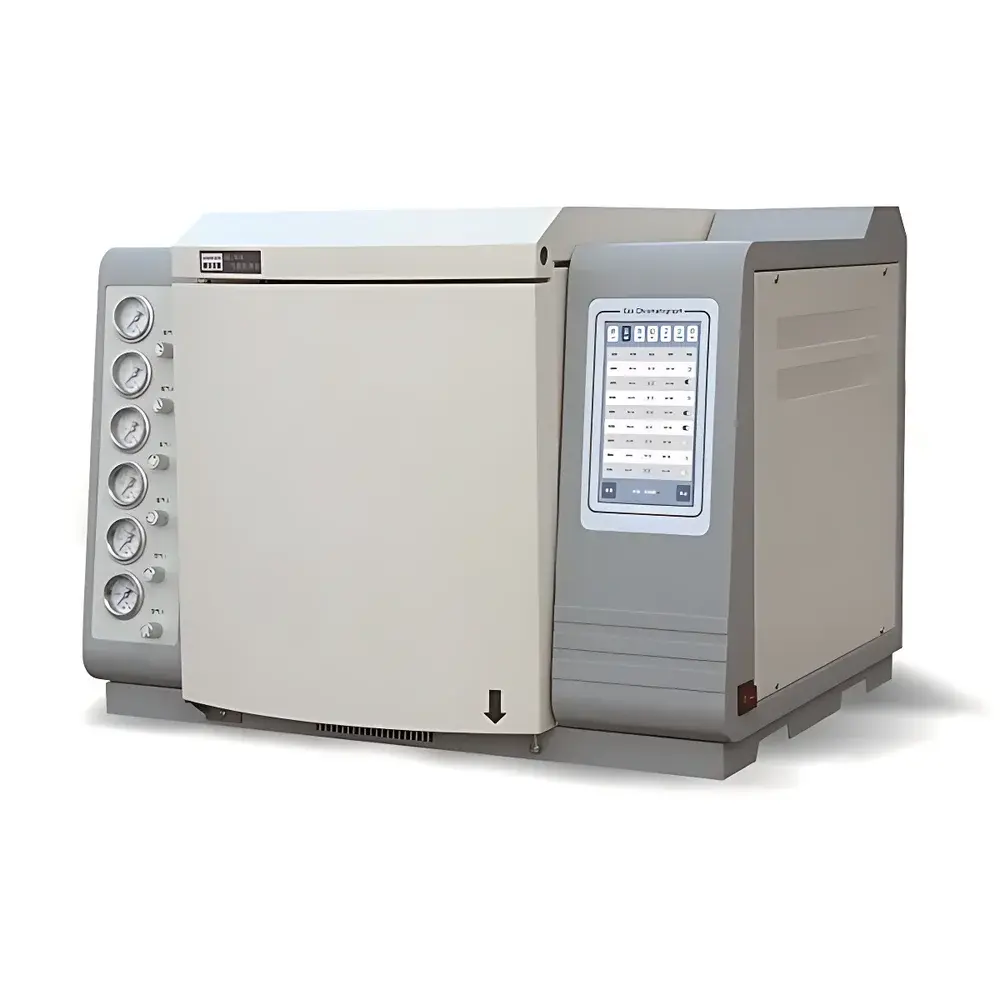
Huifen Instruments GC-7820 Liquefied Petroleum Gas (LPG) Analysis Dedicated Gas Chromatograph
| Brand | Huifen Instruments |
|---|---|
| Origin | Shandong, China |
| Instrument Type | Laboratory Gas Chromatograph |
| Application Field | High-Purity Gas Analysis |
| Temperature Control Range | Ambient + 3°C to 450°C |
| Oven Ramp Rate | 0.1–40°C/min |
| Cooling Rate | ~8 min (450°C → 50°C) |
| Carrier Gas Flow Range & Control | 0–1200 mL/min |
| Carrier Gas Pressure Range & Control | 0–970 kPa |
| Injector Maximum Operating Temperature | 450°C |
| Injector Pressure Setting Range | 0–970 kPa |
| Injector Total Flow Setting Range | 0–1200 mL/min |
| Detection System | Dual FID |
| Column Configuration | Dual-column, dual-valve, dual-detector |
| Sample Introduction | Automated loop injection (0.5–1.0 mL) |
| Key Standards Compliance | GB/T 5274, ISO 6142, GB 11174, GB/T 12576, GB 19159, SH/T 0233 |
Overview
The Huifen Instruments GC-7820 Liquefied Petroleum Gas (LPG) Analysis Dedicated Gas Chromatograph is a purpose-built laboratory gas chromatograph engineered for precise, reproducible quantification of hydrocarbon and oxygenated compound composition in commercial and industrial LPG streams. It operates on the principle of capillary gas chromatography with dual-column separation and dual-flame ionization detection (FID), enabling simultaneous resolution of C1–C5 paraffins, olefins, isomers, and key oxygenates—including dimethyl ether (DME), methanol, and methyl tert-butyl ether (MTBE)—in a single injection cycle. The system integrates microfluidic valve switching and backflush capabilities to eliminate column contamination and extend column lifetime, while its thermally stable oven architecture ensures high retention time repeatability (<0.02 min RSD) across extended run sequences. Designed to meet the analytical rigor demanded by refinery QC labs, gas distribution terminals, and regulatory testing facilities, the GC-7820 adheres to the physical and metrological requirements outlined in GB 11174 (LPG specification), GB/T 12576 (vapor pressure and relative density calculation), and ISO 6142 (calibration gas preparation by gravimetric method).
Key Features
- Dual-column, dual-valve, dual-FID configuration enabling full compositional analysis of LPG in one injection—eliminating manual re-injection and reducing operator-induced variability.
- High-precision temperature-controlled oven with programmable ramp rates (0.1–40°C/min) and rapid cooling (<8 min from 450°C to 50°C), supporting tight thermal control for complex boiling point distributions.
- Passivated stainless-steel pneumatic pathways and zero-dead-volume fittings minimize surface adsorption and catalytic degradation of reactive species (e.g., alkenes, DME), preserving sample integrity.
- Imported high-temperature automated rotary valves (rated to 150°C valve box temperature) with micro-cutting gas path technology ensure robust, long-term valve actuation stability and leak-free operation.
- Optimized column set: 30 m × 0.53 mm Al2O3/KCl PLOT column (15 µm film) for C1–C4 separation; 10 m × 0.53 mm Lowox column (10 µm film) for oxygenate resolution—both certified for LPG applications per GB/T 12576 and SH/T 0233.
- FID detectors calibrated per ASTM D1945 and ISO 10101-2, operating at 230°C with optimized H2 (30 mL/min), air (350 mL/min), and makeup N2 (25 mL/min) flows to deliver linear response (R² > 0.9999) over four orders of magnitude.
Sample Compatibility & Compliance
The GC-7820 is validated for direct analysis of liquefied petroleum gas samples collected via SH/T 0233-compliant sampling cylinders or integrated into continuous monitoring loops. It accommodates both vapor-phase and liquid-phase injections using a heated 0.5–1.0 mL quantitative loop, with optional cryogenic focusing for trace component enrichment. All hardware materials—including injector liners, septa, and detector jets—are selected for inertness toward sulfur compounds, mercaptans, and acidic impurities commonly found in field-sourced LPG. The instrument satisfies essential regulatory alignment for quality control laboratories operating under GLP frameworks and supports audit-ready data handling compliant with FDA 21 CFR Part 11 when paired with validated chromatography data systems (CDS). Its calibration traceability follows ISO/IEC 17025 principles, with documented uncertainty budgets for each reported component (e.g., propane ±0.12 vol%, DME ±0.25 vol%).
Software & Data Management
Built-in chromatography data system (CDS) provides method-driven acquisition, peak integration using valley-to-valley and tangent skim algorithms, and automated calibration curve generation with quadratic or linear regression options. All sequence parameters—including oven program, valve timing, detector settings, and integration events—are stored as encrypted method files with user-defined version control. Audit trails record all method modifications, data reprocessing actions, and user logins with timestamps and IP addresses. Raw data (.cdf) and report outputs (.pdf, .xlsx) are generated with embedded metadata (instrument ID, operator, sample ID, injection time, calibration status) to support ISO 17025 documentation requirements. Optional export modules enable seamless transfer to LIMS platforms via ASTM E1384-compliant XML or HL7 interfaces.
Applications
- Quantitative determination of hydrocarbon composition (C1–C5) in commercial LPG per GB 11174 and EN 589 specifications.
- Verification of oxygenate content (DME, MTBE, methanol) in blended autogas formulations per GB 19159 and ASTM D7717.
- Monitoring compositional drift during storage or transport to assess phase stability and vapor pressure compliance.
- Supporting refinery process optimization through real-time feedback on depropanizer, debutanizer, and fractionation unit performance.
- Forensic analysis of adulterated LPG batches containing prohibited diluents (e.g., butane-enriched propane, naphtha cutbacks).
- Research-grade characterization of alternative LPG substitutes including bio-propane and synthetic DME blends.
FAQ
What carrier gas is recommended for optimal resolution of LPG components?
Helium (≥99.999% purity) is specified for consistent retention time stability and optimal efficiency on both Al2O3 and Lowox columns; hydrogen may be used with appropriate safety interlocks but requires re-optimization of flow and detector parameters.
Can the GC-7820 analyze liquefied samples directly without vaporization?
Yes—the system supports liquid-phase injection via a pressurized, temperature-controlled loop; however, vapor-phase injection is preferred for improved precision and reduced risk of column overloading.
Is the instrument compatible with third-party chromatography data systems?
The GC-7820 exports standard .cdf files compliant with ASTM E1384 and supports OLE DB connectivity for integration with Agilent OpenLab, Thermo Chromeleon, and Waters Empower CDS platforms.
How often does the system require calibration verification for routine QC use?
Per GB/T 12576 guidance, daily bracketing with certified reference gas mixtures (CRM) is required; full multi-point calibration is recommended weekly or after column replacement, maintenance, or significant ambient temperature shifts.
Does the dual-valve configuration support automated backflushing?
Yes—valve timing is fully programmable within the CDS; backflushing is enabled to elute heavy ends (C5+, residues) away from the analytical column, preserving resolution and extending column life beyond 1,500 injections under typical LPG QC conditions.







