
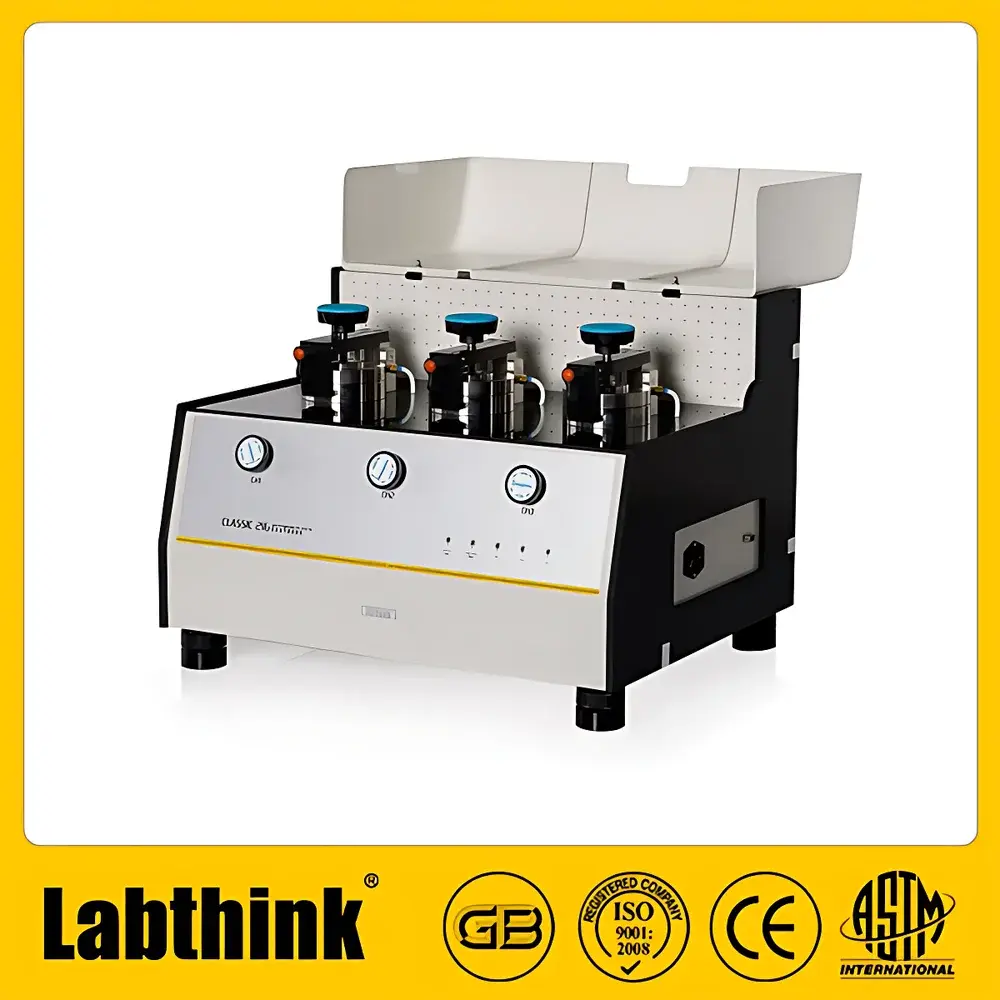
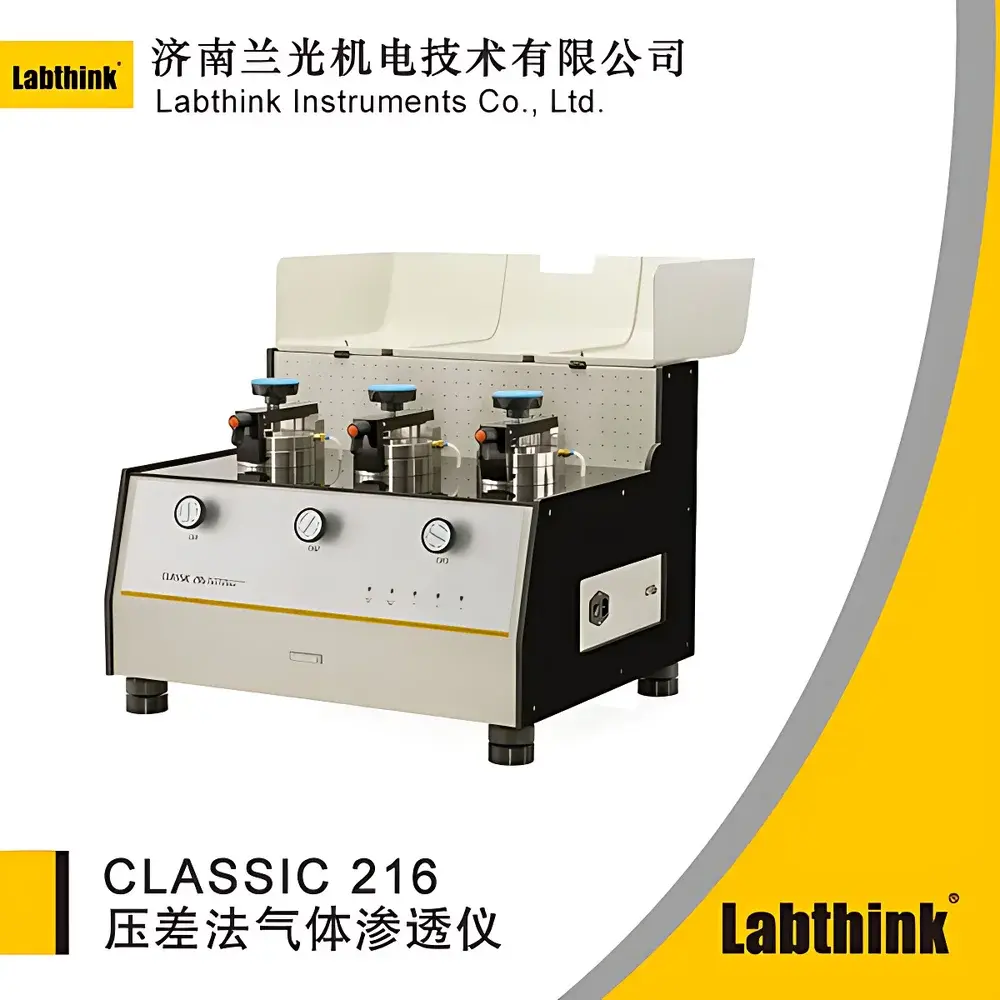
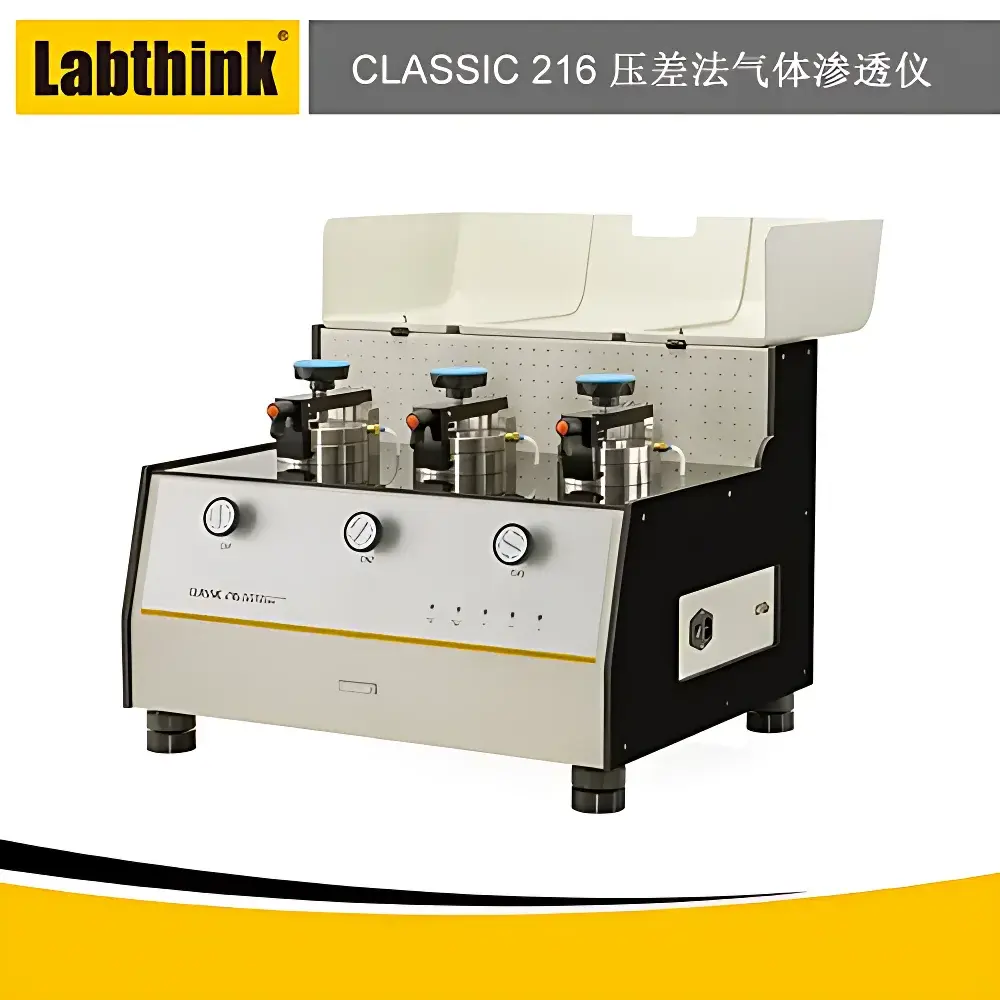
Labthink CLASSIC 216 Differential-Pressure Gas Permeability Analyzer for Packaging Films and Aluminum-Plastic Laminates
| Brand | Labthink |
|---|---|
| Origin | Shandong, China |
| Manufacturer Type | Direct Manufacturer |
| Model | CLASSIC 216 |
| Test Principle | Differential-Pressure (Manometric) Method |
| Measurement Range | 0.1–50,000 cm³/m²·24h·0.1MPa (standard) |
| Test Stations | 3 independent chambers |
| Vacuum Resolution | 0.1 Pa |
| Chamber Vacuum Level | <20 Pa |
| Temperature Control Range | 15–55 °C (external chiller/heater required) |
| Humidity Control Options | 0% RH, 100% RH, or intermediate levels per ASTM E104 (humidification module optional) |
| Specimen Area | 38.48 cm² (Φ97 mm) |
| Test Gases | O₂, N₂, CO₂, air, He (user-supplied gas sources, 0.4–0.6 MPa inlet pressure) |
| Pressure Differential | –0.1 to +0.1 MPa |
| Power Supply | AC 220 V 50 Hz / AC 120 V 60 Hz |
| Dimensions | 670 × 540 × 430 mm (L×W×H) |
| Net Weight | 75 kg |
| Compliance Standards | ISO 15105-1, ISO 2556, ASTM D1434, GB/T 1038-2000, JIS K7126-1, YBB 00082003-2015 |
Overview
The Labthink CLASSIC 216 Differential-Pressure Gas Permeability Analyzer is an engineered solution for precise, reproducible measurement of gas transmission rates (GTR), permeability coefficients (P), diffusion coefficients (D), and solubility coefficients (S) in flexible packaging materials—including aluminum-plastic laminates, multilayer coextrusions, metallized films, and polymer-based gas sampling bags. Operating on the manometric differential-pressure principle per ISO 15105-1 and ASTM D1434, the instrument establishes a controlled pressure gradient across a sealed test specimen: the high-pressure chamber (upper cavity) is pressurized with the target gas, while the low-pressure chamber (lower cavity) is maintained under high vacuum (<20 Pa, resolution 0.1 Pa). Real-time monitoring of pressure rise in the evacuated chamber enables calculation of gas flux through the material under defined thermodynamic conditions. This method delivers traceable, absolute measurements without reliance on carrier gases or calibration standards—making it suitable for regulatory-compliant barrier validation in pharmaceutical primary packaging, food-grade flexible pouches, and certified environmental sampling media.
Key Features
- Triple independent test chambers enable concurrent evaluation of three specimens—identical or dissimilar—reducing inter-test variability and accelerating throughput for QC laboratories.
- High-resolution vacuum sensing (0.1 Pa) and stable pressure control (±0.005 MPa) ensure measurement repeatability ≤2% RSD for low-permeability materials such as AlOx-coated PET or SiOx-laminated structures.
- Modular thermal management: temperature range spans 15–55 °C; external recirculating chiller or heater (optional) maintains ±0.3 °C stability during extended tests, supporting Arrhenius-based activation energy modeling.
- Dual-mode test logic: users select between proportional control (for rapid stabilization) or fuzzy logic algorithms (for complex transient responses), optimizing convergence time without compromising endpoint accuracy.
- Expandable measurement range: standard configuration covers 0.1–50,000 cm³/m²·24h·0.1MPa; optional large-volume expansion kit extends upper limit to ≥500,000 cm³/m²·24h·0.1MPa—critical for evaluating porous substrates or degraded biopolymers.
- Full data traceability: integrated audit trail logs operator actions, parameter changes, calibration events, and environmental conditions—aligned with FDA 21 CFR Part 11 requirements when paired with validated software configurations.
Sample Compatibility & Compliance
The CLASSIC 216 accommodates flat, non-porous sheet materials up to 1 mm thick, including aluminum-plastic composite films used in gas sampling bags (e.g., PE/Al/PE laminates), pharmaceutical blister lidding foils, retort pouch substrates, and industrial geomembranes. It supports standardized specimen geometry (Φ97 mm, effective area 38.48 cm²) and interfaces with common lab gas sources (O₂, N₂, CO₂, He) via 6 mm polyurethane tubing (0.4–0.6 MPa supply pressure). All operational protocols adhere to internationally recognized barrier testing standards—including ISO 2556 (plastic films), ASTM D1434 (gas transmission rate), and YBB 00082003-2015 (Chinese pharmaceutical packaging)—ensuring data acceptance in GLP/GMP environments and cross-border regulatory submissions.
Software & Data Management
The system operates via Labthink’s proprietary PermeationSuite™ v4.2 software, installed on a dedicated Windows-based host PC. The interface provides real-time graphical display of pressure vs. time curves, automatic endpoint detection, and one-click generation of ASTM/ISO-compliant reports—including permeability coefficient (P), diffusion coefficient (D), and solubility (S) derived from Fickian analysis. Raw data files are stored in encrypted .ltdb format with embedded metadata (operator ID, timestamp, ambient T/RH, calibration history). Export options include CSV, PDF, and XML for LIMS integration. Optional 21 CFR Part 11 compliance packages include electronic signatures, role-based access control, and immutable audit trails—validated per IQ/OQ protocols.
Applications
- Packaging Development: Quantifying O₂ transmission rates (OTR) in modified-atmosphere packaging (MAP) films and evaluating CO₂ permeability in carbonated beverage pouches.
- Gas Sampling Bag Validation: Verifying integrity of aluminum-laminated sampling bags used in EPA Method TO-15 and ISO 16000-6 compliant air quality monitoring—ensuring <0.5% analyte loss over 72 h at 23 °C.
- Pharmaceutical Barrier Assessment: Testing peelable lidding foils and cold-forming blister bases per USP and EP 2.6.27 for moisture and oxygen ingress resistance.
- Sustainable Materials Research: Characterizing degradation-dependent permeability shifts in starch-based bioplastics and PLA/PBAT blends under accelerated aging conditions.
- Industrial Film QA: Routine verification of PVDC-coated BOPP, SiOx-deposited PET, and Al foil composites against internal specifications and customer release criteria.
FAQ
What gases can be tested with the CLASSIC 216?
Oxygen, nitrogen, carbon dioxide, helium, and dry air are routinely supported. Gas purity must meet ISO 8573-1 Class 2 requirements; users supply regulated gas cylinders (0.4–0.6 MPa inlet pressure).
Is humidity control built-in?
No—relative humidity conditioning requires the optional HumiControl™ module, which generates stable RH levels from 0% to 100% per ASTM E104. Standard operation assumes dry gas testing.
Can the instrument comply with FDA 21 CFR Part 11?
Yes—when configured with PermeationSuite™ v4.2 Part 11 Edition, including electronic signatures, audit trail logging, and user permission hierarchies—all validated per GAMP5 guidelines.
How is calibration performed?
Certified reference membranes (e.g., NIST-traceable low-permeability PET film) are used for daily verification. System zero checks are automated prior to each test sequence using high-vacuum hold validation.
What sample preparation tools are included?
Standard configuration includes a circular die cutter (Φ97 mm), vacuum grease, quantitative filter paper, and a two-stage rotary vane vacuum pump. Optional accessories include humidity generators, thermal jackets, and gas mixing manifolds.






