
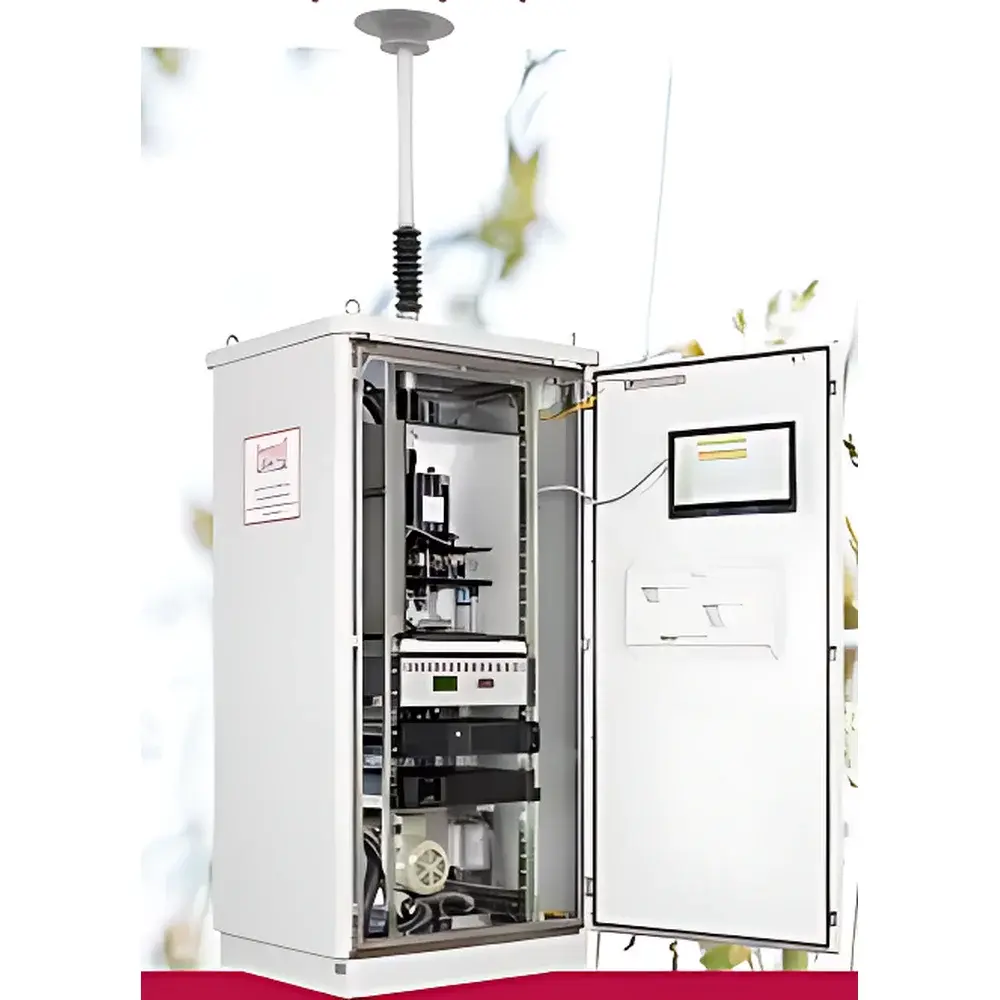
Hund BAA500e Automated Pollen Monitoring System
| Brand | Hund |
|---|---|
| Origin | Germany |
| Model | BAA500e |
| Instrument Type | Aerosol Detector |
| Pollen Identification Capacity | 40+ species (expandable) |
| Accuracy | >90% |
| Sensitivity | 1 particle/m³ |
| Particle Size Range | 10–150 µm |
| Sampling Flow Rate | 1117 L/min |
| Dimensions | 900 mm × 700 mm × 1800 mm |
| Weight | ≤400 kg |
| Power Supply | 230 V AC / max. 3.7 kW |
| Operating Temperature | −20 °C to +40 °C |
| Relative Humidity | 0–100% RH |
| Sampling Interval | 1–3 h |
| Autonomous Operation Duration | 2–4 weeks |
| Sample Carrier Capacity | Reusable magazine-style cassette (8–24 carriers/day) |
Overview
The Hund BAA500e Automated Pollen Monitoring System is a laboratory-grade, real-time aerosol monitoring platform engineered for continuous, unattended quantification and morphological classification of airborne pollen grains. Unlike passive or filter-based samplers, the BAA500e employs active virtual impactor sampling coupled with automated optical microscopy and AI-driven image analysis—operating on the fundamental principle that taxonomic differentiation of pollen relies exclusively on morphological features (e.g., exine ornamentation, aperture number/position, colpus geometry, intine thickness, and granular plasma structure), not biochemical signatures. This system captures high-resolution z-stack image sequences across multiple focal planes per sample location, reconstructs extended-depth-of-field composites, and applies multi-dimensional feature descriptors—including geometric invariants, texture metrics, and scale-invariant shape transforms—to achieve species-level identification. Designed for deployment in environmental monitoring networks, public health infrastructure, and agricultural research stations, the BAA500e delivers validated, traceable pollen concentration data with sub-hour latency—enabling dynamic forecasting models compliant with WHO and ERS allergy management guidelines.
Key Features
- Fully automated end-to-end workflow: ambient air sampling → virtual impaction → slide preparation → autofocus microscopy → multi-plane imaging → AI classification → digital reporting
- Reconfigurable sampling schedule: programmable intervals from 1 to 3 hours, supporting adaptive temporal resolution for seasonal phenology studies
- Reusable carrier magazine (“ammo clip”) architecture: accommodates 8–24 slides per day; total capacity supports 2–4 weeks of autonomous operation without manual intervention
- Extended environmental tolerance: certified operation across −20 °C to +40 °C and 0–100% RH, eliminating seasonal downtime or climate-controlled housing requirements
- High-fidelity optical imaging subsystem: motorized stage, precision Z-drive, and LED-illuminated transmitted-light optics optimized for pollen morphology contrast
- Secure remote access: encrypted HTTP(S) API and native mobile application integration for real-time dashboard visualization and alarm notification
Sample Compatibility & Compliance
The BAA500e is validated for detection and classification of anatropous, orthotropous, and hemitropous pollen grains within the 10–150 µm aerodynamic diameter range—including but not limited to Alnus, Betula, Quercus, Poaceae, Artemisia, and Ambrosia. Its classification engine supports expansion to spores (e.g., Alternaria, Cladosporium) and fungal conidia via supervised retraining using user-provided ground-truth image sets. The system adheres to ISO 21501-4 for particle sizing instrumentation calibration protocols and meets mechanical safety requirements per EN 61000-6-2/-4 (EMC) and EN 61010-1 (electrical safety). Data integrity aligns with GLP principles through immutable timestamping, audit-trail logging, and role-based access control—facilitating regulatory readiness for public health surveillance programs.
Software & Data Management
The InfoZoom software suite provides both local workstation control and cloud-hosted data aggregation. It implements a modular neural network architecture trained on curated, expert-annotated pollen libraries, with built-in tools for model fine-tuning using new morphological datasets. All raw images, z-stacks, feature vectors, and classification confidence scores are stored in vendor-agnostic HDF5 format. Export options include CSV (time-series concentration), GeoJSON (spatiotemporal mapping), and XML (ISO/IEC 11179-compliant metadata). Audit logs record every operator action, algorithm update, and hardware status transition—fully satisfying FDA 21 CFR Part 11 requirements for electronic records and signatures when deployed under GxP frameworks.
Applications
- Allergen exposure assessment for epidemiological cohort studies and clinical trial site selection
- Real-time pollen index generation for national meteorological services and public health alert systems
- Long-term phenological monitoring to assess climate change impacts on plant reproductive timing
- Validation of atmospheric dispersion models (e.g., SILAM, HYSPLIT) with ground-truth biological aerosol data
- Support for precision agriculture initiatives—e.g., optimizing orchard pollination windows or managing hay fever risk zones near crop fields
- Cross-domain adaptation to bioaerosol surveillance in pharmaceutical cleanrooms or hospital HVAC systems
FAQ
How does the BAA500e ensure taxonomic accuracy without chemical analysis?
It relies on high-magnification, multi-focus optical imaging to extract >120 morphometric and textural descriptors per grain—validated against reference herbarium specimens and electron micrographs.
Can the system distinguish between viable and non-viable pollen?
No—viability assessment requires biochemical or germination assays; the BAA500e reports total airborne particulate concentration by morphology only.
Is routine calibration required?
Yes—annual verification of impactor cut-point performance and microscope magnification fidelity is recommended per ISO/IEC 17025 guidelines.
What data formats are supported for third-party integration?
RESTful JSON API, OGC SensorThings API v1.1, and standardized NetCDF-4 for time-series environmental datasets.
Does the system comply with EU Air Quality Directive reporting standards?
While not a regulated air quality monitor per 2008/50/EC, its data output structure conforms to EEA AQ e-reporting schema for supplementary biological aerosol indicators.







