
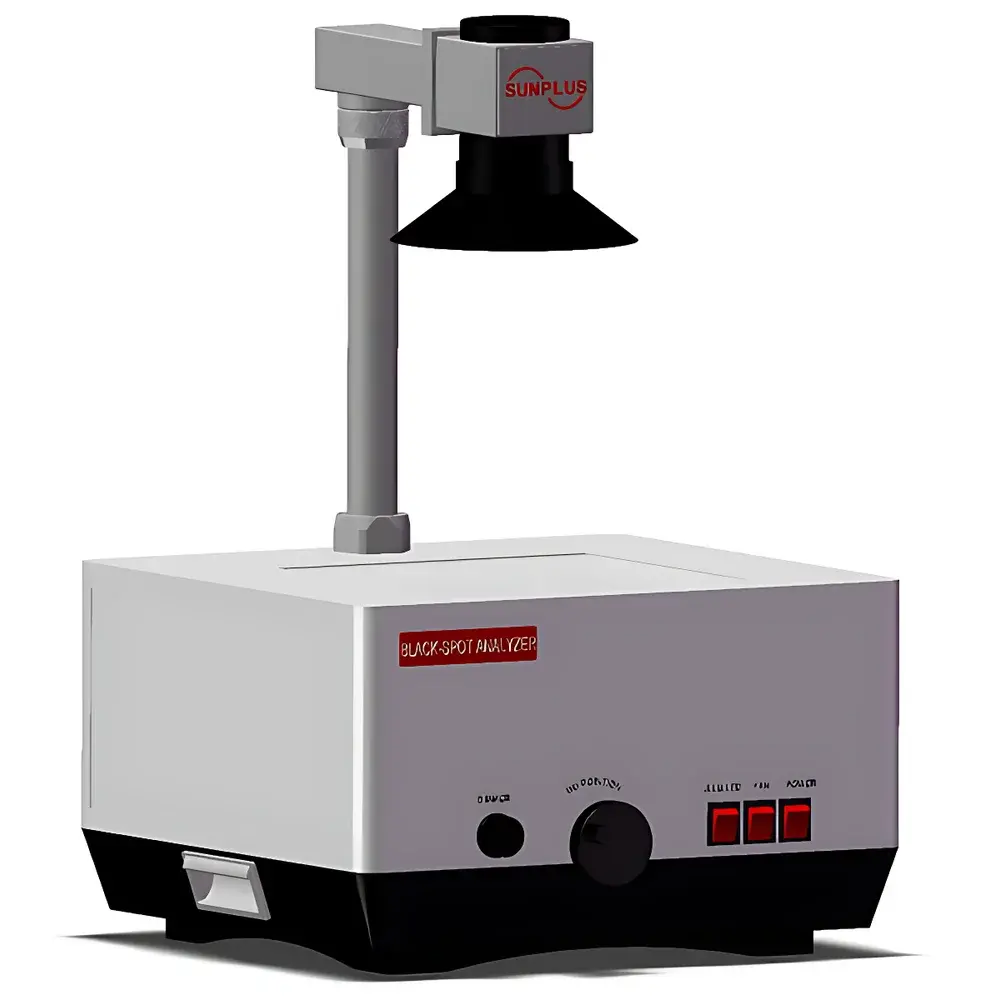
HunterLab SP-BS-1908 Advanced Black Spot & Defect Analyzer for Resin Pellets and Films
| Brand | HunterLab |
|---|---|
| Origin | Canada |
| Model | SP-BS-1908 |
| Minimum Detectable Size | 0.1 mm |
| Detection Accuracy | < 0.035 mm |
| Inspection Area | ≥ 200 × 200 mm |
| Optical Magnification | >20× |
| Light Output | ≥6000 lm |
| Illumination Source | 24 V / 60 W |
| Power Supply | 220 V, 50 Hz |
| Dimensions | ~459 × 426 × (276 + 380) mm |
| Sample Tray Size | 200 × 200 mm (net) |
Overview
The HunterLab SP-BS-1908 Advanced Black Spot & Defect Analyzer is a high-precision, vision-based inspection system engineered for quantitative assessment of extrinsic and intrinsic defects in polymeric materials—including resin pellets, granules, thin films, and sheets. Operating on high-contrast transmittance imaging principles, the instrument captures high-resolution monochrome images under uniform, calibrated illumination (≥6000 lm), enabling reliable detection of black specks, carbonized particles, gel particles, and microstructural anomalies—even in semi-transparent or opaque thermoplastics such as PP, PE, PVC, and PPS. Unlike conventional manual counting or low-resolution optical comparators, the SP-BS-1908 integrates metrological-grade optics, programmable threshold segmentation, and pixel-level spatial calibration to deliver traceable, repeatable measurements compliant with ASTM D7250 (Standard Practice for Determining Relative Polymer Matrix Composition), ISO 18064 (Plastics — Polypropylene — Specification), and relevant sections of USP for pharmaceutical packaging material quality control.
Key Features
- Automated detection and classification of black spots, burnt particles, gels, and surface striations with size resolution down to 0.1 mm and positional accuracy better than ±0.035 mm.
- Configurable defect sizing thresholds (0.1 mm, 0.2 mm, 0.3 mm, 0.4 mm, 0.8 mm, 1.0 mm, 1.2 mm, etc.) aligned with user-selected industry standards via intuitive software interface.
- Large-format inspection stage (≥200 × 200 mm active area) accommodates standard transparent trays for batch pellet analysis or direct placement of flat film specimens—no pre-treatment (e.g., black backing, adhesive mounting) required.
- Digital zoom functionality (≥20× optical magnification) enables detailed morphological review of individual defects, including shape factor, aspect ratio, and edge contour analysis.
- Integrated spatial mapping engine generates heatmaps and distribution charts showing areal density, clustering tendency, and positional frequency of defects across the entire sample field.
- Fully automated reporting engine exports structured data (count, size distribution, % area coverage, defect type histogram) in PDF, CSV, and XML formats—supporting audit-ready documentation for GLP/GMP environments.
Sample Compatibility & Compliance
The SP-BS-1908 supports rigid and flexible polymer forms without modification: free-flowing resin pellets (PP, PE, PS, ABS), injection-molded chips, extruded sheets (≤5 mm thickness), and biaxially oriented films (BOPP, BOPET, CPP). Its wide dynamic range and adaptive illumination compensate for variable optical density—enabling consistent performance across transparent, translucent, and mildly opaque substrates. System validation includes NIST-traceable calibration using certified standard plates; all measurement algorithms adhere to ISO/IEC 17025 requirements for testing laboratories. Data integrity complies with FDA 21 CFR Part 11 through electronic signature support, audit trail logging, and role-based user access control within the application software.
Software & Data Management
The proprietary VisionInspect™ software suite provides full control over acquisition parameters, image preprocessing (background subtraction, noise filtering, contrast enhancement), and AI-assisted segmentation. Users define custom defect classes (e.g., “carbon agglomerate”, “metal fragment”, “die-line scratch”) and assign pass/fail criteria per size bin and count limit. All raw images, processed masks, metadata (operator ID, timestamp, instrument serial, calibration status), and final reports are stored in an encrypted local database with optional network backup. Export modules support integration into LIMS platforms via HL7 or RESTful API, and report templates are customizable to match internal SOPs or regulatory submission formats (e.g., ICH M4, EU Annex 11).
Applications
- Quality assurance of virgin and recycled resin feedstock prior to extrusion or compounding.
- In-process monitoring of pelletizing lines to identify upstream degradation or contamination events.
- Final release testing of medical-grade polymer films used in sterile barrier packaging.
- Root cause analysis of haze, opacity, or mechanical weakness linked to particulate inclusion.
- Supplier qualification and incoming inspection per ASTM D1600 or ISO 293.
- Supporting technical documentation for ISO 9001:2015 Clause 8.6 (Release of products and services).
FAQ
Does the SP-BS-1908 require sample preparation for opaque pellets?
No—samples are placed directly into the supplied 200 × 200 mm transparent tray; no solvent washing, staining, or backlighting modification is needed.
Can the system distinguish between black spots and colored contaminants?
Yes—using grayscale intensity profiling and morphological filters, it differentiates carbon-based black specks from red/yellow/orange contaminants based on optical density and edge sharpness.
Is calibration traceable to national standards?
Yes—each unit ships with a NIST-traceable calibration plate; annual recalibration services are available through HunterLab’s certified service centers in North America and EMEA.
What file formats does the software support for data export?
PDF (formatted reports), CSV (raw counts and metrics), XML (structured data for LIMS ingestion), and TIFF/PNG (annotated high-res images).
How is user accountability maintained during inspection sessions?
Role-based login, session timestamps, operator ID tagging, and immutable audit logs meet FDA 21 CFR Part 11 requirements for electronic records and signatures.



