
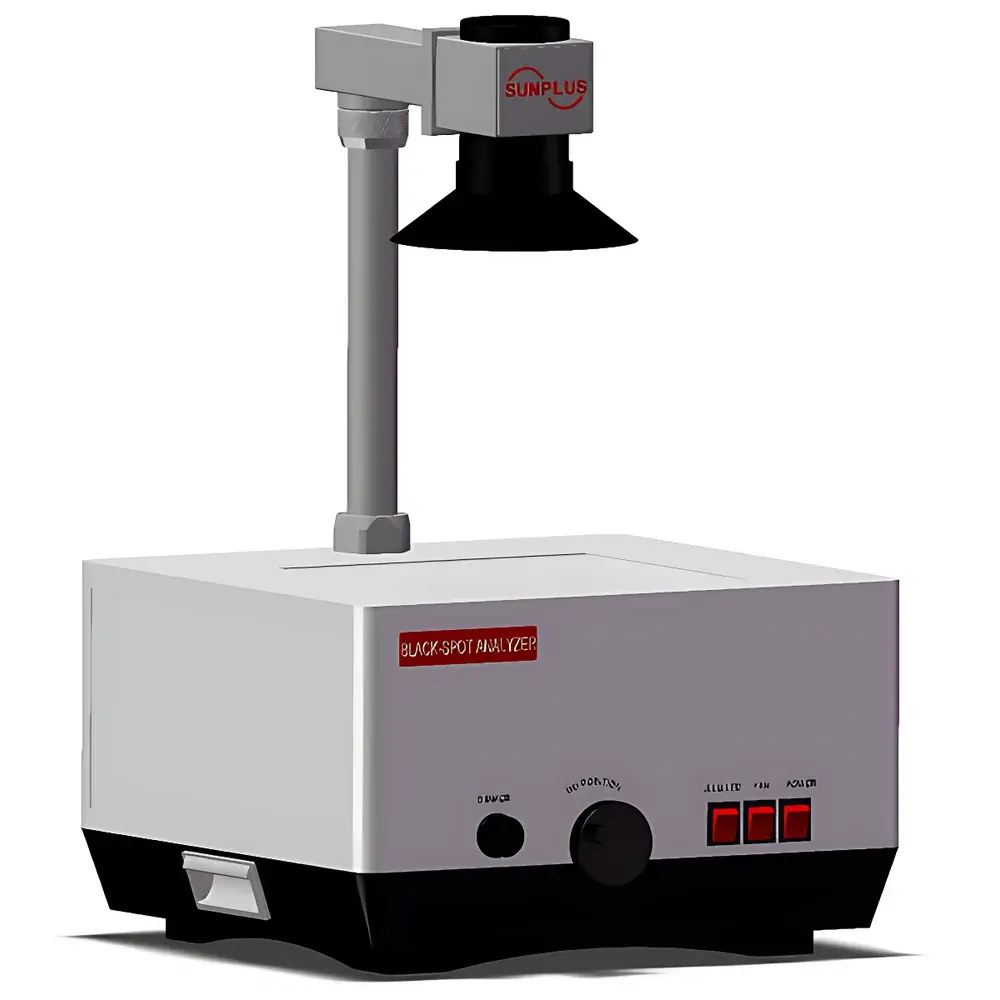
HunterLab SP-BS-1908 Black Spot Inspection System for Polymer Pellets and Films
| Brand | HunterLab |
|---|---|
| Origin | Canada |
| Model | SP-BS-1908 |
| Minimum Detectable Spot Size | 0.1 mm |
| Detection Accuracy | < 0.035 mm |
| Inspection Area | ≥ 200 × 200 mm |
| Optical Magnification | >20× |
| Light Output | ≥ 6000 lumens |
| Light Source | 24 V / 60 W |
| Power Supply | 220 V, 50 Hz |
| Dimensions | ~459 × 426 × (276 + 380) mm |
| Sample Carriers | 200 × 200 mm transparent tray (for pellets) and direct platform placement (for films) |
| Compliance | ASTM D7252, ISO 18064, GB/T 29187, USP <788> (particle inspection principles), GLP-compliant data audit trail support |
Overview
The HunterLab SP-BS-1908 Black Spot Inspection System is an automated optical imaging platform engineered for quantitative assessment of foreign particulate contamination—specifically black specks, carbonized residues, and intrinsic defects—in thermoplastic polymer materials. It operates on high-contrast transmissive illumination coupled with calibrated monochrome CMOS imaging and pixel-based morphological analysis. Unlike manual visual inspection or generic particle counters, the SP-BS-1908 implements standardized thresholding algorithms aligned with ASTM D7252 (Standard Test Method for Determination of Black Specks in Polyolefin Resins) and ISO 18064 (Plastics — Polyolefins — Determination of Black Specks), enabling objective, repeatable classification of defects by size, shape, density, and spatial distribution. The system is validated for use across resin pellet batches, extruded film sheets, and injection-molded preforms—regardless of base material opacity—leveraging dynamic backlight intensity control and adaptive contrast normalization to maintain measurement fidelity across PP, PE, PVC, PPS, PET, and other engineering polymers.
Key Features
- Automated detection and classification of black spots from 0.1 mm upward, with sub-0.035 mm sizing accuracy verified against NIST-traceable calibration standards.
- Configurable inspection thresholds supporting multiple industry-defined size bins (e.g., 0.1, 0.2, 0.3, 0.4, 0.8, 1.0, 1.2 mm), selectable via intuitive software interface per ASTM or internal QC protocols.
- Dual-mode sample handling: standardized 200 × 200 mm transparent quartz tray for bulk pellet analysis; flat-field platform for direct placement of flexible films up to 200 × 200 mm without masking, coating, or background modification.
- Real-time zoomable defect mapping with ≥20× optical magnification, enabling verification of morphology—including fused agglomerates, charred fragments, and die-line scratches—without physical repositioning.
- Batch-level statistical reporting including total count, area-weighted distribution, black spot ratio (% surface coverage), and classified defect density (spots/cm²), all traceable to acquisition timestamp and operator ID.
- Fully compliant with data integrity requirements: audit trail logging, electronic signature support, and exportable raw image stacks (TIFF/RAW) and structured reports (PDF, CSV, XML) for FDA 21 CFR Part 11 and EU Annex 11 readiness.
Sample Compatibility & Compliance
The SP-BS-1908 accommodates a broad spectrum of polymeric forms—including opaque granules, translucent flakes, and optically clear biaxially oriented films—without requiring sample preparation such as carbon coating or substrate backing. Its 6000-lumen high-CRI LED backlight ensures uniform illumination across heterogeneous thicknesses, while real-time exposure compensation mitigates vignetting effects in curved or warped specimens. The system meets functional equivalency requirements under ISO 18064 Annex B (imaging-based black speck enumeration), aligns with GB/T 29187–2012 methodology for plastic pellet quality grading, and supports validation documentation for GMP manufacturing environments. All calibration routines utilize certified reference plates traceable to NRC Canada, and instrument performance verification follows HunterLab’s IQ/OQ/PQ protocol suite.
Software & Data Management
The proprietary SP-Insight™ application provides a secure, role-based interface for method setup, acquisition control, and post-processing analytics. Users define inspection parameters—including minimum/maximum particle area, circularity filters, and intensity thresholds—via drag-and-drop templates compatible with internal SOPs or regulatory submission formats. Each inspection session auto-generates a timestamped report containing annotated images, statistical summaries, pass/fail determinations per selected standard, and full metadata (instrument ID, operator, ambient temperature/humidity logs). Data export supports LIMS integration via HL7 or REST API, and archived sessions retain full image provenance for retrospective root-cause analysis. Software versioning complies with IEC 62304 Class B medical device software guidelines where applicable.
Applications
- Quality release testing of virgin and recycled polyolefin pellets prior to extrusion or molding.
- In-process monitoring of twin-screw extruder output to identify thermal degradation onset or screw wear signatures.
- Root-cause investigation of film haze, pinholes, or gauge banding correlated with localized defect clustering.
- Supplier qualification audits requiring objective, third-party-validated black speck metrics.
- Regulatory dossier preparation for ISO 9001, IATF 16949, and FDA Device Master Record submissions.
- Material development studies quantifying stabilizer efficacy under accelerated aging conditions.
FAQ
Does the SP-BS-1908 require sample staining or background enhancement for opaque pellets?
No. The system uses high-intensity transmissive illumination optimized for scattering media; no dyeing, carbon coating, or adhesive backing is necessary.
Can the software distinguish between carbonized polymer and metal contaminants?
It classifies based on grayscale intensity and edge morphology only; elemental identification requires complementary EDX or FTIR analysis.
Is the 200 × 200 mm inspection area fixed, or can larger samples be tiled?
The active field is fixed at 200 × 200 mm; oversized films must be segmented manually and stitched during post-processing using registered fiducial markers.
How often does the system require recalibration?
Annual calibration with certified standard plates is recommended; daily verification using the included reference plate satisfies routine operational checks.
Does HunterLab provide installation qualification (IQ) documentation?
Yes—factory-issued IQ/OQ protocols, including environmental monitoring records and electrical safety test reports, are supplied with each unit.



