
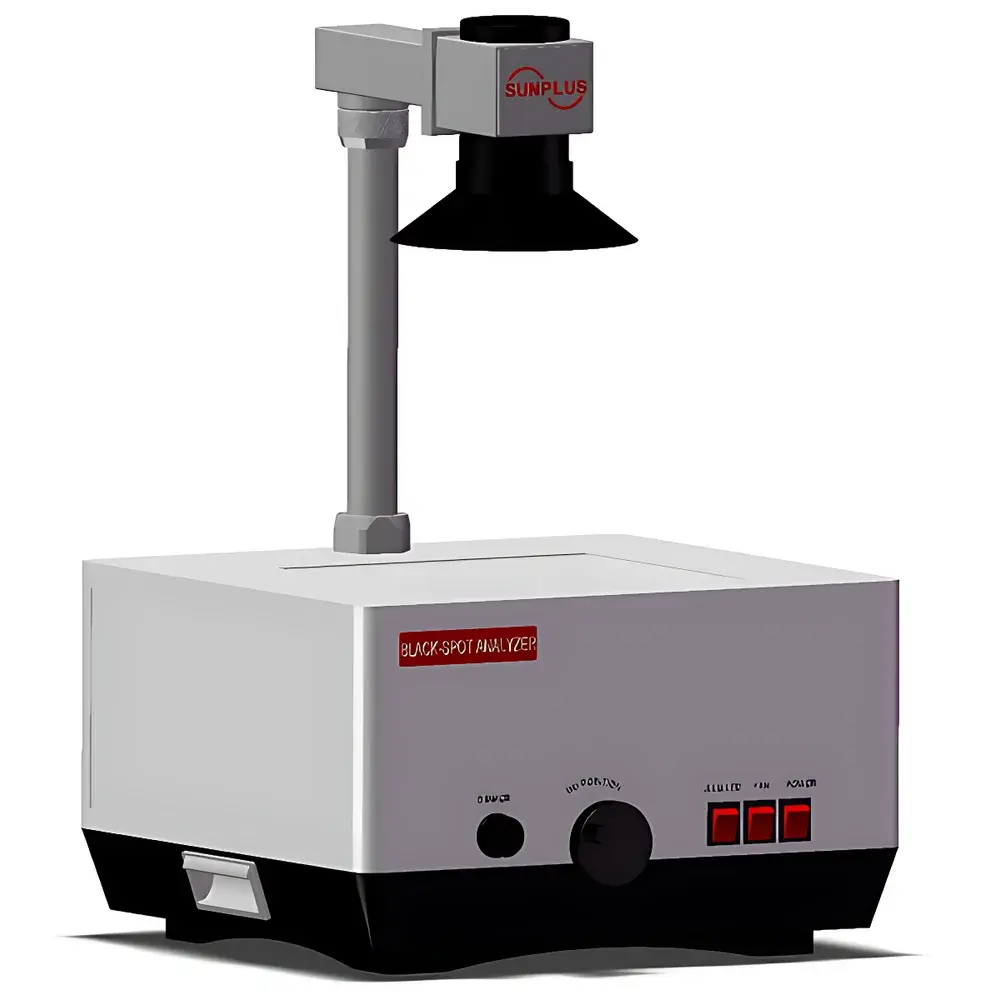
HunterLab SP-BS-1908 Blackspot and Foreign Particle Inspection System
| Brand | HunterLab |
|---|---|
| Origin | Canada |
| Manufacturer Type | Authorized Distributor |
| Origin Category | Imported |
| Model | SP-BS-1908 |
| Price | Upon Request |
| Minimum Detectable Size | 0.1 mm |
| Detection Accuracy | < 0.035 mm |
| Inspection Area | ≥ 200 × 200 mm |
| Tray Dimensions | 200 × 200 mm (net usable area) |
| Optical Magnification | >20× |
| Light Output | ≥6000 lumens |
| Light Source | 24 V / 60 W |
| Power Supply | 220 V, 50 Hz |
| Overall Dimensions | ~459 × 426 × (276 + 380) mm |
Overview
The HunterLab SP-BS-1908 Blackspot and Foreign Particle Inspection System is an automated optical inspection platform engineered for quantitative analysis of visible contaminants—including black specks, carbonized particles, gel particles, and intrinsic structural defects—in thermoplastic polymer materials. It operates on high-contrast transmitted-light imaging principles, leveraging calibrated monochromatic illumination and high-resolution CMOS capture to detect and classify particulate anomalies across transparent, semi-transparent, and opaque polymeric substrates. Designed in alignment with ASTM D7209–22 (Standard Practice for Visual Evaluation of Polymer Pellets), ISO 18064:2017 (Plastics — Polypropylene — Specification), and relevant sections of USP for pharmaceutical-grade resin qualification, the system delivers objective, repeatable, and audit-ready measurements of defect count, size distribution (down to 0.1 mm), and area-weighted contamination ratio—critical parameters for incoming raw material QC, process validation, and regulatory compliance in compounding, film extrusion, and medical device manufacturing.
Key Features
- Automated detection and classification of blackspots, gels, specks, and surface/interior defects without chemical pretreatment or contrast enhancement
- Configurable size thresholds (0.1 mm, 0.2 mm, 0.3 mm, 0.4 mm, 0.8 mm, 1.0 mm, 1.2 mm, etc.) aligned with industry-standard grading protocols
- True batch-mode inspection using a standardized 200 × 200 mm transparent tray—enabling consistent particle dispersion and statistical representativeness
- Direct flatbed scanning of unsupported films up to 200 × 200 mm; no black backing, adhesive tape, or thermal stabilization required
- Zoom-enabled spatial mapping interface for visual verification, defect localization, and morphology assessment (e.g., angularity, edge definition, clustering)
- Real-time classification by size bin, shape factor, and intensity profile—supporting multi-category counting (e.g., “black speck”, “oxidized fragment”, “metal inclusion”)
- Fully traceable measurement log with timestamp, operator ID, sample ID, and instrument calibration status embedded per acquisition
Sample Compatibility & Compliance
The SP-BS-1908 accommodates a broad range of polymeric forms: virgin and regrind pellets (PP, PE, PS, PPS, ABS, PC), flake, granules, and continuous films (LDPE, PET, BOPP, PVC). Its optical architecture supports materials with varying light transmission characteristics—from highly transmissive optical-grade polycarbonate to heavily pigmented or filled compounds. All measurements comply with GLP and GMP documentation requirements: audit trails are retained for ≥36 months, user access is role-controlled, and software enforces electronic signatures per FDA 21 CFR Part 11. Calibration is verified daily using NIST-traceable standard plates (included), and system performance qualification (SPQ) templates are provided for IQ/OQ/PQ execution.
Software & Data Management
The proprietary HunterLab VisionInsight™ software provides ISO/IEC 17025-compliant data handling. It supports configurable pass/fail limits per size class, automated report generation in PDF/XLSX formats (including summary statistics, histogram plots, and spatial heatmaps), and secure export to LIMS via HL7 or CSV. Raw image archives are stored with EXIF metadata (exposure time, gain, lens focus, illumination uniformity index). All processing algorithms—including background subtraction, adaptive thresholding, and sub-pixel centroid calculation—are deterministic and version-locked; no machine learning or “black-box” AI components are employed, ensuring full method transparency and regulatory defensibility.
Applications
- Raw material acceptance testing for polymer suppliers and compounders
- Root cause analysis of black speck formation during extrusion or drying processes
- Qualification of recycled feedstocks prior to melt filtration validation
- Stability monitoring of resin batches under thermal aging or UV exposure studies
- Supporting ICH Q5E comparability assessments for biopharmaceutical packaging resins
- Documentation of defect reduction following filter changeout or screw cleaning interventions
FAQ
Does the SP-BS-1908 require sample digestion or staining?
No—detection relies solely on optical contrast under controlled transmitted illumination; no wet chemistry or surface modification is needed.
Can the system differentiate between carbonized polymer and metal contaminants?
Yes—via integrated grayscale intensity profiling and edge sharpness analysis; classification rules can be customized per material type.
Is the software compliant with FDA 21 CFR Part 11 for electronic records?
Yes—full audit trail, electronic signature enforcement, and user authentication are enabled by default.
What is the recommended calibration frequency?
Daily verification using the supplied standard plate; full system verification every 6 months or after hardware service.
Does the instrument support integration with MES or SAP QM modules?
Yes—via configurable REST API or flat-file export; custom field mapping and SFTP-based transfer are supported.



