
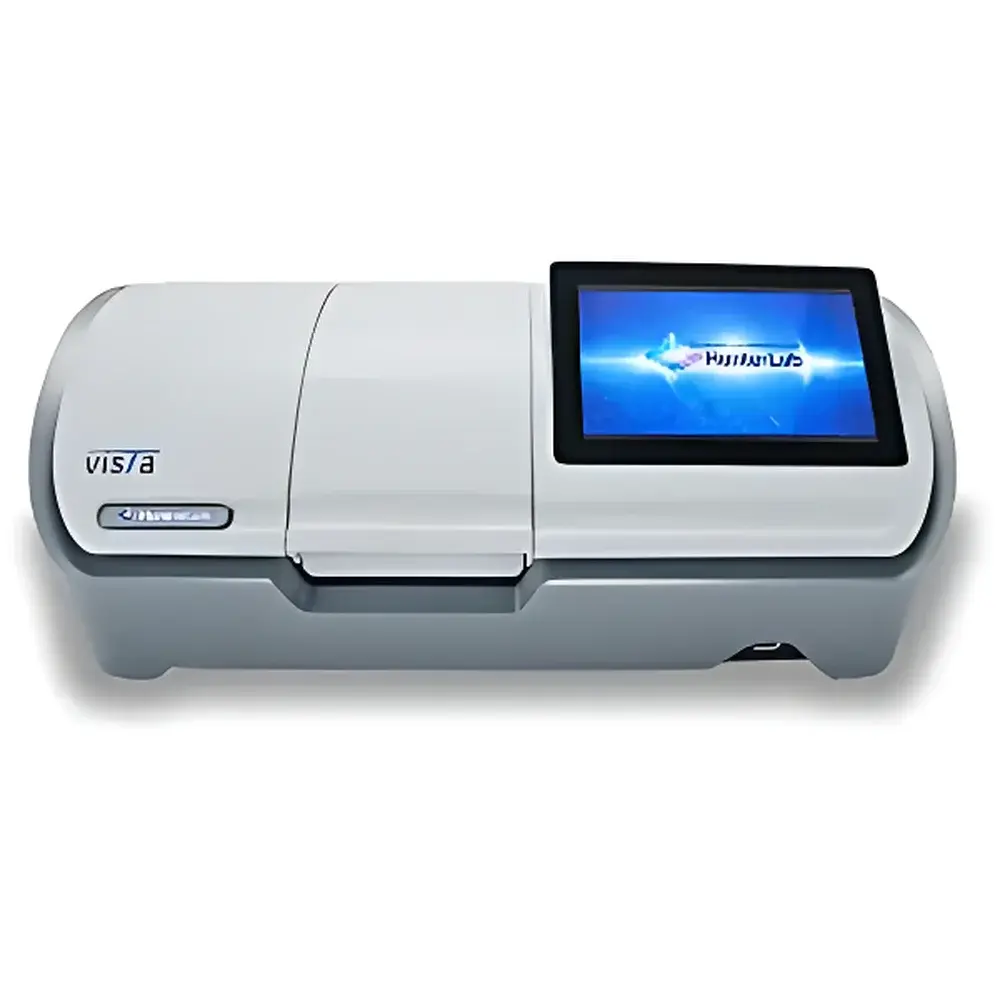
HunterLab Vista Pesticide Intermediate Colorimeter
| Brand | HunterLab |
|---|---|
| Origin | USA |
| Manufacturer Type | Authorized Distributor |
| Product Category | Imported Instrument |
| Model | HunterLab Vista Pesticide Intermediate Colorimeter |
| Product Type | Color Difference Meter |
| Instrument Type | Benchtop |
| Optical Geometry | d/8° Integrating Sphere |
| Light Source | Full-Spectrum LED Array |
| Spectral Range | 400 nm – 700 nm |
| Repeatability | 0.02 ΔE* |
Overview
The HunterLab Vista Pesticide Intermediate Colorimeter is a high-precision, benchtop spectrophotometer engineered for quantitative color and haze analysis of liquid and translucent solid samples in agrochemical manufacturing and quality control environments. Built on a dual-beam optical architecture with a 76 mm integrating sphere and 256-element diode array detector coupled to a high-resolution concave holographic grating, the Vista delivers traceable, repeatable spectral data across the visible spectrum (400–700 nm) at <3 nm effective bandwidth and 10 nm equidistant sampling intervals. Its d/8° geometry—compliant with CIE 15:2004, ASTM E1164, DIN 5033 Teil 7, JIS Z 8722 Condition E, and ISO/CIE standards—ensures robust color measurement under standardized illuminant/observer conditions (D65/10° and C/2°). Unlike conventional colorimeters, the Vista simultaneously acquires full-spectrum transmittance, colorimetric coordinates (CIE L*a*b*, LCh, Yxy, XYZ), and haze (per ASTM D1003) in a single measurement cycle (<5 seconds), enabling rapid assessment of raw material purity, batch consistency, and regulatory conformance for pesticide intermediates.
Key Features
- Dual-beam spectrophotometric design with 256-channel diode array and concave holographic grating for high signal-to-noise ratio and long-term photometric stability
- Integrated haze measurement capability fully compliant with ASTM D1003—no secondary instrumentation or manual recalibration required
- Full-spectrum LED illumination with >5-year operational lifetime, eliminating lamp replacement and spectral drift concerns
- Automated calibration routine with built-in ceramic tile and transmission reference standards; zero user intervention needed for daily verification
- Compact footprint (305 × 254 × 330 mm) and spill-resistant sample compartment optimized for high-throughput QC labs handling volatile or viscous agrochemical solutions
- Touchscreen interface (1280 × 800 resolution) with intuitive workflow navigation, real-time spectral preview, and on-device pass/fail thresholding
Sample Compatibility & Compliance
The Vista accommodates standard 100 mm pathlength cuvettes and custom cell holders for low-volume or high-viscosity intermediates. It supports total transmittance (TTRAN), regular transmittance (RTRAN), and diffuse transmittance modes—enabling precise discrimination between clarity and turbidity effects in halogenated aromatics, amine derivatives, and ester-based precursors. All color and haze measurements adhere to internationally recognized metrological frameworks: colorimetry per CIE 15:2004 and ASTM E1164; haze per ASTM D1003 (Method A); APHA/PtCo and Hazen per ASTM D1209/D5386; Saybolt per ASTM D156; Gardner per ASTM D1544; YI E313 and YI D1925 per ASTM E313/E1995; ADMI per ASTM D1209 Annex A3; Lovibond Red/Yellow (LovR/LovY) per AOCS Cd 13b-92. Instrument performance is validated against NIST-traceable standards, with inter-unit agreement ≤0.15 ΔE* (avg.) and ≤0.25 ΔE* (max.) for transmission filters under D65/10° conditions.
Software & Data Management
Vista operates natively with EasyMatch QC software, supporting FDA 21 CFR Part 11-compliant audit trails, electronic signatures, and role-based access control. Measurement data—including spectral curves, color indices, haze %, and derived metrics (e.g., YI E313, ADMI, LovR)—are exportable in CSV, XML, and PDF formats. The software enables statistical process control (SPC) charting, trend analysis over time, and automated report generation aligned with internal SOPs or external regulatory submissions (e.g., EPA registration dossiers, EU REACH technical files). All raw spectra are stored with metadata (date/time, operator ID, instrument serial number, calibration status), ensuring full GLP/GMP traceability without reliance on cloud infrastructure.
Applications
- Quantitative assessment of color deviation in chlorinated benzenes, pyridine derivatives, and organophosphate precursors during synthesis and purification
- Haze and clarity verification of formulated intermediates to prevent downstream crystallization or emulsion instability
- Batch-to-batch comparison against master standards for release testing per ISO 9001 and ICH Q5A guidelines
- Stability studies tracking yellowing (YI E313), platinum-cobalt index drift, or Lovibond color shifts under accelerated aging conditions
- Supporting impurity profiling where chromophore formation correlates with degradation pathways (e.g., oxidation-induced browning)
FAQ
Does the Vista meet regulatory requirements for pesticide intermediate release testing?
Yes—the instrument’s measurement protocols, traceability chain, and data integrity features align with EPA, EU Plant Protection Products Regulation (EC No 1107/2009), and ICH Q5A quality guidelines.
Can it measure highly viscous or non-Newtonian intermediates?
Yes, using optional thermostatted flow cells or custom pathlength adapters; viscosity does not affect spectral acquisition as long as optical path remains unobstructed.
Is spectral data export compatible with LIMS integration?
Yes—CSV and XML outputs support direct ingestion into laboratory information management systems via configurable field mapping and scheduled FTP/SFTP transfer.
What maintenance is required beyond daily calibration?
None—solid-state LED source and sealed optical train eliminate routine lamp or grating servicing; annual verification with NIST-traceable standards is recommended.
How is instrument consistency verified across multiple Vista units in a global manufacturing network?
HunterLab provides inter-instrument agreement validation kits and cross-site harmonization protocols per ASTM E2539, ensuring <0.25 ΔE* maximum deviation across geographically distributed units.





