
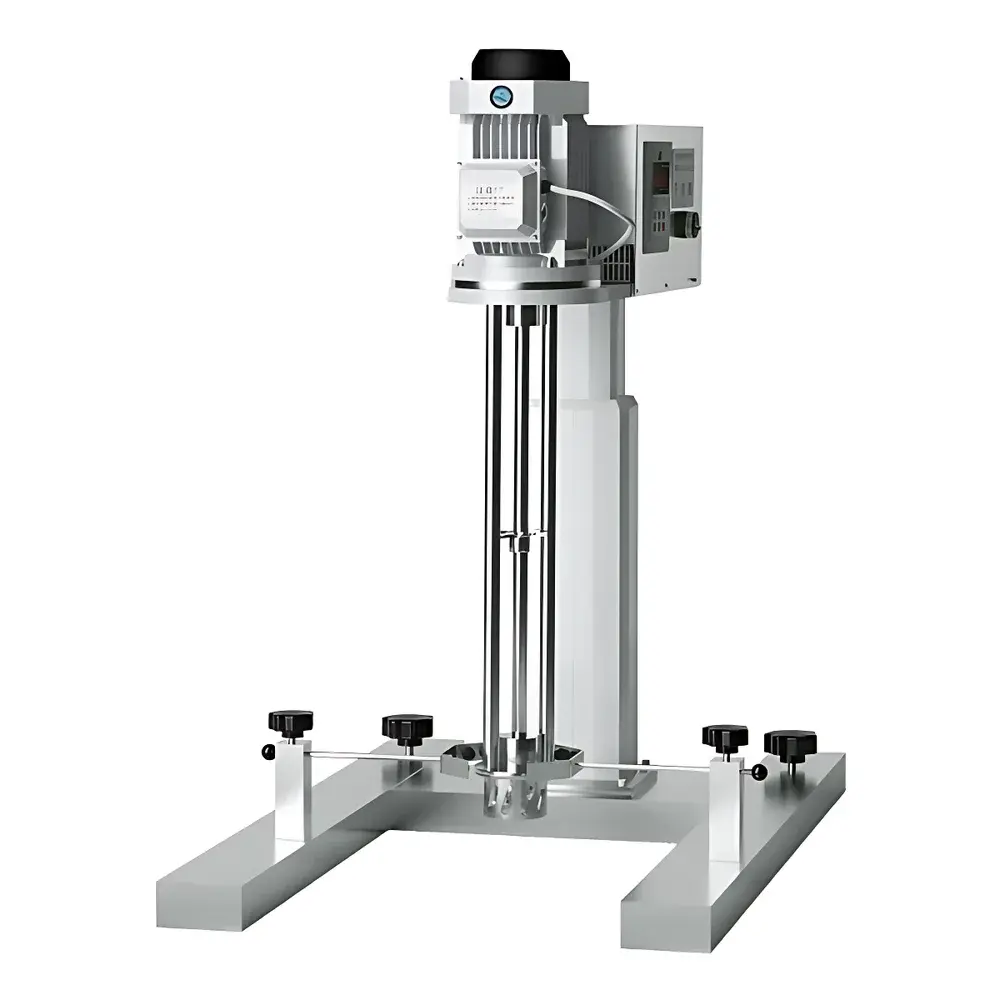
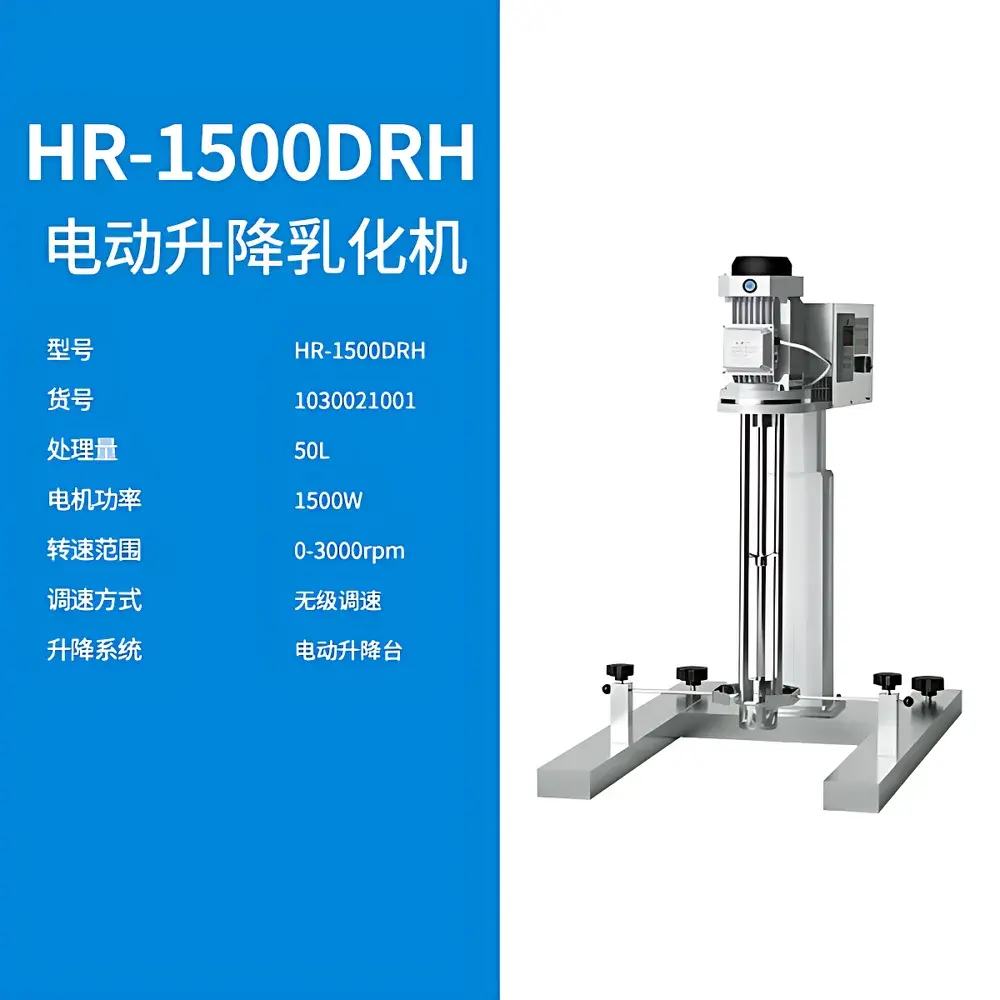
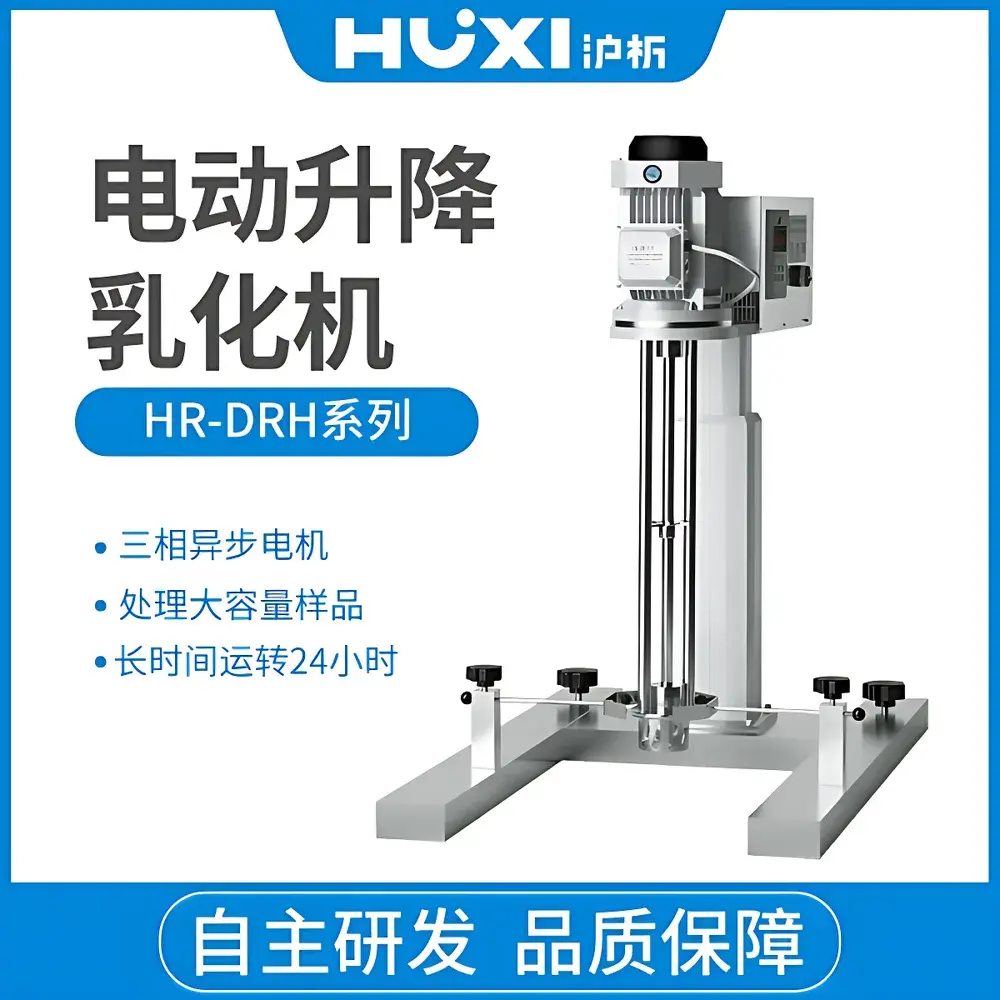
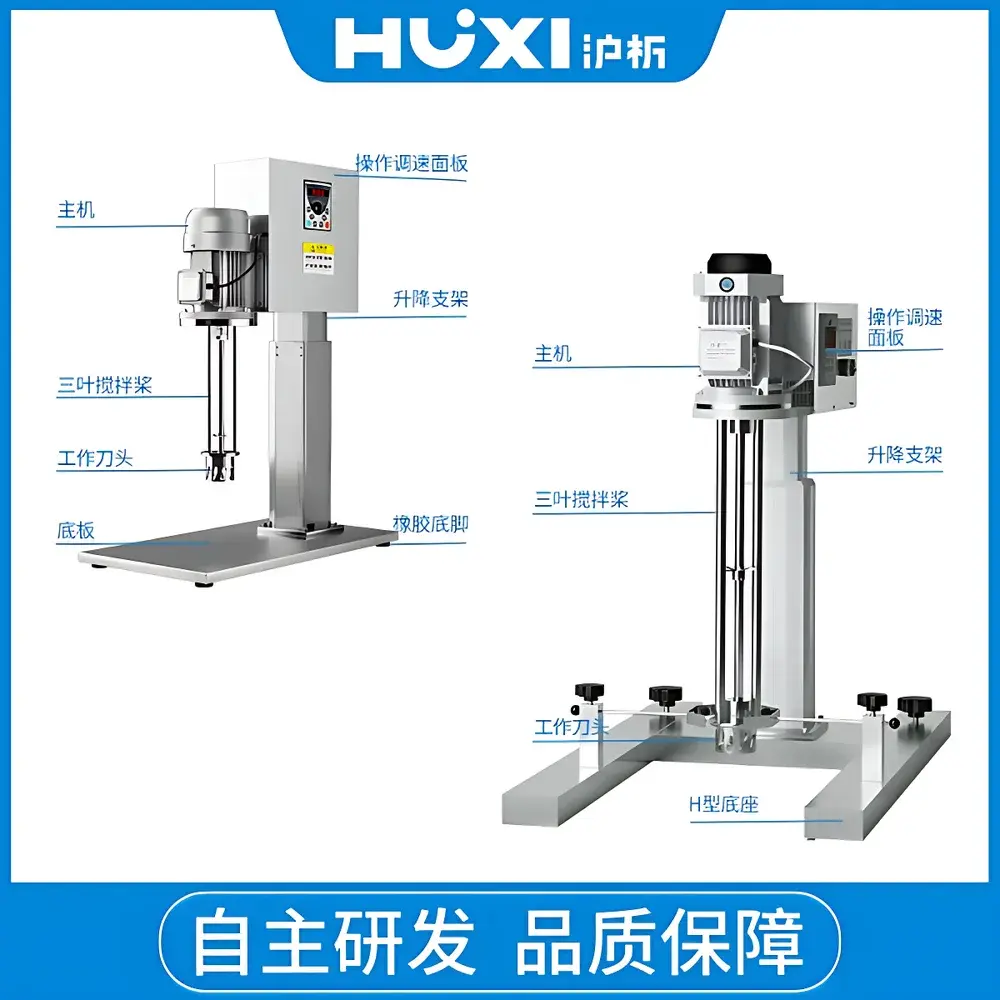
HUXI HR-1500DRH Electric-Lift High-Shear Homogenizer
| Brand | HUXI |
|---|---|
| Origin | Shanghai, China |
| Manufacturer Type | Direct Manufacturer |
| Country of Origin | China |
| Model | HR-1500DRH |
| Instrument Type | Probe-type Rotor-Stator Homogenizer |
| Dimensions (W×D×H) | 750×620×1050 mm |
| Maximum Processing Volume | 50 L |
| Motor Type | Three-Phase Asynchronous Motor |
| Power Rating | 1500 W |
| Speed Range | 0–3000 rpm |
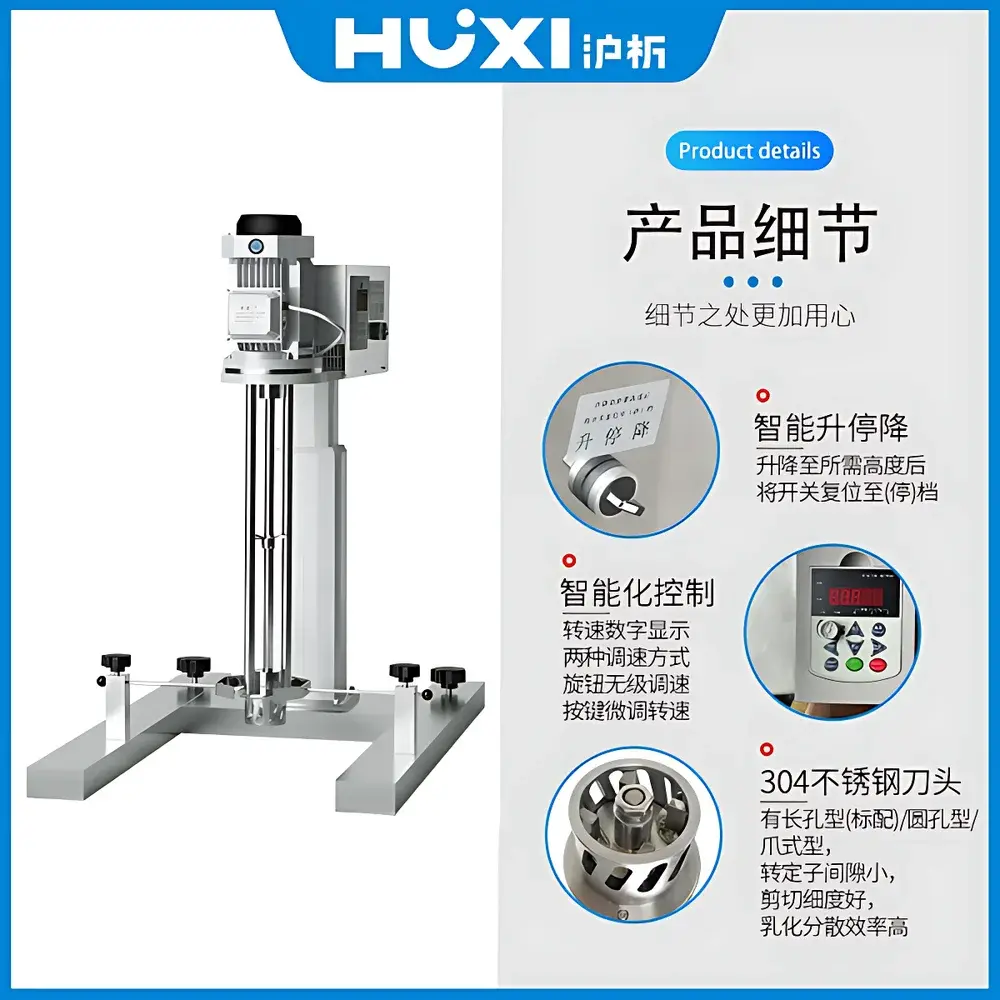
| Rotor-Stator Configuration | Slotted (Standard), Perforated, or Claw-Type |
| Lift Mechanism | Motorized Vertical Lift |
| Lift Stroke | 400 mm |
| Emulsifier Head Length | 670 mm |
| Height from Floor to Tip of Probe | 50–80 mm |
| Base Footprint | 395×420 mm |
| Housing Material | 304 Stainless Steel Enclosure |
| Optional Materials | 316L SS, Hastelloy®, Titanium-Molybdenum-Nickel Alloy |
Overview
The HUXI HR-1500DRH is a laboratory-scale, electric-lift high-shear rotor-stator homogenizer engineered for reproducible dispersion, emulsification, and particle size reduction in liquid–liquid and solid–liquid systems. It operates on the principle of intense mechanical shear generated within a precisely engineered rotor–stator gap, where fluid dynamics—including cavitation, turbulent flow, hydraulic shear, and localized high-velocity impact—induce rapid droplet breakup and particle deagglomeration. Unlike ultrasonic or magnetic stirrer-based systems, this device delivers scalable, process-relevant shear stress profiles suitable for formulation development, stability screening, and small-batch prototyping. Its design conforms to fundamental fluid mechanics principles governing laminar-to-turbulent transition in narrow annular gaps, enabling consistent energy input per unit mass across variable viscosities (up to 10,000 mPa·s with appropriate head selection). The system is intended for use under controlled ambient conditions (20–25 °C, non-corrosive atmosphere) and is not rated for continuous industrial operation but optimized for intermittent lab duty cycles up to 30 minutes per run.
Key Features
- Motorized vertical lift mechanism with 400 mm stroke enables precise probe immersion depth control and ergonomic operation without manual cranking or external supports.
- High-torque three-phase asynchronous motor (1500 W) delivers stable rotational speeds from 0 to 3000 rpm, supporting both low-shear blending and high-intensity homogenization protocols.
- Precision-machined rotor–stator assemblies—available in slotted, perforated, or claw configurations—are fabricated from forged stainless steel components processed via CNC milling to ensure sub-50 µm gap consistency and long-term dimensional stability.
- Modular head interchangeability allows rapid adaptation to material rheology: single-layer vessels for low-viscosity fluids (e.g., aqueous surfactant solutions), double-jacketed vessels for temperature-sensitive formulations requiring external cooling.
- 304 stainless steel enclosure with reinforced base frame ensures structural rigidity during high-load operation; optional construction materials include 316L SS, Hastelloy C-276, and Ti–Mo–Ni alloys for aggressive chemical environments.
- Programmable timer function enables automated run duration control with auto-shutdown, supporting GLP-compliant documentation of processing time per batch.
Sample Compatibility & Compliance
The HR-1500DRH accommodates a broad spectrum of sample types including suspensions (e.g., pigment dispersions, ceramic slurries), oil-in-water and water-in-oil emulsions (e.g., pharmaceutical nanoemulsions, cosmetic creams), tissue homogenates (up to 10% w/v mammalian soft tissue), and polymeric solutions. It is compatible with standard laboratory glass and stainless-steel containers ranging from 500 mL beakers to 50 L jacketed reactors. While not certified to IEC 61000-6-2/4 or ATEX directives by default, explosion-proof variants can be configured per customer specification. The equipment supports alignment with ISO 27307 (homogenizer performance testing), ASTM D3418 (thermal analysis of polymers prepared using high-shear mixing), and USP (light scattering assessment of lipid emulsion droplet size distribution). All contact surfaces meet FDA-compliant finish standards (Ra ≤ 0.8 µm) when specified with electropolished 316L options.
Software & Data Management
This model operates as a standalone analog-controlled instrument without embedded firmware or digital interface. Speed setting is adjusted via calibrated potentiometer; lift position is monitored visually using integrated scale markings. For traceability in regulated environments, users may integrate external data loggers (e.g., Omega OM-DAQPRO-5300) to record rpm, elapsed time, and thermal feedback from optional PT100 sensors mounted on double-jacketed vessels. Audit trails generated through such third-party systems comply with FDA 21 CFR Part 11 requirements when deployed with appropriate access controls and electronic signature validation. HUXI provides calibration certificates for speed accuracy (±2% full scale) and mechanical lift repeatability (±0.5 mm) upon request.
Applications
The HR-1500DRH serves critical roles across multiple R&D domains: preparation of nanoscale lipid carriers for oral and parenteral drug delivery; stabilization of agrochemical suspensions prior to spray-drying; development of high-gloss architectural coatings requiring submicron pigment dispersion; optimization of surfactant-mediated asphalt emulsions for cold-mix paving applications; and generation of uniform cell lysates for proteomic workflows. In food science laboratories, it facilitates rapid reconstitution of dairy protein isolates and homogenization of plant-based beverage bases containing insoluble fibers. Its ability to generate shear histories comparable to pilot-scale colloid mills makes it particularly valuable for scaling dispersion processes from benchtop to manufacturing.
FAQ
What is the maximum viscosity the HR-1500DRH can effectively process?
With appropriate rotor–stator geometry (e.g., wide-gap claw head) and reduced speed settings (<1200 rpm), the unit handles Newtonian fluids up to ~10,000 mPa·s; non-Newtonian samples require empirical optimization based on yield stress and power-law index.
Can the system be validated for GMP environments?
Yes—when equipped with optional electropolished 316L wetted parts, calibrated speed sensor, and external data logging, the configuration supports IQ/OQ protocols aligned with EU Annex 15 and ASTM E2500.
Is cooling integration available for extended operation?
Double-jacketed vessel compatibility enables connection to external chillers (e.g., Huber Ministat) for temperature maintenance between 5 °C and 40 °C during prolonged homogenization runs.
How is rotor–stator wear monitored and maintained?
Users inspect clearance using feeler gauges quarterly; replacement intervals depend on abrasive load—typically 500–1000 operating hours for standard 304 SS heads in low-abrasion applications.
Does HUXI provide application support for method development?
Yes—application engineers supply documented protocols for common matrices (e.g., silicone oil/water emulsions, titanium dioxide suspensions) and assist in selecting optimal head geometry, speed ramping profiles, and cycle repetition strategies.



