
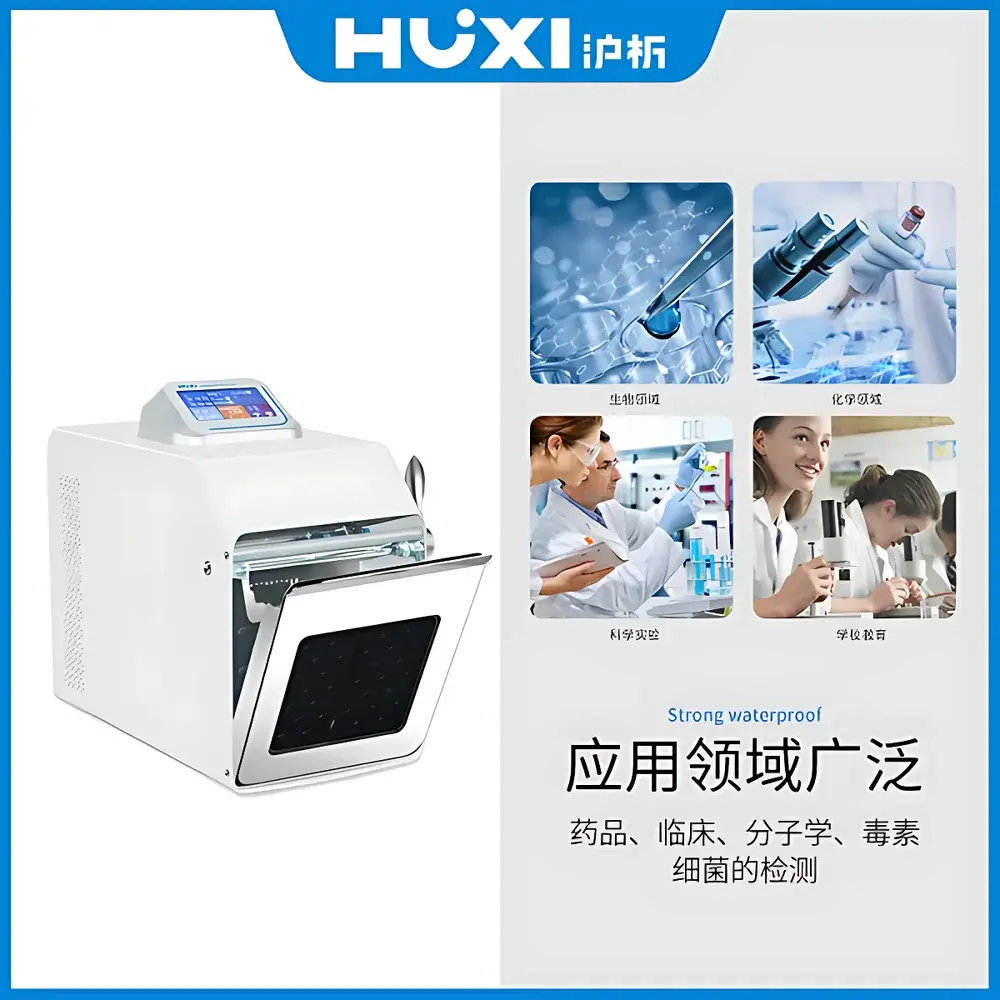
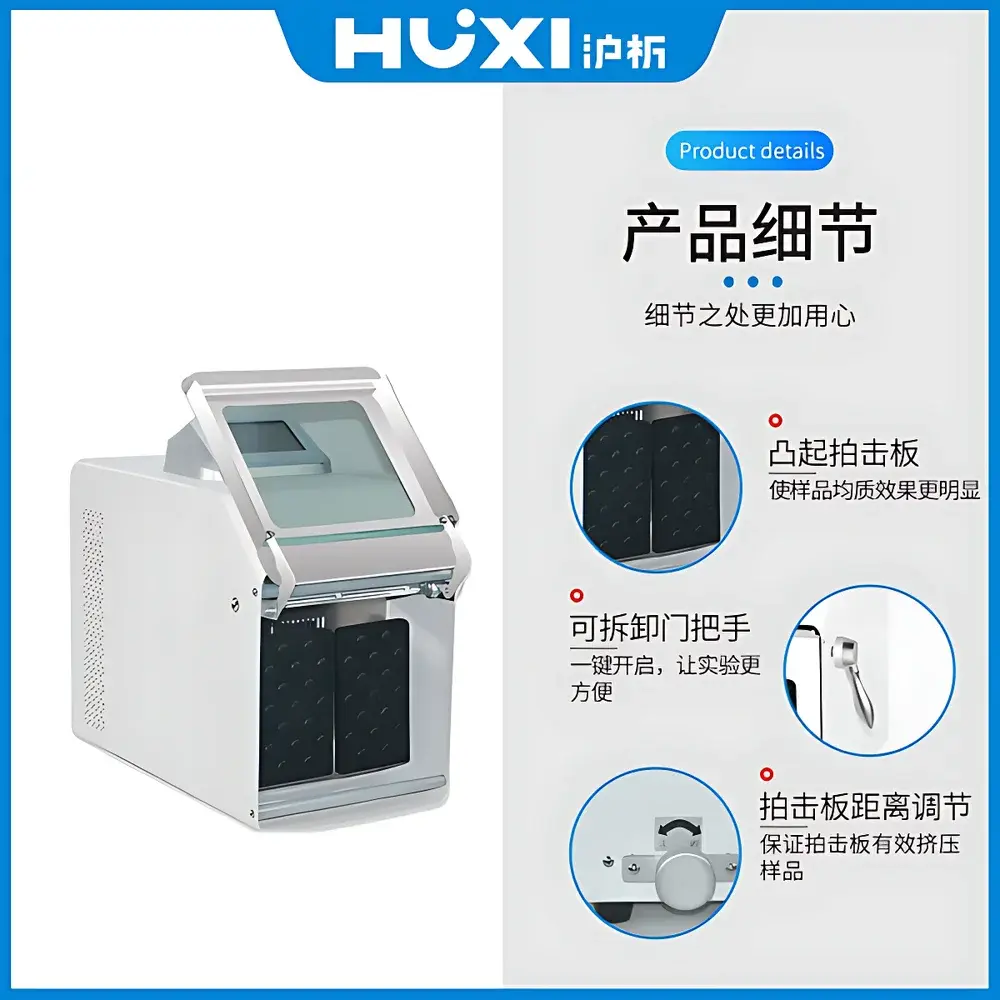
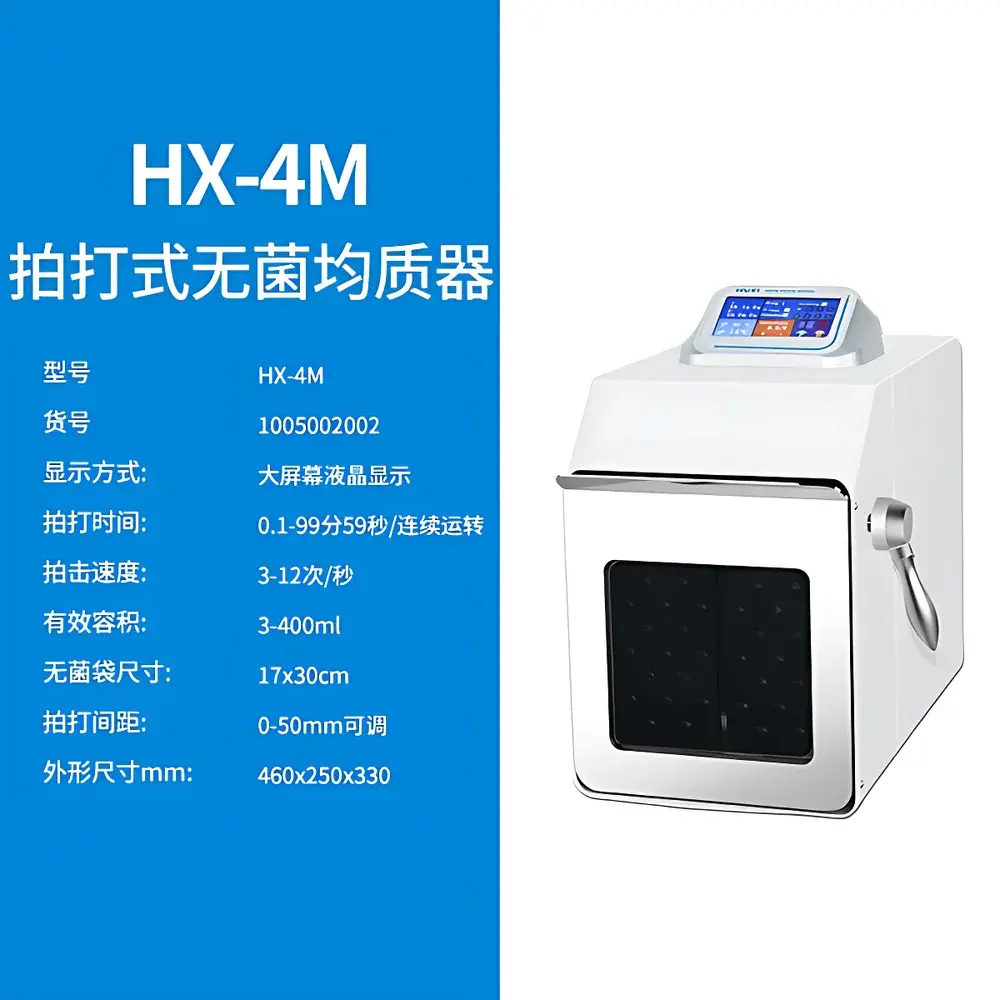
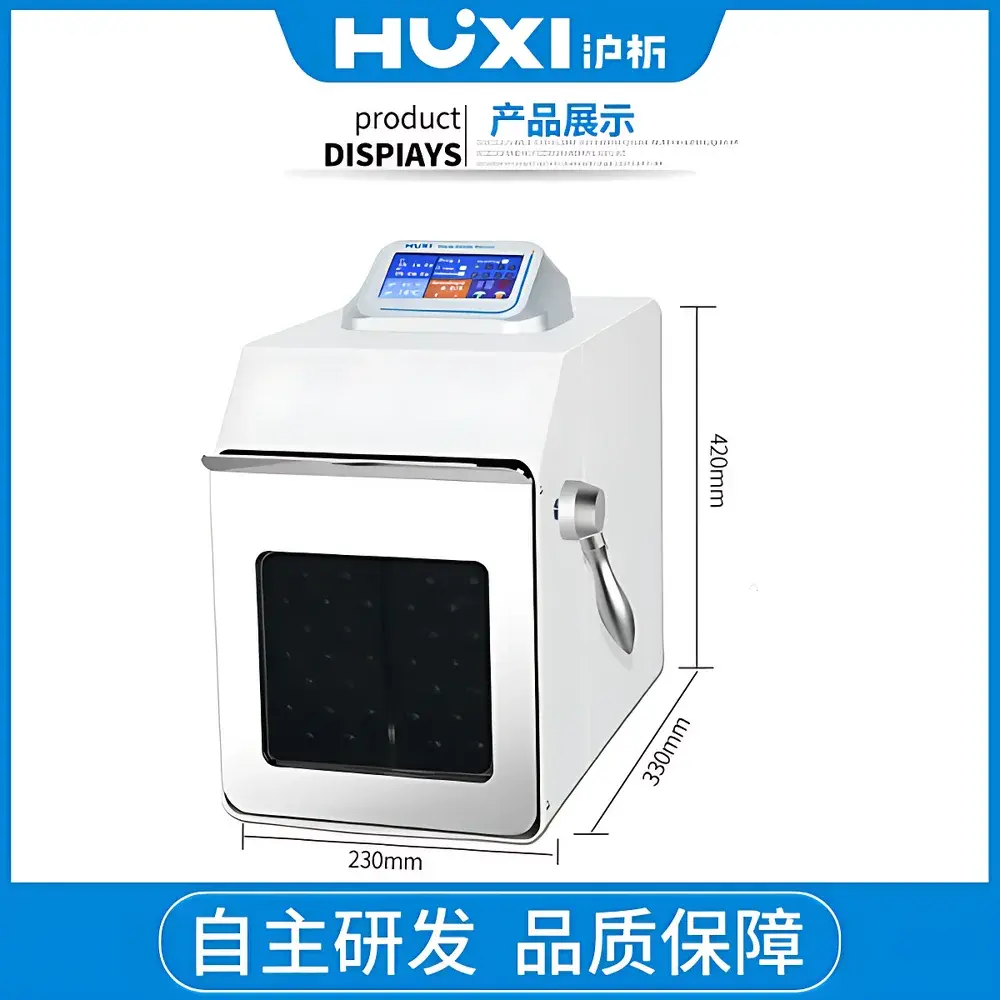
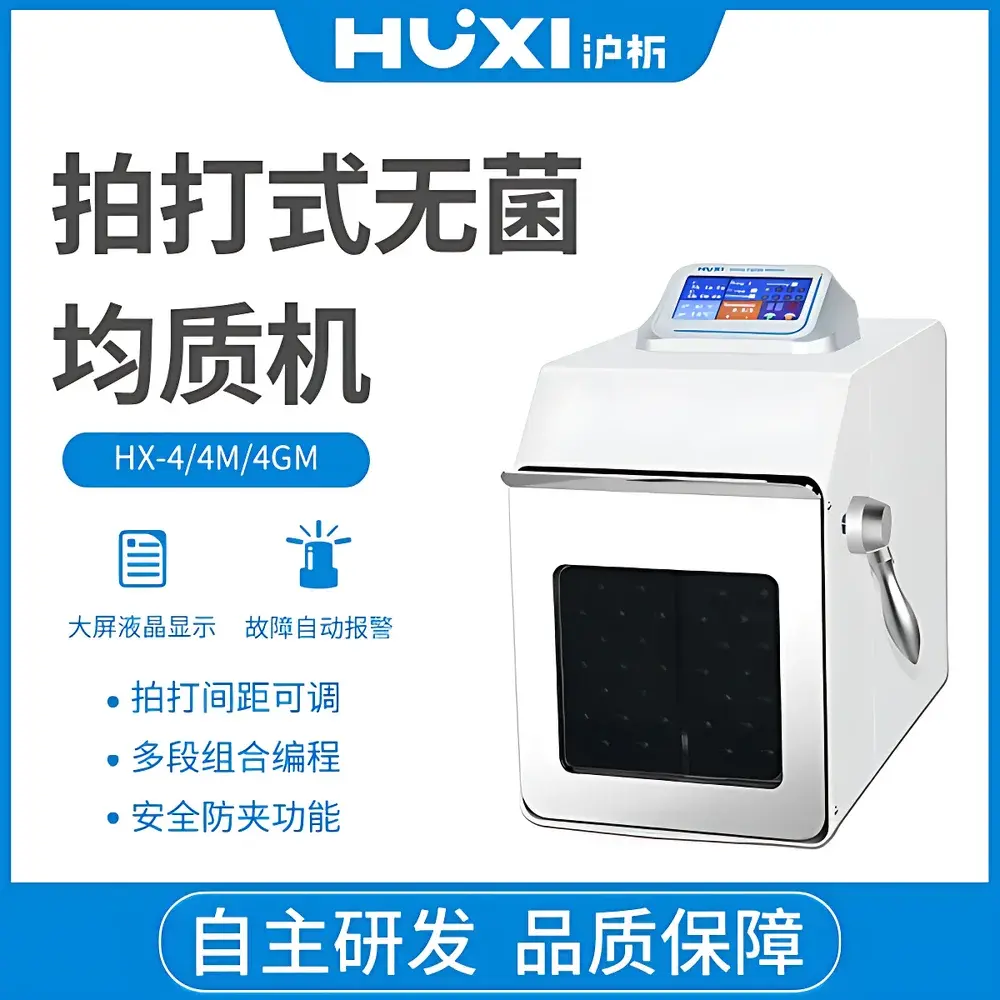
HUXI HX-4M Stomacher-Type Aseptic Homogenizer
| Brand | HUXI |
|---|---|
| Origin | Shanghai, China |
| Manufacturer | HUXI Instrument Co., Ltd. |
| Type | Stomacher (Paddle-Beating) Homogenizer |
| Model | HX-4M |
| Dimensions (W×D×H) | 420 × 230 × 330 mm |
| Sample Volume Range | 3–400 mL |
| Display | Large LCD Screen |
| Programmable Protocols | 8 user-defined programs |
| Beating Frequency | 3–12 beats/sec |
| Beating Time Range | 0.1 sec to 99 h 59 min 59 sec (or continuous mode) |
| Beating Gap Adjustment | 0–50 mm |
| UV Disinfection | 253.7 nm wavelength |
| Safety Features | Auto-stop anti-pinch, tempered glass viewing window, full-opening door, stainless steel + anti-corrosion coated chamber |
| Power Supply | 220 V / 220 W |
| Weight | 22 kg |
| Sterile Bag Size | 17 × 30 cm |
Overview
The HUXI HX-4M Stomacher-Type Aseptic Homogenizer is a precision-engineered laboratory instrument designed for the gentle, reproducible, and contamination-free homogenization of biological and food samples under aseptic conditions. Operating on the stomacher principle—where controlled mechanical beating of a sealed sample bag against rigid paddles generates shear and oscillatory forces—the HX-4M achieves uniform microbial dispersion without thermal degradation, cellular lysis artifacts, or cross-contamination. Unlike rotor-stator or probe-based homogenizers, this system isolates the sample entirely within a single-use sterile filter bag, eliminating direct contact between the specimen and instrument surfaces. This design fulfills critical requirements for microbiological testing workflows compliant with ISO 6887-1, FDA Bacteriological Analytical Manual (BAM), and USP /, where sample integrity, operator safety, and environmental containment are non-negotiable.
Key Features
- Gentle yet effective mechanical homogenization via adjustable paddle-beating frequency (3–12 beats/sec) and precisely timed cycles (0.1 sec to 99 h 59 min 59 sec), enabling optimization for fragile tissues, spore-rich matrices, or viscous suspensions.
- Eight programmable homogenization protocols stored in microprocessor memory—each configurable for beating speed, duration, pause intervals, and ramp-up profiles—supporting standardized SOP execution across shifts and operators.
- Full-opening front door with tempered glass viewport allows real-time visual monitoring and rapid access for bag loading/unloading; the stainless steel chamber with anti-corrosion coating ensures long-term durability in high-humidity or disinfectant-exposed lab environments.
- Integrated 253.7 nm UV-C germicidal lamp provides automated surface decontamination of the chamber interior between runs, reducing bioburden carryover and supporting GLP-compliant workflow hygiene.
- Comprehensive safety architecture includes auto-stop anti-pinch detection, soft-start motor control, and gap-adjustable beating plates (0–50 mm) to accommodate variable bag thicknesses and prevent over-compression of low-volume samples.
- No post-run cleaning required: as samples remain fully enclosed in disposable sterile bags (17 × 30 cm), the instrument avoids liquid ingress, aerosol generation, or residue buildup—minimizing downtime and validation burden.
Sample Compatibility & Compliance
The HX-4M accommodates a broad spectrum of solid and semi-solid matrices—including raw meat, fish fillets, leafy vegetables, dairy products, cosmetic emulsions, clinical swab eluates, and lyophilized bacterial cultures—within its 3–400 mL working volume range. Its aseptic operation meets key regulatory expectations for food safety labs (ISO/IEC 17025), pharmaceutical QC (ICH Q5C, EU Annex 1), and clinical microbiology (CLSI M02-A12). The use of certified sterile, DNAse/RNAse-free, low-binding polyethylene bags ensures compatibility with downstream molecular assays (qPCR, NGS library prep) and culture-based enumeration (plate counts, MPN). All mechanical and electrical components conform to IEC 61010-1 safety standards; CE marking applies for EU market deployment.
Software & Data Management
While the HX-4M operates via embedded microcontroller (no external PC dependency), its 8-program memory supports audit-ready traceability: each run logs timestamp, selected protocol ID, actual beating parameters, and UV cycle status to internal non-volatile memory. Optional RS-232 or USB-to-serial interface enables integration with LIMS or ELN systems for automated data export—facilitating 21 CFR Part 11 compliance when paired with electronic signature-enabled software platforms. Protocol files can be backed up externally, and parameter changes require administrator-level access to prevent unauthorized deviation from validated methods.
Applications
This homogenizer is routinely deployed in accredited food testing laboratories for pathogen enrichment (e.g., Salmonella, Listeria monocytogenes) per ISO 6579 and AOAC 990.12; in pharmaceutical R&D for tissue dissociation prior to host-cell protein analysis; in cosmetics QA for preservative efficacy testing (ISO 11930); and in academic research for microbiome sample preparation where cell viability and community structure preservation are essential. Its low-shear profile also supports mycotoxin extraction from cereals and endotoxin recovery from medical device rinsates—applications demanding minimal matrix disruption and maximal analyte release fidelity.
FAQ
Is the HX-4M suitable for processing heat-sensitive samples such as probiotics or live vaccines?
Yes—the stomacher mechanism generates negligible adiabatic heating; temperature rise in the bag remains typically below 2 °C even during extended cycles, preserving microbial viability and antigen integrity.
Can the instrument be validated for GMP environments?
Yes—its fixed mechanical design, programmable repeatability (CV < 3% for CFU recovery across replicates), and traceable parameter logging support IQ/OQ/PQ documentation; UV disinfection logs further strengthen cleaning validation packages.
What sterile bag specifications are recommended for optimal performance?
Use 17 × 30 cm polyethylene bags with integrated 100 µm nylon mesh filters; bags must be certified sterile (SAL 10⁻⁶), pyrogen-free, and compatible with aqueous and mild organic solvent systems (e.g., 0.1% Tween 80, peptone water).
Does the HX-4M meet noise emission standards for open-lab settings?
Yes—the fully enclosed chamber and vibration-dampened base reduce operational noise to ≤ 62 dB(A) at 1 m distance, complying with ISO 7779 and EU Directive 2000/14/EC for laboratory equipment.
How is calibration maintained over time?
No routine calibration is required—the beating frequency and timer are crystal-controlled and factory-trimmed; users perform periodic performance verification using standardized reference samples (e.g., Bacillus subtilis spore suspensions) per internal SOPs aligned with ISO/IEC 17025 clause 7.7.



