
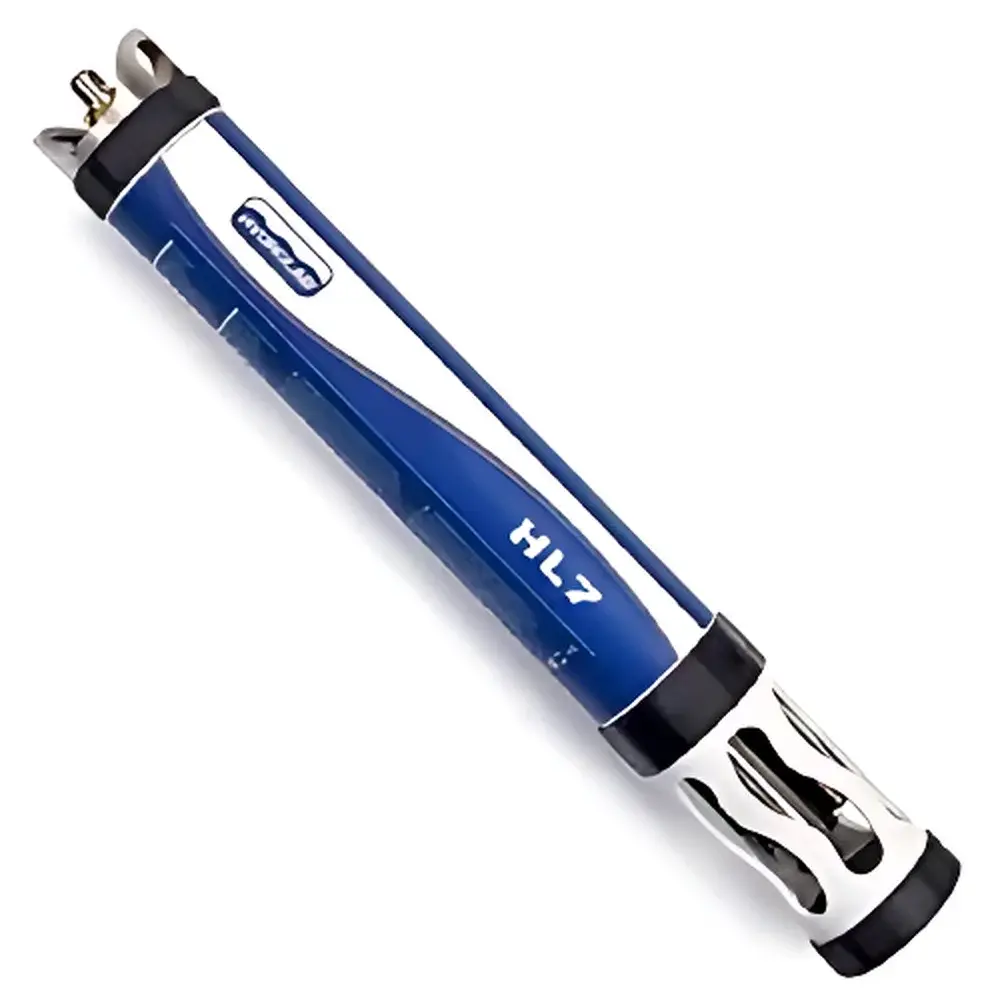

Hydrolab HL7 Multiparameter Water Quality Sonde
| Brand | OTT Hydromet |
|---|---|
| Origin | USA |
| Manufacturer Type | Authorized Distributor |
| Origin Category | Imported |
| Model | Hydrolab HL7 |
| Pricing | Upon Request |
Overview
The Hydrolab HL7 Multiparameter Water Quality Sonde is a field-deployable, high-integrity environmental monitoring platform engineered for long-term, unattended operation in diverse aquatic environments—including rivers, lakes, estuaries, coastal zones, groundwater wells, wastewater outfalls, and aquaculture systems. Built upon Hydrolab’s proven electrochemical and optical sensing architecture, the HL7 employs calibrated, factory-traceable sensors to simultaneously measure up to ten parameters in real time using a single, integrated probe body. Its measurement principle combines potentiometric (pH, ORP), conductometric (conductivity, salinity, TDS, resistivity), amperometric (dissolved oxygen), optical (turbidity, chlorophyll-a, phycocyanin/blue-green algae, Rhodamine WT), and ion-selective electrode (ammonium/ammonia, nitrate, chloride) methodologies—each sensor operating under NIST-traceable calibration protocols. Designed for regulatory-grade data collection, the HL7 supports continuous profiling and fixed-station deployments with pressure-compensated depth measurement and temperature stabilization across ±0.1 °C accuracy.
Key Features
- Modular sensor architecture with five dedicated optical sensor ports—enabling flexible configuration for site-specific monitoring needs including algal bloom detection, tracer studies, and nutrient loading assessment.
- Integrated central cleaning brush system that automatically sweeps optical windows and electrode surfaces at user-defined intervals, significantly reducing biofouling-induced drift and extending maintenance cycles in turbid or organically rich waters.
- Ruggedized titanium and PEEK housing rated to 300 m depth, IP68 ingress protection, and shock-resistant design validated per MIL-STD-810G for transport and deployment in remote or high-impact field conditions.
- Self-diagnostic firmware continuously monitors sensor health, battery voltage, memory status, and communication integrity—logging diagnostic events with timestamps for audit-ready traceability.
- Extended battery life: up to 90 days of continuous logging at 15-minute intervals using standard lithium-thionyl chloride cells, with optional external power integration for permanent installations.
- Durable reference electrode assembly for pH measurement featuring double-junction gel-filled electrolyte and ceramic frit junction—designed to minimize junction clogging and maintain stability in high-suspended-solids environments.
Sample Compatibility & Compliance
The HL7 is validated for direct immersion in freshwater, brackish water, seawater, wastewater effluents, and sediment-laden runoff. Sensor materials—including platinum black DO electrodes, glass pH bulbs with low-resistance membranes, and sapphire-windowed optical cells—are chemically inert to common environmental contaminants (e.g., H₂S, Fe²⁺, organic tannins). The instrument complies with ASTM D3370 (sampling and measurement of water quality parameters), ISO 5814 (electrochemical determination of dissolved oxygen), and US EPA Method 180.1 (turbidity). Data output formats support EPA WQX, SDMX, and CSV export; firmware includes configurable alarm thresholds and event-triggered sampling aligned with GLP and GMP documentation requirements.
Software & Data Management
Data acquisition and configuration are managed via Hydrolab’s FieldView™ desktop software (Windows/macOS), which provides intuitive sensor mapping, calibration curve management, QA/QC flagging, and metadata tagging (operator ID, location GPS, weather conditions). Raw sensor outputs include timestamped, temperature-compensated values with embedded uncertainty estimates per sensor specification sheet. All calibration events, firmware updates, and diagnostic logs are stored with cryptographic hash verification. For enterprise deployments, the HL7 integrates with OTT’s ecoLog® cloud platform—supporting 21 CFR Part 11-compliant electronic signatures, audit trails, role-based access control, and automated report generation compliant with state and federal reporting mandates (e.g., NPDES, TMDL).
Applications
- Regulatory compliance monitoring for NPDES permits, drinking water source protection, and wastewater discharge verification.
- Vertical profiling campaigns in stratified reservoirs and estuarine mixing zones using winch-deployed cable systems.
- Real-time cyanobacterial bloom early warning in recreational lakes and irrigation reservoirs.
- Tracer dilution studies using Rhodamine WT fluorescence quantification for hydraulic residence time estimation.
- Long-term wetland biogeochemical monitoring—including redox potential shifts during seasonal flooding and denitrification hotspots.
- Port and harbor sediment resuspension impact assessments via synchronized turbidity–chloride–DO correlation analysis.
FAQ
What is the maximum depth rating for the HL7 sonde?
The HL7 is rated for continuous operation to 300 meters water column (mwc) with optional high-pressure housing variants available for deeper applications.
Can the HL7 be used in highly turbid wastewater streams?
Yes—the central cleaning brush, combined with sapphire optical windows and corrosion-resistant sensor housings, enables reliable operation in suspended solids concentrations exceeding 1,000 mg/L.
Does the HL7 support remote telemetry integration?
Yes—via RS-485, SDI-12, or optional cellular/Iridium modem modules compatible with industry-standard SCADA protocols (Modbus RTU, DNP3).
How often does the pH sensor require recalibration in field use?
Under typical freshwater conditions, bi-weekly two-point calibration is recommended; in high-ionic-strength or sulfide-rich environments, weekly verification is advised per USGS NWIS protocols.
Is raw sensor data accessible for third-party modeling tools?
Yes—FieldView™ exports fully timestamped, unit-normalized CSV files with metadata headers; all variables adhere to CF (Climate and Forecast) conventions for interoperability with Python, R, and GIS platforms.
Related Products







