
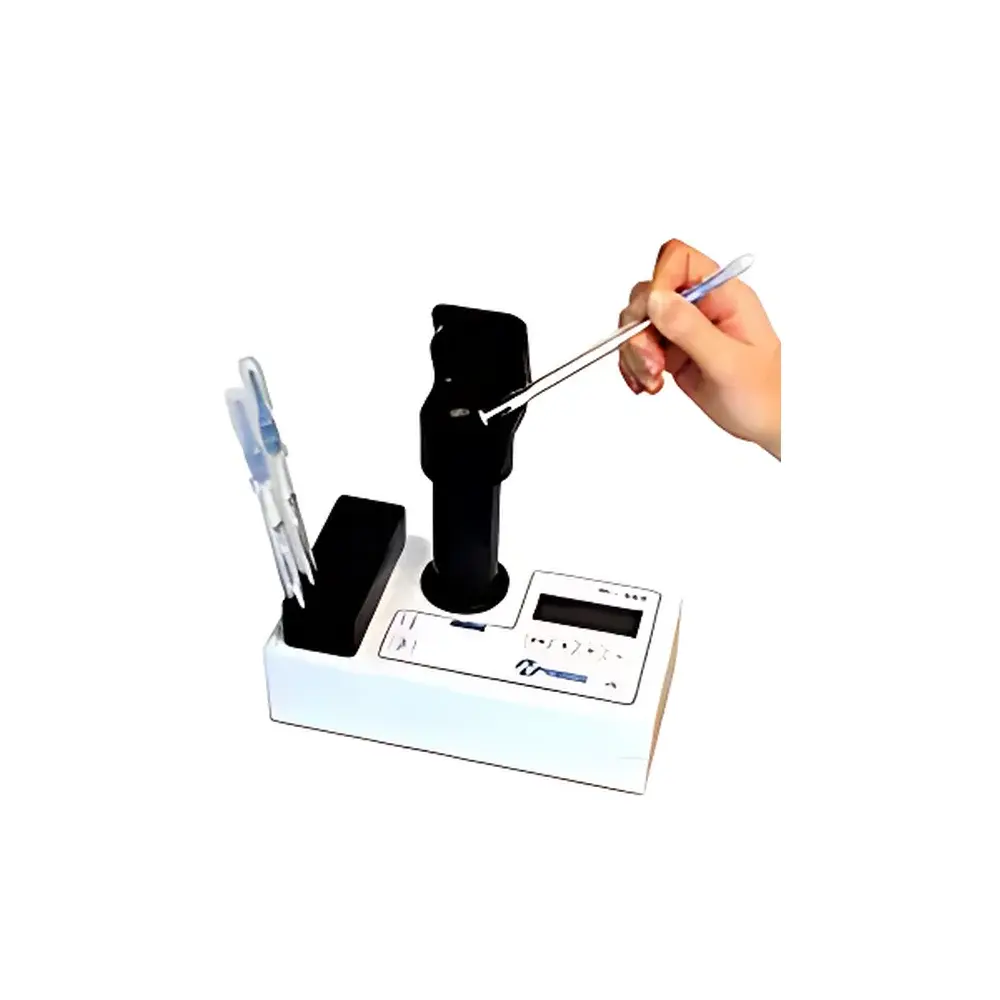
Hygiena Pi-102 ATP Bioluminescence Analyzer for Food and Water Microbial Monitoring
| Brand | Hygiena |
|---|---|
| Origin | USA |
| Model | Pi-102 |
| Detection Limit | 1 × 10⁻¹⁸ mol ATP/assay |
| Measurement Time | Adjustable from 0.2 to 100 s (default 5 s) |
| Output Units | RLU (Relative Light Units) and fg (femtograms of bacterial ATP) |
| Memory Capacity | 800 stored results with category tagging |
| Display | LCD |
| Dimensions | 208 × 105 × 57 mm (L × W × H) |
| Weight | 1.5 kg |
| Measurement Range | 0–3,000,000 RLU |
| Accuracy | ±5% |
| Power Supply | Rechargeable Ni/Cd battery + AC adapter |
| Connectivity | Real-time data transmission to PC via USB |
Overview
The Hygiena Pi-102 ATP Bioluminescence Analyzer is a laboratory-grade, benchtop instrument engineered for quantitative assessment of total microbial load in food, water, and environmental surface samples through adenosine triphosphate (ATP) bioluminescence detection. Based on the luciferin–luciferase enzymatic reaction—where ATP serves as the essential cofactor for light emission—the Pi-102 measures photon output proportional to intracellular ATP concentration. This principle enables rapid estimation of viable microbial biomass (not species-specific identification), providing an objective, culture-independent metric correlated with hygiene status and process control efficacy. Unlike conventional plate count methods requiring 24–72 h incubation, the Pi-102 delivers results within minutes following standardized sample preparation, making it suitable for high-throughput quality assurance labs, regulatory inspection units, and production-floor verification workflows.
Key Features
- Ultra-high sensitivity detection limit of 1 × 10⁻¹⁸ mol ATP per assay—approximately three orders of magnitude more sensitive than handheld alternatives such as the SystemSURE Plus.
- Integrated high-gain photomultiplier tube (PMT) optimized for low-light signal capture, ensuring reproducible quantification across low-biomass samples including potable water, rinse water, and lightly contaminated surfaces.
- Configurable measurement duration (0.2–100 s) and dual reporting modes: RLU (instrument-calibrated relative light units) and fg (femtograms of bacterial ATP), enabling direct comparison against internal calibration curves or published reference thresholds.
- Onboard memory stores up to 800 test results with user-defined categorization (e.g., “Production Line A”, “Post-CIP Rinse”, “Raw Material Lot #2024-089”), supporting traceability and audit readiness.
- Robust architecture compliant with ISO 22000, HACCP, and FDA Food Safety Modernization Act (FSMA) preventive controls frameworks; validated for use with Hygiena’s FDA-registered reagent kits—including Ultrasnap™ (general surface/food) and Aquasnap™ (aqueous matrices).
- USB interface supports real-time data streaming to Windows-based analysis software for automated report generation, statistical trend analysis, and integration into LIMS or electronic batch record systems.
Sample Compatibility & Compliance
The Pi-102 accommodates liquid (e.g., water, milk, broth), solid (e.g., meat, produce, dairy products), and swab-eluate samples after standardized extraction and ATP stabilization protocols. Sample processing requires use of Hygiena-certified reagents to eliminate extracellular ATP interference and lyse microbial cells efficiently while inhibiting endogenous ATPases. The system complies with ASTM E2631–23 (“Standard Practice for Use of ATP Bioluminescence for Microbial Monitoring in Food Processing Environments”) and aligns with guidance documents issued by the U.S. FDA Center for Food Safety and Applied Nutrition (CFSAN) and the European Union’s EFSA Scientific Opinion on hygiene monitoring tools. While not classified as a medical device under 21 CFR Part 809, the instrument and its associated reagents are manufactured under cGMP conditions and registered with the U.S. FDA (License No. 2023790) and California Department of Public Health (License No. 61193).
Software & Data Management
Data acquisition and management are supported via Hygiena’s proprietary BioTrack™ desktop application (Windows-compatible), which provides GLP-compliant audit trails, user access controls, electronic signature capability, and 21 CFR Part 11–ready configuration options. All measurements include timestamp, operator ID, sample ID, assay parameters, and raw RLU/fg values. Export formats include CSV, PDF, and XML for integration with enterprise quality management systems (QMS). Historical datasets can be filtered by date range, location, or critical control point (CCP), facilitating root-cause analysis and CAPA documentation.
Applications
- Routine verification of sanitation effectiveness post-clean-in-place (CIP) or manual cleaning cycles in food processing facilities.
- Microbial load screening of incoming raw materials (e.g., fresh produce, dairy ingredients, seafood) prior to further processing.
- Monitoring of potable water systems, cooling towers, and wastewater effluents in compliance with EPA Method 1603 and ISO 9308-1.
- Validation of sterilization and disinfection protocols in pharmaceutical manufacturing cleanrooms and hospital environmental services departments.
- Supporting environmental monitoring programs required under USP , ISO 14644-2, and EU GMP Annex 1.
FAQ
Is the Pi-102 suitable for detecting specific pathogens such as E. coli or Salmonella?
No—the Pi-102 measures total ATP-derived bioluminescence, which correlates with overall viable microbial burden but does not differentiate taxonomic groups. For pathogen-specific identification, orthogonal methods (e.g., PCR, immunoassay, or culture enrichment) must be employed.
How does ATP-based testing compare to traditional colony-forming unit (CFU) enumeration?
ATP assays reflect metabolically active biomass and yield results in minutes versus days required for CFU counts. However, ATP levels vary by organism type, growth phase, and stress response; therefore, Pi-102 outputs serve as rapid indicators—not absolute CFU equivalents—and require correlation with historical lab data to establish site-specific action limits.
Can the Pi-102 be used in regulated GMP environments?
Yes—when operated with documented procedures, calibrated reagents, and configured with BioTrack™ software enabled for audit trail and electronic signature features, the Pi-102 meets key elements of FDA 21 CFR Part 11 and EU Annex 11 requirements for computerized system validation.
What maintenance is required for long-term accuracy?
Annual PM (preventive maintenance) is recommended, including PMT gain calibration using Hygiena’s certified ATP standards, optical path cleaning, and firmware updates. Daily verification using control swabs ensures ongoing performance consistency.
Does the instrument require external certification for ISO/IEC 17025 accreditation?
While the Pi-102 itself is not accredited, laboratories may include it within their scope of accreditation by validating method performance per ISO/IEC 17025:2017 Clause 7.2.2 and documenting uncertainty contributions from instrumentation, reagents, and operator technique.





