
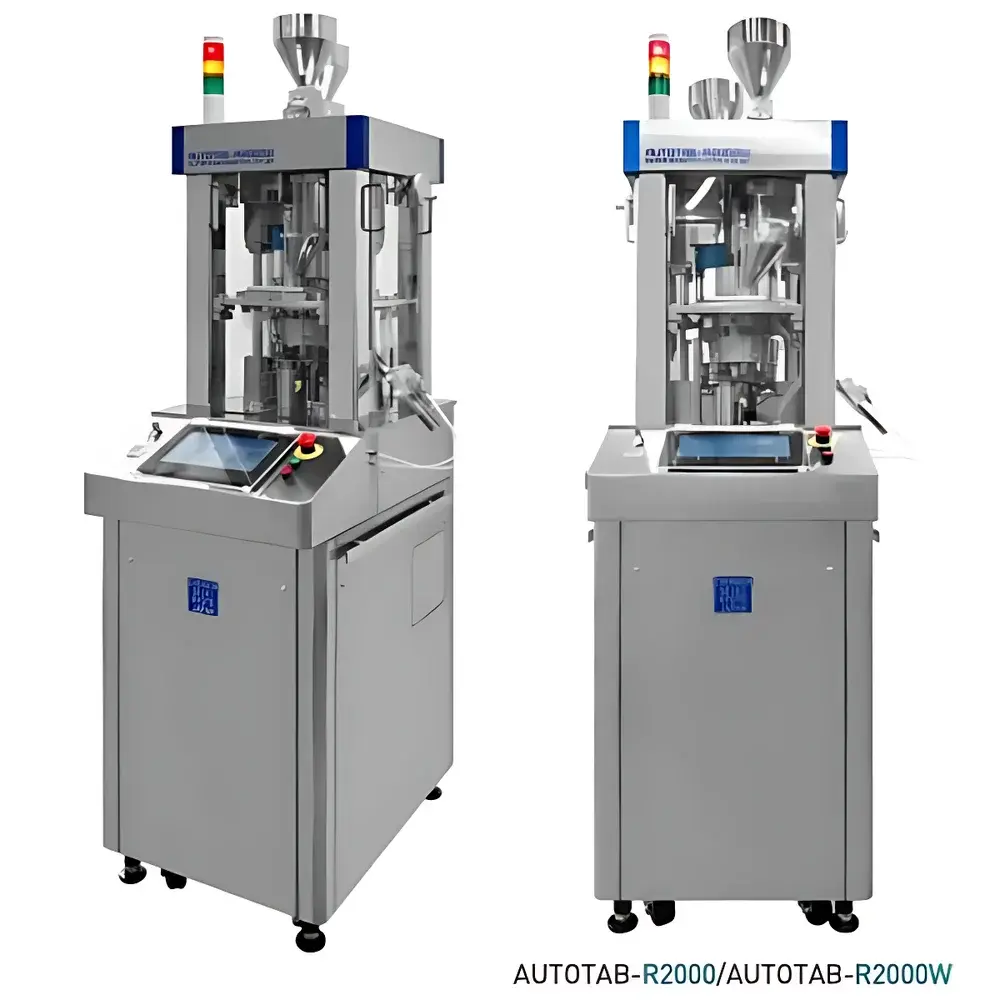
Ichihashi Seiki AUTOTAB-R2000 Series Fully Automated Rotary Tablet Press
| Brand | Ichihashi Seiki |
|---|---|
| Origin | Japan |
| Model | AUTOTAB-R2000 / AUTOTAB-R2000W |
| Max Compression Force | Pre-compression 12 kN / Main compression 40 kN |
| Max Tablet Diameter | 20 mm (R2000), 16 mm (R2000W) |
| Max Fill Depth | 18 mm (single-layer), 8 mm (second-layer for R2000W) |
| Max Output | 12,600–16,200 tablets/hour |
| Turret Speed | up to 30 rpm |
| Punch Standard | TSM/IPT (EU-B: 7 stations, EU-D: 9 stations) |
| Control Interface | 10-inch industrial touchscreen HMI |
| Weight | 580–600 kg |
| Dimensions (W×D×H) | 620 × 870 × 1930 mm |
| Power Supply | 3-phase 380 V AC |
| Motor Rating | 2.2 kW |
Overview
The Ichihashi Seiki AUTOTAB-R2000 Series is a fully automated rotary tablet press engineered for precision, reproducibility, and operational flexibility in regulated laboratory and pilot-scale manufacturing environments. Designed according to core principles of mechanical compression dynamics and powder flow rheology, the system operates on a dual-stage compression principle—pre-compression followed by main compression—to ensure uniform density distribution and minimize capping or lamination in fragile formulations. Its compact turret design (200 mm diameter) enables high-resolution control over dwell time, compression force, and fill depth while maintaining compliance with international pharmaceutical engineering standards. The press supports both single-layer (AUTOTAB-R2000) and double-layer (AUTOTAB-R2000W) tablet production without hardware reconfiguration—making it suitable for formulation development, stability batch runs, and small-batch GMP-compliant manufacturing.
Key Features
- Integrated forced-feeding and mixing hopper: Continuously agitates and homogenizes powder during feed, improving flowability and fill consistency—critical for low-density or cohesive APIs.
- TSM/IPT-standard punch compatibility: Supports EU-B (7-station) and EU-D (9-station) configurations; maximum punch tip diameters of 16 mm (B-type) and 20 mm (D-type), enabling broad formulation scalability.
- Real-time automatic weight control: Monitors main compression force deviation and dynamically adjusts fill volume via feeder cam positioning—reducing tablet weight variation (RSD < 3% typical under optimized conditions).
- NG rejection logic: Detects out-of-spec compression force events and diverts defective tablets to a dedicated reject chute, supporting statistical process control (SPC) and 100% in-process monitoring.
- 20-program memory with user authentication: Stores complete parameter sets—including turret speed, pre/main pressure setpoints, fill depth, ejection height, and dwell time—each linked to operator ID and timestamped audit logs.
- Modular dust extraction interface (R2000W): Integrates seamlessly with optional Ichihashi vacuum dust collectors to prevent inter-layer contamination during bilayer compression—essential for incompatible actives or functional layering.
- Mobile base with industrial casters: Total unit mass ≤ 600 kg allows repositioning within ISO Class 7/8 cleanrooms or shared lab spaces without structural anchoring.
Sample Compatibility & Compliance
The AUTOTAB-R2000 series accommodates a wide range of powder-based materials—including pharmaceutical actives and excipients (e.g., microcrystalline cellulose, lactose monohydrate, dibasic calcium phosphate), nutraceutical blends, catalyst precursors, ceramic green bodies, and agricultural granules. It meets mechanical and electrical safety requirements per IEC 61000-6-2/6-4 and conforms to JIS B 8701 (Japanese standard for tablet presses). While not certified as a Class A GMP production system out-of-the-box, its architecture supports qualification protocols aligned with ASTM E2500-23 (Good Practice in Verification and Validation), USP (Mechanical Qualification of Compression Equipment), and Annex 15 (IQ/OQ/PQ) frameworks. Data integrity features—including password-protected access, electronic signatures, and immutable operation logs—facilitate alignment with FDA 21 CFR Part 11 and EU Annex 11 expectations when deployed in validated environments.
Software & Data Management
The 10-inch industrial touchscreen HMI runs a deterministic real-time control OS with no general-purpose OS dependencies. All operational parameters are configured through intuitive graphical menus—no programming knowledge required. Process data (compression force profiles, fill volume adjustments, reject counts, cycle timing) are logged at 10 Hz resolution and exportable via USB or Ethernet to CSV or SQLite formats. Audit trails record every parameter change, login/logout event, and program execution with SHA-256 hashed timestamps. Optional OPC UA server integration enables direct connectivity to MES/LIMS platforms for centralized batch record compilation and SPC dashboarding.
Applications
- Pharmaceutical R&D: Rapid prototyping of immediate-release, sustained-release, and bilayer tablets; excipient compatibility screening; compaction behavior analysis (Heckel, Kawakita modeling).
- Nutraceutical manufacturing: Production of vitamin-mineral complexes, probiotic tablets, and herbal extract compacts under cGMP-aligned workflows.
- Materials science: Preparation of ceramic green compacts for sintering studies; catalyst pelletization for fixed-bed reactor testing.
- Chemical industry: Tabletting of fertilizer blends, pigment carriers, and controlled-release agrochemical formulations.
- Academic research: Teaching platform for powder technology, solid dosage form engineering, and process analytical technology (PAT) implementation.
FAQ
What punch standards does the AUTOTAB-R2000 support?
It accepts TSM/IPT-compliant punches per EU-B (7-station) and EU-D (9-station) specifications, with maximum tip diameters of 16 mm and 20 mm respectively.
Can the machine switch between single-layer and double-layer compression without hardware changes?
Yes—the AUTOTAB-R2000W model includes dual-feed mechanisms and programmable second-layer fill control; the R2000 base model is single-layer only.
Is the system compatible with regulatory data integrity requirements?
Its embedded audit trail, user authentication, and tamper-evident logging meet foundational criteria for 21 CFR Part 11 and Annex 11—though site-specific validation remains the user’s responsibility.
What is the maximum allowable tablet weight variation under automatic weight control mode?
Typical weight RSD is ≤3% for well-flowing formulations; performance depends on powder compressibility, particle size distribution, and feeder calibration.
Does the system include preventative maintenance alerts?
Yes—motor current monitoring, turret vibration thresholds, and lubrication interval timers trigger visual warnings on the HMI and log entries in the audit trail.






