
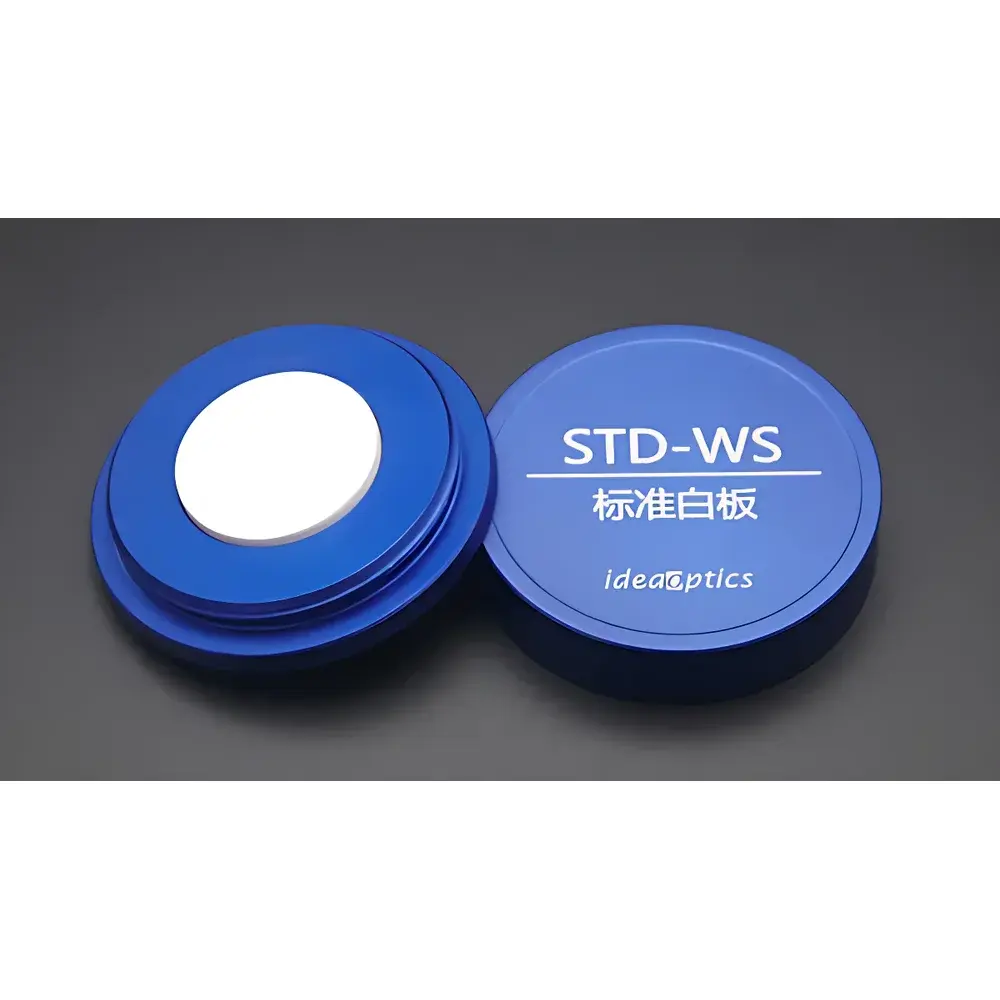
IdeaOptics STD-M Standard Aluminum Mirror
| Brand | IdeaOptics |
|---|---|
| Origin | Shanghai, China |
| Manufacturer Type | Manufacturer |
| Product Category | Optical Component |
| Model | STD-M |
| Coating | Protected Aluminum (Al + SiO₂) |
| Spectral Range | 200–2500 nm |
| Avg. Reflectance | >95% (250–2500 nm) |
| Substrate Material | Fused Silica or BK7 (customizable) |
| Surface Flatness | λ/10 @ 633 nm |
| Surface Quality | 20–10 scratch-dig |
| Clear Aperture | ≥90% of diameter |
| Mounting | Threaded aluminum housing with M25×0.75 or custom thread |
| Operating Temperature | –20 °C to +80 °C |
| Compliance | ISO 10110-7, MIL-C-48497A (aluminum coating), RoHS |
Overview
The IdeaOptics STD-M Standard Aluminum Mirror is a precision-engineered optical reference component designed for quantitative reflectance calibration across the ultraviolet, visible, and near-infrared (UV-Vis-NIR) spectral range (200–2500 nm). It employs thermally evaporated high-purity aluminum deposited onto an optically polished substrate—typically fused silica or BK7—and protected by a durable, stoichiometric silicon dioxide (SiO₂) overcoat. This architecture ensures long-term spectral stability, minimizes oxidation-induced degradation, and maintains high specular reflectance (>95% average across 250–2500 nm) under controlled laboratory conditions. Unlike bare aluminum mirrors, the STD-M’s dielectric protection layer preserves reflectance integrity in ambient environments without requiring inert gas purging or vacuum storage. Its primary metrological function is to serve as a traceable, high-fidelity specular reflectance standard in reflectance measurement setups—especially when integrated with integrating spheres (e.g., IdeaOptics IS-Series), spectrophotometers, or bidirectional reflectance distribution function (BRDF) goniometers.
Key Features
- Protected aluminum coating delivering >95% average specular reflectance from 250 nm to 2500 nm, with peak performance exceeding 98% in the NIR (800–2500 nm)
- Dual-layer architecture: high-purity Al film (≥99.999%) + stoichiometric SiO₂ anti-oxidation barrier (≥120 nm thickness), conforming to MIL-C-48497A coating specifications
- Optically polished substrate (fused silica standard; BK7 optional) with surface flatness ≤λ/10 @ 633 nm and surface quality rated 20–10 per ISO 10110-7
- Threaded aluminum housing (M25×0.75 standard) featuring blue anodized finish for thermal stability (operational range: –20 °C to +80 °C) and mechanical robustness
- Clear aperture ≥90% of nominal diameter, enabling efficient coupling with collimated or focused beams in calibration-grade optical paths
- No intrinsic fluorescence or photoluminescence—critical for low-stray-light applications such as UV reflectance quantification of photoresists and thin-film coatings
Sample Compatibility & Compliance
The STD-M mirror is compatible with standard optical breadboards, kinematic mounts, and integrating sphere ports (e.g., IS-30, IS-60, IS-100 series). Its spectral response is validated against NIST-traceable reference standards using double-beam spectrophotometry under ISO/IEC 17025-accredited conditions. The coated surface meets RoHS Directive 2011/65/EU requirements and complies with ISO 9022-3 (environmental testing: humidity resistance) and ISO 9211-4 (optical coatings: abrasion and adhesion testing). For regulated environments—including GLP-compliant materials characterization labs—the STD-M supports documented calibration workflows aligned with ASTM E275, ISO 13468-2 (plastic film reflectance), and USP (spectrophotometric reflectance validation).
Software & Data Management
While the STD-M is a passive optical standard and requires no embedded firmware or drivers, its use is fully supported within IdeaOptics’ OASIS™ software suite (v4.2+). OASIS enables automated reflectance ratio calculations (sample/STD-M), spectral baseline correction, and uncertainty propagation based on user-defined measurement parameters (integration time, slit width, detector gain). Raw spectral data are exportable in ASTM E131-compliant .jdx format and CSV, ensuring interoperability with third-party analysis platforms including MATLAB, Python (SciPy/NumPy), and LabVIEW-based DAQ systems. Audit trails—including date/time stamps, operator ID, and instrument configuration logs—are retained per FDA 21 CFR Part 11 requirements when deployed in validated GxP environments.
Applications
- Calibration of reflectance measurements for photoresist films, anti-reflective coatings, and functional optical thin films (e.g., TiO₂, ITO, SiNₓ)
- Reference standard in BRDF and BTDF characterization of structured surfaces and micro-optical elements
- Baseline correction in UV-Vis-NIR spectroscopy of pigmented polymers, solar absorber materials, and semiconductor wafers
- Validation of integrating sphere system throughput and geometric collection efficiency (per CIE 130-1999)
- Traceable reflectance transfer between laboratory spectrophotometers and field-deployable hyperspectral imagers
FAQ
What is the certified uncertainty of the STD-M’s reflectance value?
The STD-M does not carry a factory-certified absolute reflectance uncertainty. Instead, it is characterized relative to NIST SRM 2036 (Aluminum Mirror) and calibrated using a double-monochromator spectrophotometer traceable to NIST. Typical relative measurement uncertainty in routine lab use is ±0.3% (k=2) for wavelengths >300 nm.
Can the STD-M be used below 250 nm?
No. Below 250 nm, unprotected aluminum exhibits rapid oxidation and reduced reflectance; even with SiO₂ protection, the coating shows increased absorption and potential bandgap limitations. For deep-UV applications (<200 nm), magnesium fluoride-coated aluminum or lithium fluoride substrates are recommended.
Is the substrate material customizable?
Yes. Standard delivery uses fused silica for UV transmission and thermal stability. BK7 glass is available upon request for cost-sensitive Vis-NIR applications. CaF₂ and sapphire substrates are offered for specialized IR or high-power laser compatibility (lead time applies).
How should the STD-M be cleaned?
Use only spectroscopic-grade acetone or isopropanol applied with lint-free optical wipes (e.g., Texwipe TX609). Avoid ultrasonic cleaning, abrasive solvents, or direct finger contact. Refer to ISO 10110-7 cleaning protocols for Class 1000 cleanroom handling.
Does the aluminum housing affect thermal drift during long-term measurements?
The anodized aluminum housing exhibits a coefficient of thermal expansion (CTE) of ~23 × 10⁻⁶ /°C, closely matched to BK7 and fused silica substrates. Bench testing shows <0.02% reflectance drift over 2-hour thermal soak at 40 °C—within acceptable limits for most reflectance intercomparisons.




