
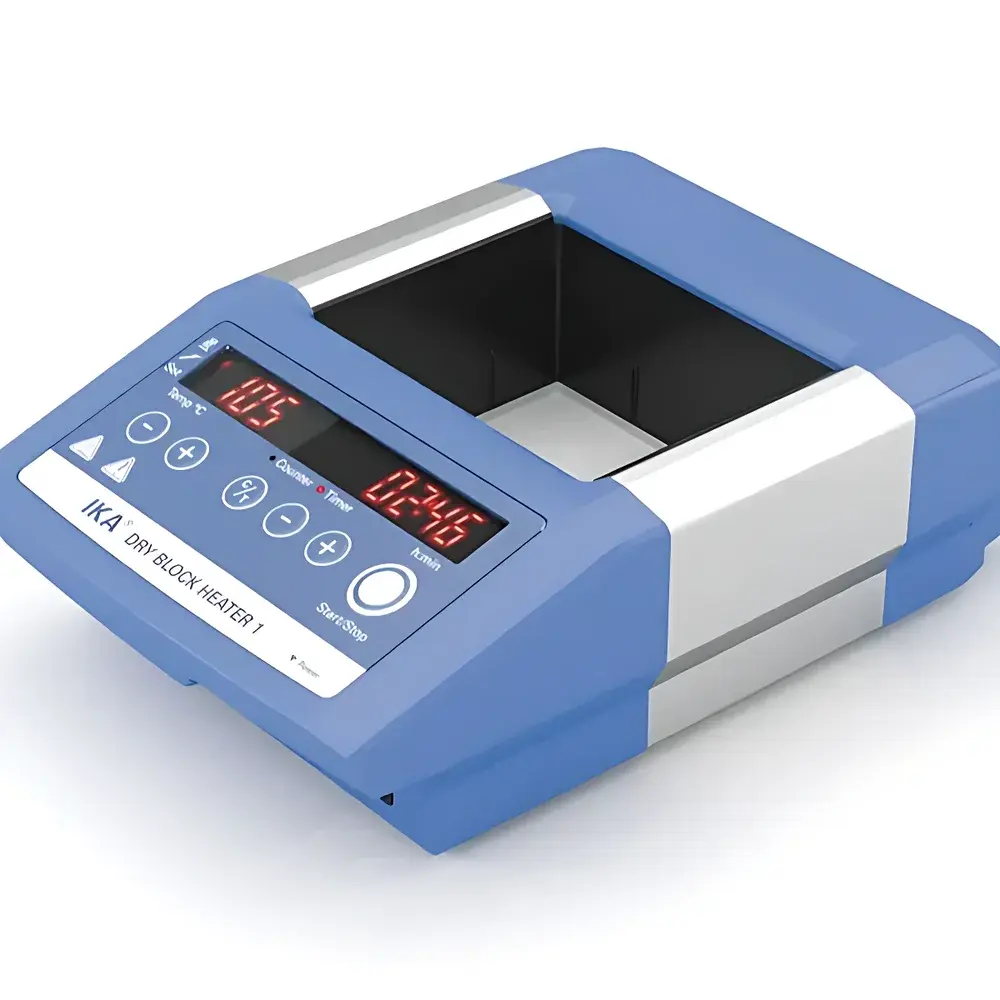
IKA Dry Block Heater 1 Digital Single-Block Dry Bath Incubator
| Brand | IKA |
|---|---|
| Origin | Germany |
| Model | Dry Block Heater 1 |
| Temperature Range | +5 °C to 120 °C |
| Temperature Stability | ±0.2 K at 37 °C, ±0.4 K at 60 °C |
| Temperature Uniformity | ±0.2 K at 37 °C, ±0.4 K at 60 °C |
| Heating Rate | 5 K/min (with external PT1000 sensor) |
| Temperature Resolution | 0.1 K |
| Control Accuracy | ±(0.15 + 0.002× |
| Heating Block Quantity | 1 |
| Block Dimensions | 96 × 76 mm |
| Block Material | Anodized Aluminum |
| Max. Safety Cut-off | 150 °C |
| Timer Range | 1 s – 99 h 59 min |
| Input Power | 165 W |
| Voltage | 220–240 V AC |
| Frequency | 50/60 Hz |
| IP Rating | IP21 |
| Ambient Operating Conditions | 5–40 °C, ≤80% RH |
| Net Weight | 1.342 kg |
| Dimensions (W×H×D) | 151 × 228 × 73 mm |
| External Sensor Interface | DIN 12878 compliant PT1000 |
Overview
The IKA Dry Block Heater 1 is a precision-engineered digital dry bath incubator designed for stable, contact-based thermal control of small-volume samples in vials, tubes, and microplates. Unlike water or oil baths, it employs solid-state conductive heating via a single anodized aluminum heating block—eliminating evaporation, contamination risk, and maintenance overhead associated with liquid media. Its core operating principle relies on direct thermal conduction from the heated block surface to sample containers, with real-time feedback provided by an integrated DIN 12878-compliant PT1000 temperature sensor inserted directly into the sample vessel. This architecture enables accurate, reproducible temperature control across a wide operational range (+5 °C to 120 °C), making it suitable for applications requiring strict thermal consistency without immersion or circulation.
Key Features
- Digital PID temperature control with 0.1 K resolution and ±(0.15 + 0.002×|T|) K accuracy per DIN EN 60751
- Single high-conductivity anodized aluminum heating block (96 × 76 mm) ensuring rapid heat transfer and mechanical durability
- Integrated safety circuit limiting maximum temperature to 150 °C—compliant with IEC 61010-1 for laboratory equipment safety
- Programmable timer with dual modes: countdown (1 s – 99 h 59 min) and elapsed time display
- Acoustic end-of-program alert and error code display for immediate fault identification (e.g., sensor disconnect, overtemperature)
- DIN 12878 standardized sensor port enabling seamless integration of external PT1000 probes for sample-core temperature monitoring
- IP21-rated enclosure providing protection against vertically falling drops and limited ingress of solid objects
- Compact footprint (151 × 73 × 228 mm) and low mass (1.342 kg) optimized for benchtop deployment in regulated QC labs and research environments
Sample Compatibility & Compliance
The Dry Block Heater 1 accommodates standard labware including 0.2 mL and 0.5 mL PCR tubes, 96-well microplates, Greiner tubes, cuvettes, and 10–15 mL test tubes—provided compatible interchangeable blocks are installed (block not included with base unit). Its thermal performance meets critical requirements for GLP/GMP-aligned workflows: temperature uniformity of ±0.2 K at 37 °C and ±0.4 K at 60 °C supports reproducibility in enzymatic assays, DNA denaturation, and cell activation protocols. The device complies with DIN EN 60529 (IP21), DIN EN 60751 (RTD accuracy), and IEC 61010-1 (safety). While not inherently 21 CFR Part 11 compliant, its deterministic timer logging and fixed safety cutoff support audit-ready documentation when used within validated SOPs.
Software & Data Management
The Dry Block Heater 1 operates as a standalone instrument with no embedded software stack or network interface. All parameter inputs—including setpoint, timer duration, and sensor selection—are executed via front-panel membrane keys and confirmed by a high-contrast LCD display. Temperature data is not stored internally; however, the unit’s analog output capability (via optional accessories) allows connection to external data loggers or SCADA systems for continuous traceability. For laboratories implementing electronic record systems, manual entry of setpoints and run durations into LIMS or ELN platforms is supported by the device’s unambiguous display and deterministic behavior—facilitating alignment with ALCOA+ data integrity principles.
Applications
This dry bath is routinely deployed in molecular biology for PCR tube preheating and post-amplification hold steps; in clinical chemistry for controlled urea hydrolysis in blood urea nitrogen (BUN) assays; in immunology for antigen-antibody incubation at defined temperatures; and in quality control for media sterility testing, clotting time assays, and melting point verification of reference standards. Its stability at 37 °C and 60 °C makes it particularly suited for enzyme kinetics studies (e.g., alkaline phosphatase activity), bacterial culture reactivation, and nucleic acid hybridization protocols such as in situ hybridization (ISH). The absence of liquid medium eliminates cross-contamination risks during high-throughput screening of compound libraries in microplate formats.
FAQ
Does the Dry Block Heater 1 support external temperature logging?
Yes—when paired with an optional analog output module and third-party data acquisition hardware, real-time temperature readings can be recorded externally.
Can multiple heating blocks be used interchangeably on this unit?
The base unit accepts only one block at a time; however, IKA offers a range of application-specific blocks (e.g., for PCR strips, microcentrifuge tubes, or deep-well plates) that are mechanically compatible with the Dry Block Heater 1 platform.
Is the PT1000 sensor included calibrated and certified?
The supplied stainless-steel PT1000.60 sensor conforms to DIN EN 60751 Class A tolerances but does not include a manufacturer-issued calibration certificate; users must perform periodic verification per internal QA procedures.
What is the recommended maintenance schedule?
No routine maintenance is required beyond periodic cleaning of the block surface with isopropyl alcohol and inspection of the sensor port for debris; the solid-state heater has no consumables or moving parts.
How does ambient temperature affect thermal stability?
Operation is rated for ambient conditions of 5–40 °C and ≤80% RH; exceeding these limits may degrade temperature uniformity and extend stabilization time, particularly above 35 °C ambient.



