
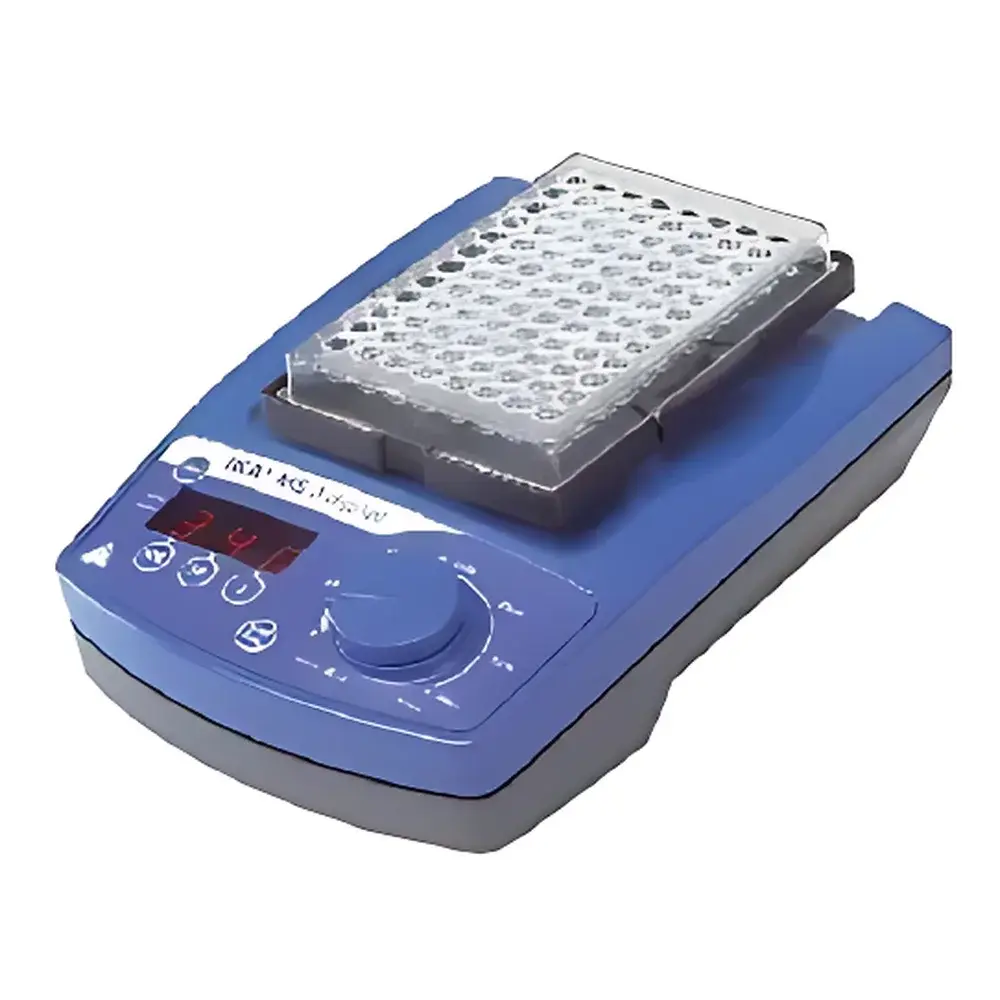
IKA MS3 Digital Vortex Mixer
| Brand | IKA |
|---|---|
| Origin | Germany |
| Manufacturer Status | Authorized Distributor |
| Product Origin | Imported |
| Model | MS3 |
| Pricing | Upon Request |
| Orbital Motion Type | Circular |
| Orbit Diameter | 4.5 mm |
| Max Load Capacity (incl. fixture) | 0.5 kg |
| Motor Input Power | 10 W |
| Motor Output Power | 8 W |
| Duty Cycle | Continuous (100%) |
| Minimum Adjustable Speed | 200 rpm |
| Speed Range | 0–3000 rpm |
| Speed Display | Digital LED (7-segment) |
| Timer Function | Yes |
| Timer Range | 1/60–999 min |
| Operation Modes | Timed, Continuous, and Pulse (Touch) |
| Pulse Mode | Supported (with standard pad) |
| Microplate Compatibility | Yes (1 × 96-well or 384-well plate) |
| Housing Material | Galvanized Cast Iron |
| Dimensions (W×D×H) | 148 × 63 × 205 mm |
| Weight | 2.9 kg |
| Operating Ambient Temperature | 5–40 °C |
| Max Relative Humidity | 80 % (non-condensing) |
| Ingress Protection | IP21 (per DIN EN 60529) |
| Power Supply | 100–240 V AC, 50/60 Hz |
| Total Instrument Power Consumption | 20 W |
| DC Output | 24 V = 800 mA |
| RS232 Interface | No |
| Analog Output | No |
Overview
The IKA MS3 Digital Vortex Mixer is a compact, precision-engineered orbital shaker designed for consistent, reproducible mixing of small-volume samples in life science laboratories. Operating on the principle of circular orbital motion with a fixed 4.5 mm orbit diameter, the MS3 generates controlled shear forces ideal for resuspending pellets, homogenizing low-viscosity solutions, and preparing enzymatic or cell-based assays. Its robust galvanized cast iron housing ensures mechanical stability and long-term durability under routine benchtop use. Engineered for reliability in regulated environments, the MS3 delivers stable rotational speed across its full 200–3000 rpm range, with digital feedback control minimizing drift during extended operation. The device complies with DIN EN 60529 for ingress protection (IP21), confirming suitability for standard laboratory ambient conditions (5–40 °C, ≤80% RH non-condensing).
Key Features
- Dual-mode operation: Mode A (safety-optimized) automatically detects standard IKA pads and limits speed to 3000 rpm; with non-standard pads, speed caps at 1300 rpm for enhanced user safety. Mode B bypasses pad detection, enabling full 3000 rpm performance with any compatible accessory.
- Intuitive digital interface featuring a 7-segment LED timer display and precise speed adjustment via rotary dial — no software or external controller required.
- Three operational modes: continuous run, programmable timed operation (1 second to 999 minutes), and momentary pulse activation for rapid sample agitation without timer engagement.
- Optimized for microplate handling: accommodates single 96-well or 384-well plates using dedicated IKA microplate adapters (sold separately); platform design prevents lateral slippage during high-speed vortexing.
- Energy-efficient brushless motor architecture with 8 W mechanical output and 20 W total system draw — compliant with IEC 60335-1 for household and similar electrical appliance safety.
- Fixed footprint (148 × 63 × 205 mm) and low mass (2.9 kg) ensure compatibility with biosafety cabinets, cold rooms, and modular lab benches without compromising stability.
Sample Compatibility & Compliance
The MS3 supports common labware including 0.2–50 mL tubes (e.g., Eppendorf, Falcon), PCR strips, and standard microplates. Its 0.5 kg load capacity includes weight of fixtures and sample containers. While not certified for GLP/GMP production environments, the MS3 meets essential design criteria referenced in ISO/IEC 17025 for equipment used in testing laboratories — particularly regarding speed accuracy, repeatability, and thermal management. It operates within voltage tolerances defined by IEC 61000-4-11 (voltage dips and interruptions), ensuring resilience in shared lab power circuits. No hazardous substances are employed in construction per RoHS Directive 2011/65/EU.
Software & Data Management
The MS3 is a standalone, microprocessor-controlled instrument with no embedded firmware update capability or network connectivity. All parameters — speed, timer setting, and mode selection — are retained in volatile memory only during active operation and reset upon power cycle. No audit trail, electronic record, or 21 CFR Part 11-compliant data logging is provided. For labs requiring traceable operation logs, integration with external environmental monitoring systems (via relay-triggered I/O modules, not included) may be implemented at the facility level.
Applications
- Routine resuspension of bacterial or yeast cell pellets prior to lysis or centrifugation.
- Preparation of dilution series and serial transfers in ELISA, qPCR, and immunoassay workflows.
- Homogenization of reagents in low-volume reaction mixtures (e.g., restriction digests, ligations, RT-PCR master mixes).
- Enhancing binding kinetics in antigen–antibody incubations on microplate surfaces.
- Supporting QC/QA procedures where manual vortexing introduces inter-operator variability — especially in accredited testing labs adhering to ISO/IEC 17025 clause 6.4.3 (equipment verification).
FAQ
Does the MS3 support FDA 21 CFR Part 11 compliance?
No. The MS3 lacks electronic signature capability, audit trail generation, or secure user access controls required for Part 11 compliance.
Can the MS3 be used inside a refrigerated chamber?
Yes — provided ambient temperature remains between 5–40 °C and relative humidity does not exceed 80% non-condensing, as specified in the operating manual.
Is calibration documentation available from IKA?
IKA provides factory calibration certificates upon request for individual units; periodic user verification against traceable tachometer standards is recommended per ISO/IEC 17025 Section 6.5.
What accessories are required for microplate vortexing?
A dedicated IKA microplate adapter (e.g., part no. 0031000200) must be mounted onto the platform; no additional clamps or fasteners are needed.
Does the MS3 generate electromagnetic interference (EMI) that could affect nearby sensitive instruments?
EMI emissions conform to CISPR 11 Group 1, Class B limits; typical lab spacing (>30 cm) mitigates coupling risk with adjacent analytical devices such as balances or pipette controllers.




