
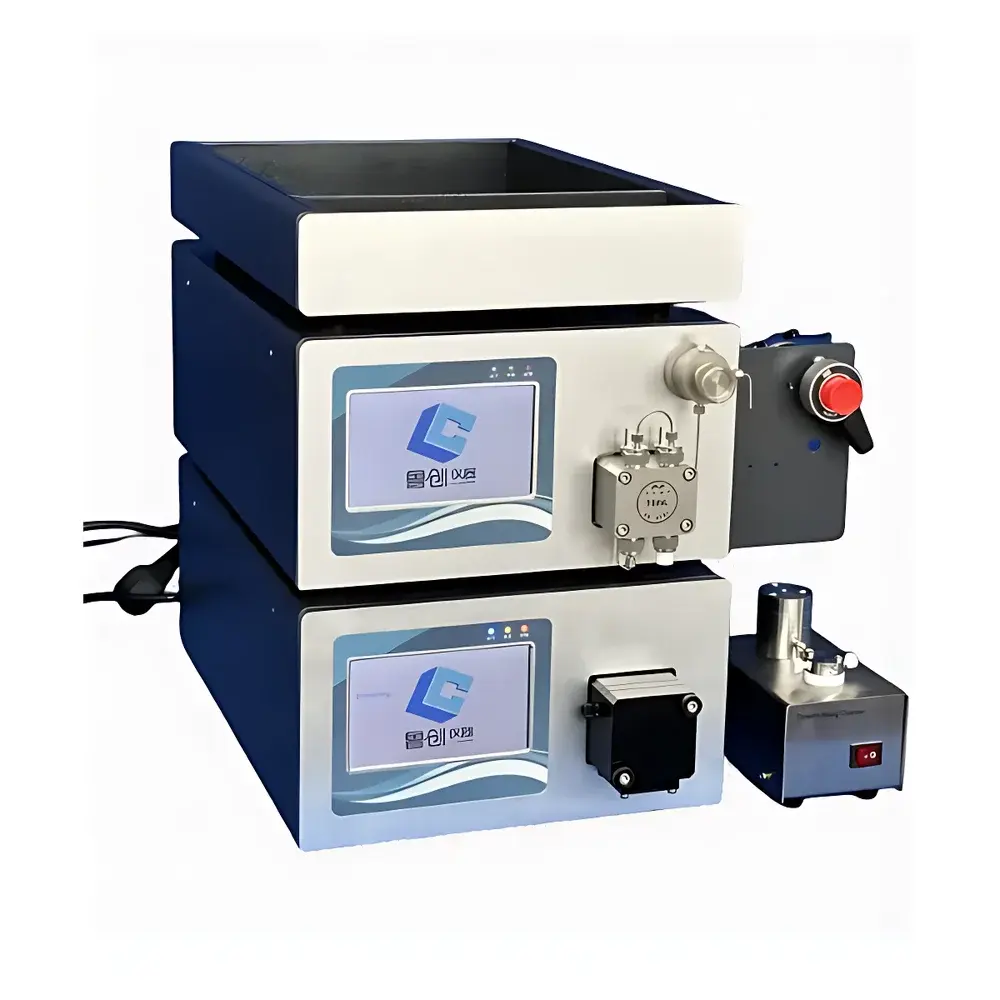
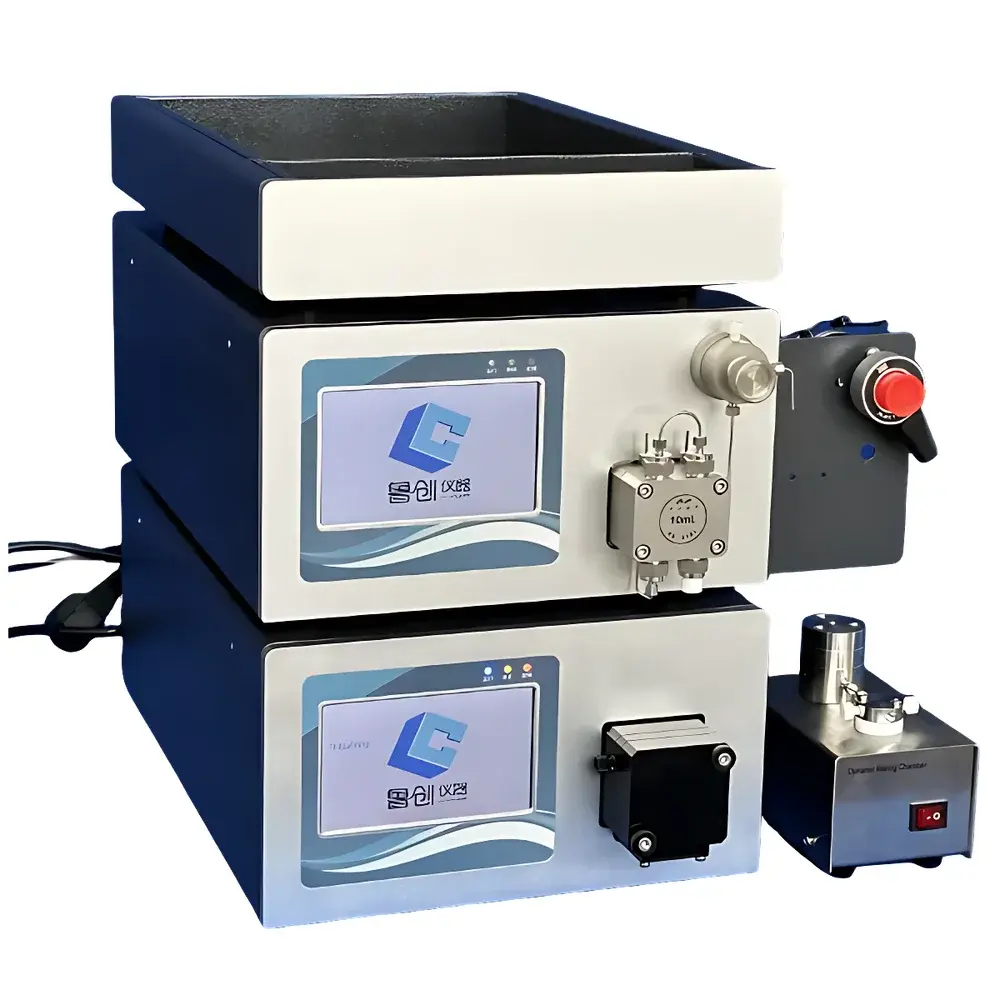
Shandong Luchuang LC-3000 Single-Pump High-Performance Liquid Chromatograph (HPLC) with PC Control
| Brand | Shandong Luchuang |
|---|---|
| Origin | Shandong, China |
| Manufacturer Type | OEM Manufacturer |
| Instrument Type | Conventional HPLC System |
| Model | LC-3000 |
| Flow Rate Range | 0.001–10.000 mL/min (0.001 mL/min increment) |
| Maximum Pressure | 40 MPa |
| Flow Accuracy | RSD ≤ 0.3% (at 1 mL/min) |
| Flow Precision | RSD ≤ 0.1% (at 1 mL/min) |
| Injection Volume | 1–50 µL |
| Sample Tray Capacity | 100 positions × 1.5 mL vials or 80 positions × 4 mL vials |
| Column Temperature | Ambient (no active oven) |
| Wavelength Range | 190–700 nm (±2 nm accuracy) |
| Data Acquisition Rate | 24 Hz |
| Detector Noise | ≤1.5 × 10⁻⁵ AU/h (254 nm, MeOH/H₂O 80/20, 1 mL/min) |
| Baseline Drift | ≤4 × 10⁻⁴ AU/h (254 nm, same conditions) |
| Lamp Source | Deuterium lamp (standard), Tungsten lamp (optional) |
Overview
The Shandong Luchuang LC-3000 is a single-pump, PC-controllable high-performance liquid chromatograph engineered for routine analytical applications in quality control, pharmaceutical stability testing, agrochemical residue analysis, and chemical R&D laboratories. Built around a dual-plunger reciprocating pump (P3000) and a digitally optimized UV-Vis absorbance detector (UV3000), the system operates on classical reversed-phase HPLC principles—separating analytes based on differential partitioning between a polar mobile phase and a non-polar stationary phase (e.g., C18 silica). Its modular architecture supports method development, validation, and long-term reproducibility under ambient column temperature conditions. Designed for compliance-ready operation, the LC-3000 integrates digital signal transmission directly to host computers via RS-232—eliminating legacy analog data acquisition cards—and supports audit-trail-capable software logging for GLP-aligned workflows.
Key Features
- High-precision P3000 binary-capable pump with CPLD-based digital frequency generation and adaptive motor control, delivering flow accuracy of ≤0.3% RSD at 1 mL/min and repeatability of ≤0.1% RSD.
- UV3000 spectrophotometric detector featuring a deuterium/tungsten dual-lamp configuration, programmable wavelength scanning (start/end/step adjustable), and seven selectable time constants (0.1–10 s) for optimized signal-to-noise response.
- Direct serial communication architecture: detector analog output (±0.1 V / ±1.0 V / ±10 V) and pump parameter control operate natively over RS-232 without intermediary hardware.
- Integrated GLP functionality including lamp usage tracking (total ignition time, cycle count), lamp replacement history, and instrument serial number logging within the CXTH-3000 workstation software.
- Robust mechanical design: stainless steel/PEEK dual-pump-head options (10 mL analytical / 50 mL semi-preparative), pressure-limited slow-start protection, and user-configurable min/max pressure thresholds.
- Large 320×240-pixel backlit LCD interface on both pump and detector modules enables standalone parameter entry, gradient verification via on-screen curve display, and real-time status monitoring.
Sample Compatibility & Compliance
The LC-3000 accommodates standard 4.6 mm ID analytical columns (e.g., included C18, 250 × 4.6 mm, 5 µm) and supports common reversed-phase solvents (acetonitrile, methanol, aqueous buffers). Its 1–50 µL manual injection range (via Rheodyne 20 µL loop) meets ASTM E2894 and ISO 17025 method transfer requirements for small-molecule quantification. While the system lacks an integrated column oven, its ambient-temperature operation remains suitable for methods validated per USP , EP 2.2.46, and ICH Q2(R2) where temperature sensitivity is low. The CXTH-3000 workstation provides electronic signature support and configurable audit trails aligned with FDA 21 CFR Part 11 Annex 11 expectations for non-critical QC environments.
Software & Data Management
CXTH-3000 Chromatography Workstation (v3.x) serves as the unified control and processing platform. It supports full instrument parameterization—including gradient programming, wavelength scheduling, and auto-zero calibration—as well as peak integration using tangent skim, baseline correction, and retention time locking. Raw data are stored in vendor-neutral .txt and .csv formats; processed reports include integral tables, overlay chromatograms, and calibration curves exportable to PDF or Excel. All acquisition events—lamp ignition cycles, pressure excursions, and user login/logout timestamps—are logged with date/time stamps and operator IDs, satisfying basic GLP documentation needs for laboratory accreditation.
Applications
The LC-3000 is routinely deployed in: pharmaceutical raw material assay (e.g., paracetamol, caffeine); pesticide residue screening in food matrices (e.g., organophosphates in fruits); polymer additive quantification (e.g., antioxidants in polyolefins); and synthetic intermediate purity assessment in fine chemical manufacturing. Its 40 MPa pressure rating and sub-microliter flow resolution enable robust separation of moderately polar compounds (log P 1–5) on C18 phases, while the 190–700 nm spectral range covers primary UV-active functional groups (aromatics, conjugated carbonyls, nitro derivatives). Method transfer to UHPLC platforms is facilitated by scalable flow and gradient parameters.
FAQ
Does the LC-3000 support gradient elution?
Yes—the P3000 pump operates in high-pressure gradient mode when paired with a second identical pump (sold separately); the master pump controls timing, flow, and displays real-time gradient profiles.
Is column oven integration possible?
No—the LC-3000 does not include or support add-on column ovens; it is designed exclusively for ambient-temperature operation.
Can the UV3000 detector be used with third-party pumps?
Yes—the detector accepts analog input and RS-232 commands independently; it is fully compatible with any pump providing standard TTL-level trigger signals and serial command sets.
What software validation documentation is provided?
CXTH-3000 includes IQ/OQ test protocols, system suitability checklists, and a traceable version history log—intended for internal lab validation per ISO/IEC 17025 Clause 5.9.
Is GMP-compliant electronic record storage supported?
The workstation supports password-protected user roles and immutable audit logs; however, full 21 CFR Part 11 compliance (e.g., biometric authentication, digital certificates) requires supplementary IT infrastructure beyond the base system.




