
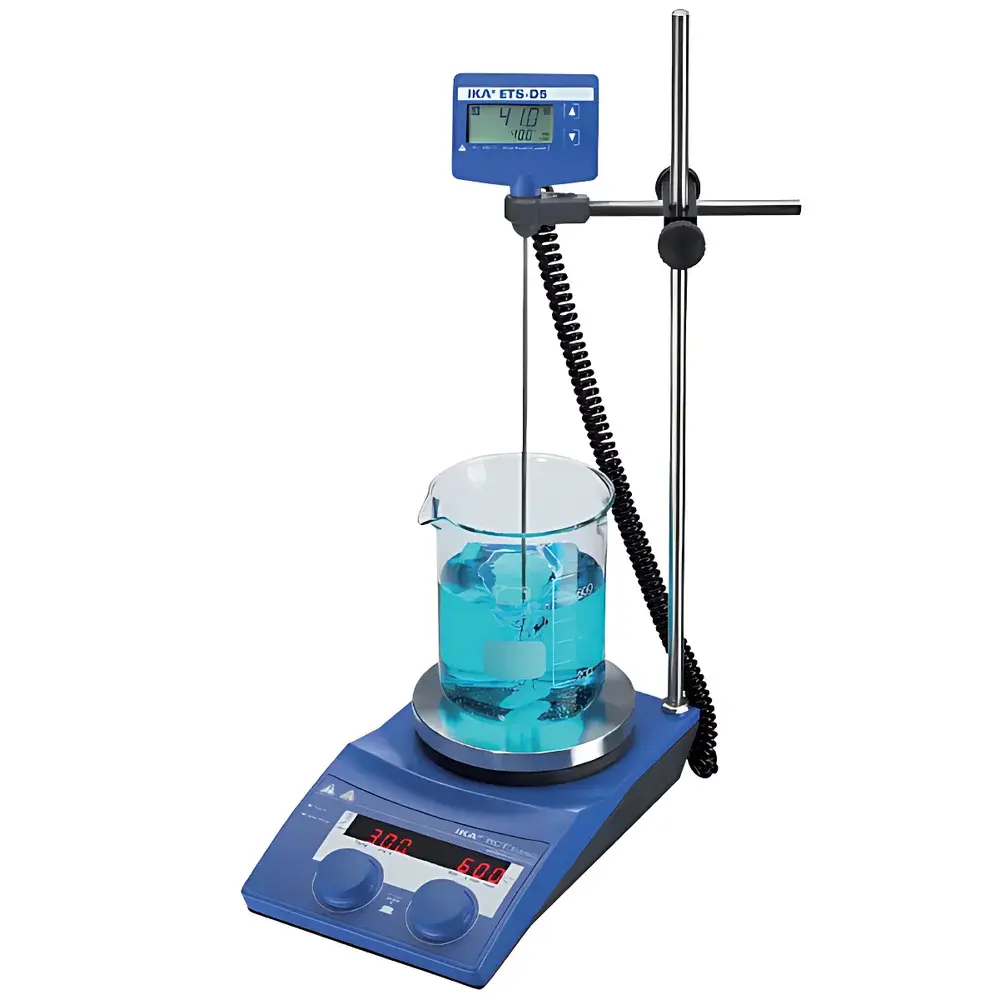
IKA RCT Basic Heating Magnetic Stirrer
| Brand | IKA |
|---|---|
| Origin | Germany (manufactured under IKA global standards |
| Model | RCT Basic |
| Instrument Type | Heating Magnetic Stirrer |
| Max. Stirring Volume | 20 L (H₂O) |
| Speed Range | 0/50–1500 rpm |
| Temperature Control Range | Ambient to 310 °C |
| Heating Power | 600 W |
| Motor Output Power | 9 W |
| Display | LED digital display for speed and temperature |
| Working plate material | Anodized aluminum |
| Plate diameter | Ø135 mm |
| Dimensions (W×H×D) | 160 × 270 × 85 mm |
| Weight | 2.5 kg |
| Power supply | 220–230 V / 115 V / 100 V, 50/60 Hz |
| Input power | 650 W |
Overview
The IKA RCT Basic Heating Magnetic Stirrer is an engineered solution for precise, reproducible mixing and temperature-controlled sample preparation in academic, industrial, and quality control laboratories. Based on the proven Couette flow principle, it employs a rotating magnetic field to drive PTFE- or glass-coated stir bars within vessels—enabling homogeneous dispersion without mechanical shaft penetration. Its integrated heating system utilizes resistive alloy elements embedded beneath an anodized aluminum plate, delivering rapid thermal response and stable plateau temperatures up to 310 °C. Designed for compliance with fundamental laboratory safety and operational integrity requirements, the RCT Basic supports unattended operation through dual-layer thermal safeguards—including an adjustable safety cutoff circuit and real-time surface temperature monitoring. As part of IKA’s globally standardized product line, it meets EN 61000-6-3 (EMC) and EN 61000-6-2 (immunity) specifications, and its construction adheres to DIN 12878 for interoperability with external temperature control modules such as the ETS-D5.
Key Features
- High-torque DC motor delivering consistent rotational performance across the full 0/50–1500 rpm range, optimized for viscous and low-volume samples alike
- Dual-mode temperature control: direct plate-surface regulation + optional external PT1000 feedback loop (±1 K accuracy)
- LED digital interface with independent parameter displays for speed and temperature—enabling simultaneous readout and adjustment
- Adjustable safety temperature circuit (50–360 °C), programmable via front-panel controls to prevent thermal runaway during extended runs
- DIN 12878-compliant socket for seamless integration with third-party contact thermometers (e.g., ETS-D5, Heidolph units with AD-C1 adapter)
- IP42-rated enclosure providing protection against solid objects >1 mm and vertically falling water droplets—ensuring durability in routine lab environments
- Included PT1000.60 sensor (stainless steel sheath, 230 mm immersion depth) enables accurate bulk-phase temperature monitoring in corrosive or high-boiling media
- Thermally insulated housing and optimized heat-dissipation geometry minimize ambient thermal drift and extend service life
Sample Compatibility & Compliance
The RCT Basic accommodates standard laboratory glassware including beakers (up to 20 L capacity), round-bottom flasks, and jacketed reactors. Its magnetic coupling design eliminates seal wear and cross-contamination risks associated with mechanical stirrers. Compatible stir bars include IKAFLON® (PTFE-coated) and TRIKA® (ceramic-reinforced) series—available in lengths from 10 mm to 80 mm. The unit complies with ISO/IEC 17025 documentation practices when used with traceable calibration procedures. While not inherently 21 CFR Part 11–compliant, audit-ready operation is achievable when paired with validated external data loggers (e.g., ETS-D5 with GLP-compliant memory export). It satisfies general requirements for GMP-aligned workflows where temperature and agitation parameters are recorded manually or via external systems.
Software & Data Management
The RCT Basic operates as a standalone instrument with no embedded software stack or network connectivity. All parameter inputs and status outputs occur locally via the LED interface. For regulated environments, users may integrate it into broader data acquisition ecosystems using analog/digital signals from compatible accessories—for instance, the ETS-D5 electronic thermometer provides RS232 output with timestamped temperature logs and configurable alarm thresholds. When deployed with validated SOPs, the system supports GLP/GMP traceability through manual entry into ELN/LIMS platforms or printed records generated by connected thermal printers. No firmware updates or cloud dependencies are required—ensuring long-term operational consistency.
Applications
- Preparation of buffer solutions, culture media, and reagent stocks requiring uniform thermal distribution and particle suspension
- Heating-assisted dissolution studies in pharmaceutical development (e.g., solubility profiling per USP <711>)
- Synthesis reaction staging where controlled ramp-and-hold thermal profiles improve yield reproducibility
- QC testing of viscosity modifiers, polymers, and colloidal suspensions under defined shear and thermal conditions
- Environmental sample digestion protocols (e.g., EPA Method 3050B) involving acid-mediated mineralization at elevated temperatures
- Calibration verification of thermocouples and RTDs using traceable reference standards in stirred oil baths
FAQ
Does the RCT Basic support remote control or PC connectivity?
No—it is a manually operated, stand-alone device with no USB, Ethernet, or Bluetooth interfaces. External control requires integration via DIN 12878-compatible accessories like the ETS-D5.
What is the maximum recommended viscosity for reliable stirring at 1500 rpm?
For optimal performance, viscosity should remain below 10,000 mPa·s when using an 80 mm stir bar in a 20 L vessel. Higher viscosities require reduced speed or larger-diameter stir bars.
Can the safety temperature limit be disabled?
No—the safety circuit is hardware-enforced and non-bypassable, in accordance with IEC 61010-1 safety requirements for laboratory equipment.
Is the included PT1000.60 sensor suitable for use in hydrofluoric acid solutions?
No—standard stainless steel sheathing is incompatible with HF. For such applications, users must select glass-sheathed alternatives (e.g., IKA part #37360001467) or apply chemical-resistant protective sleeves.
How often should the heating plate surface be recalibrated?
Annual verification against a NIST-traceable reference thermometer is recommended. Drift exceeding ±2 K warrants professional recalibration or replacement of the internal sensor assembly.



