
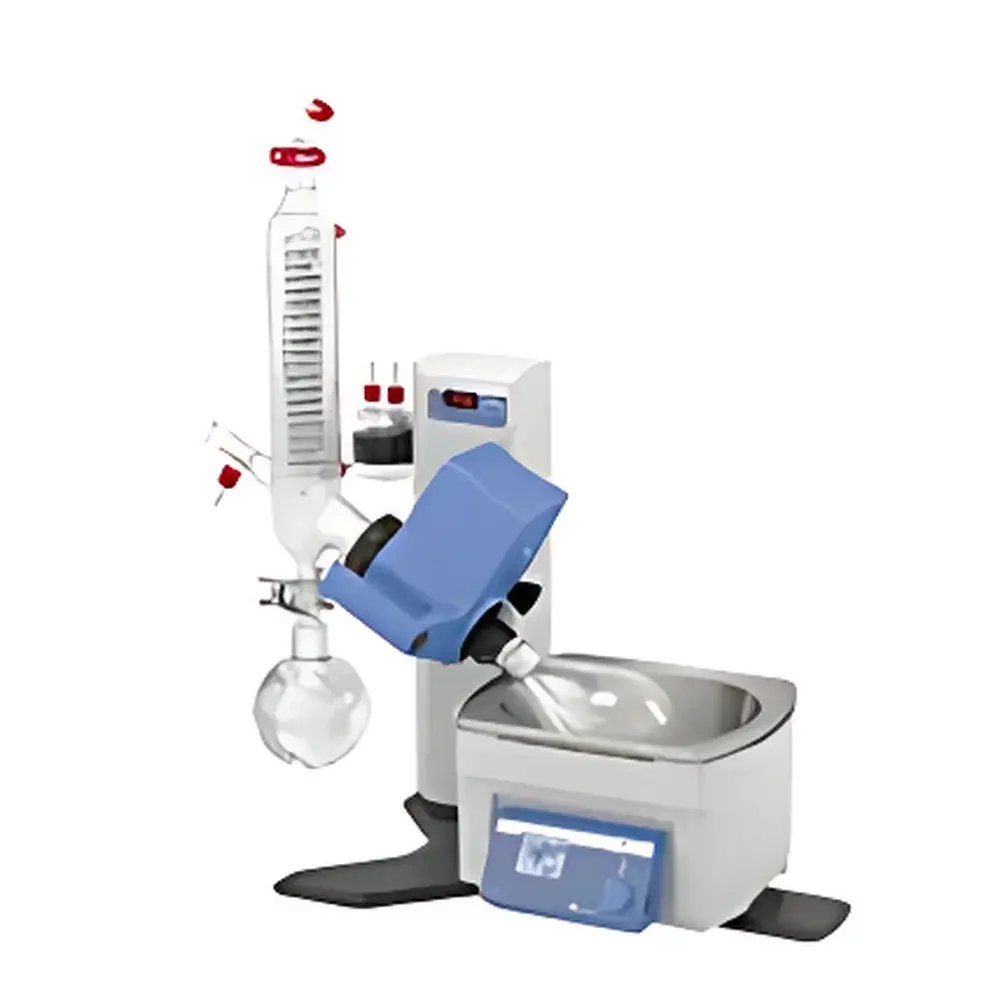
IKA RV 8 V Rotary Evaporator
| Brand | IKA |
|---|---|
| Origin | Germany |
| Model | RV 8 V |
| Capacity | 3 L |
| Rotation Speed | 5–300 rpm |
| Heating Bath Temperature Range | Ambient to 180 °C |
| Temperature Control Accuracy | ±1 K |
| Condenser Cooling Area | 1500 cm² |
| Lift Mechanism | Manual (120 mm travel) |
| Heating Power | 1300 W |
| Input Voltage | 100–240 V AC, 50/60 Hz |
| DC Motor Supply | 24 V |
| Dimensions (W×D×H) | 495 × 615 × 390 mm |
| Weight | 12.5 kg |
| IP Rating | IP20 |
| Operating Environment | 5–40 °C, ≤80% RH |
Overview
The IKA RV 8 V Rotary Evaporator is a compact, manually operated benchtop system engineered for reliable solvent removal, concentration, and gentle purification of heat-sensitive compounds under reduced pressure. Based on the fundamental principle of rotary evaporation—where simultaneous rotation, heating, and vacuum application lower the boiling point of solvents to enable efficient phase separation—the RV 8 V delivers reproducible performance in routine laboratory workflows. Designed and manufactured in Germany, it integrates core engineering features common to IKA’s evaporator platform, including a robust 24 V DC motor drive, dual-mode heating capability (water or oil bath), and precision-machined mechanical lift with safety stop functionality. Its fixed vertical condenser geometry ensures consistent vapor path length and high surface-area-to-volume ratio (1500 cm²), supporting effective condensate recovery across a broad range of low- to medium-volatility solvents (e.g., acetone, ethanol, ethyl acetate, dichloromethane). The unit operates without integrated vacuum regulation or digital timer functions, positioning it as a purpose-built, maintenance-efficient instrument for standardized evaporation protocols compliant with GLP-aligned documentation practices.
Key Features
- Manual lift mechanism with 120 mm vertical travel and automatic safety stop: In the event of power interruption, the motor disengages and lifts the evaporation flask above the heating bath to prevent thermal degradation or bumping.
- 24 V DC motor drive: Enhances user safety by eliminating high-voltage exposure at the rotating interface; supports stable torque delivery across the full speed range (5–300 rpm) with ±1 rpm accuracy below 100 rpm and ±1% above.
- Dual-purpose heating bath (HB 10 compatible): Accepts both water and silicone oil media, adjustable from ambient temperature up to 180 °C with ±1 K control accuracy and programmable temperature lock to prevent accidental setting changes.
- Ergonomic design elements: Integrated safety handle on the heating bath, single-handed operation capability, and adjustable immersion angle for optimized film formation and heat transfer efficiency.
- Universal glassware compatibility: Fully interoperable with the complete IKA RV 10 series glass components—including the vertical condenser RV 10.1—enabling seamless integration into existing lab infrastructures and facilitating method transfer between instruments.
- Compliance-ready mechanical architecture: Conforms to DIN EN 60529 (IP20) for protection against solid ingress; designed for continuous operation within standard laboratory environmental conditions (5–40 °C, ≤80% RH).
Sample Compatibility & Compliance
The RV 8 V accommodates standard 3 L evaporation flasks and is routinely deployed in organic synthesis, natural product isolation, pharmaceutical QC sample preparation, and polymer solution processing. Its bath capacity (3 L), combined with precise rotational control and uniform heating distribution, ensures homogeneous thin-film formation across diverse viscosities—from low-viscosity solvents to moderately viscous crude extracts. While the instrument lacks built-in vacuum sensing or regulatory-grade data logging, its mechanical stability, traceable calibration pathways (via external PT100 probes), and adherence to IEC 61010-1 for electrical safety support use in environments governed by ISO/IEC 17025, USP , and internal GMP/GLP procedures where manual process recording is permitted. All wetted surfaces are borosilicate glass (DIN ISO 3585), ensuring chemical resistance to common organic solvents and mild acids/bases.
Software & Data Management
The RV 8 V operates as a standalone analog-digital hybrid system: rotation speed and heating bath temperature are displayed numerically on dedicated LED indicators, enabling real-time visual monitoring without software dependency. No RS232, USB, or analog output interfaces are provided; therefore, data capture requires external logging devices (e.g., calibrated thermocouple recorders or vacuum gauge data loggers) synchronized with manual procedural notes. This architecture aligns with laboratories maintaining paper-based or LIMS-integrated SOPs where instrument parameters are recorded manually per batch or run—fully compatible with audit requirements under FDA 21 CFR Part 11 when paired with controlled documentation practices.
Applications
- Solvent removal following column chromatography or liquid–liquid extraction
- Concentration of thermolabile natural product fractions (e.g., essential oils, flavonoid isolates)
- Recovery of reaction solvents in pilot-scale synthetic chemistry
- Preparative drying of polymer solutions prior to film casting or rheological analysis
- Standardized evaporation steps in pharmacopeial methods (e.g., USP dissolution sample prep)
- Teaching laboratories requiring robust, intuitive instrumentation for undergraduate organic chemistry instruction
FAQ
Does the RV 8 V include an integrated vacuum controller or pressure sensor?
No. Vacuum must be supplied and regulated externally using a separate vacuum pump and controller.
Can the heating bath be used with silicone oil at 180 °C continuously?
Yes—provided the selected oil has a flash point exceeding 200 °C and is regularly inspected for thermal degradation.
Is the RV 8 V compatible with IKA’s RV 10 digital controllers or remote interfaces?
No. It is a non-networked, manually operated unit without communication ports or upgrade paths to digital control modules.
What is the maximum recommended flask size for stable operation?
The system is rated for 3 L flasks; use of larger vessels may compromise rotational balance and film uniformity.
How is temperature calibration verified on this model?
Users should perform periodic verification using a NIST-traceable PT100 probe immersed in the bath medium at defined setpoints (e.g., 40 °C, 80 °C, 120 °C).



