
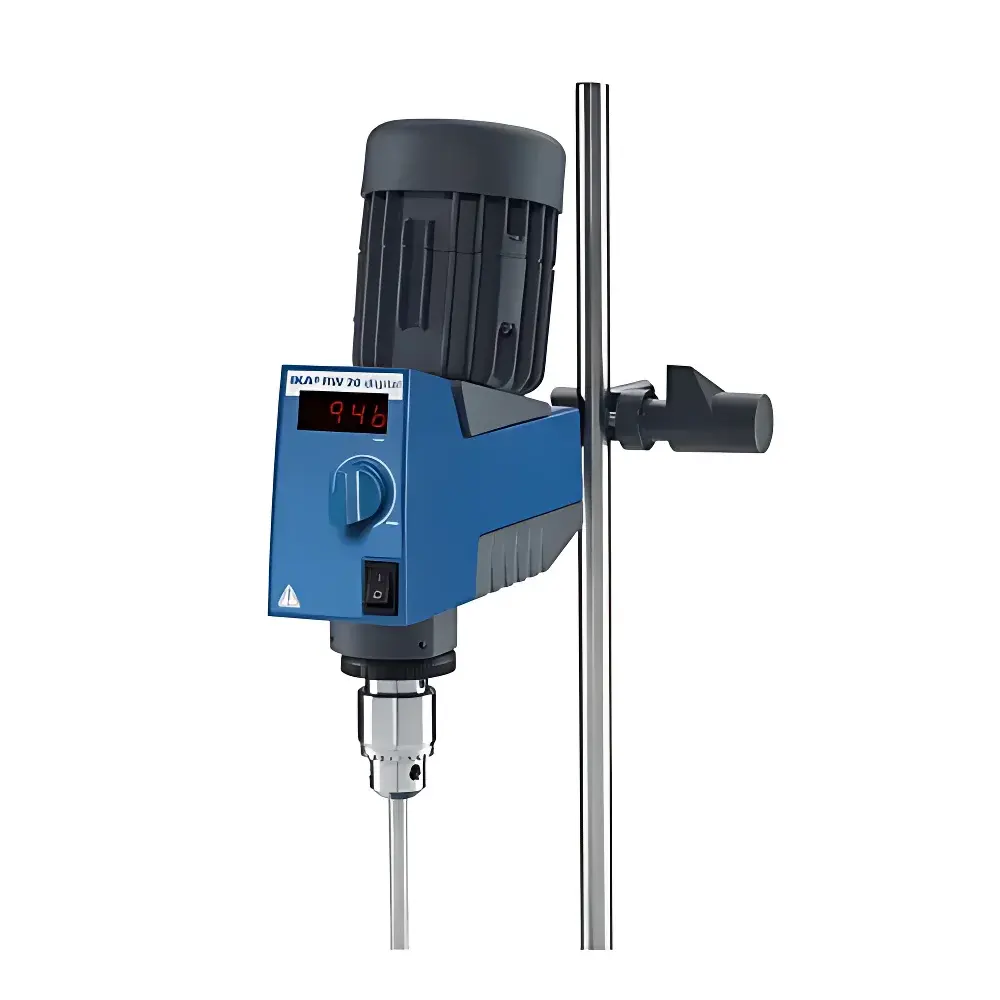
IKA RW20 Digital Display Mechanical Stirrer
| Brand | IKA |
|---|---|
| Origin | Germany |
| Model | RW20 Digital |
| Motor Input Power | 70 W |
| Motor Output Power | 35 W |
| Stirring Shaft Output Power | 26 W |
| Speed Range | 60–2000 rpm (continuously adjustable) |
| Max. Torque | 150 N·cm (at 100 rpm), 300 N·cm (overload at 60 rpm) |
| Max. Viscosity | 10,000 mPa·s |
| Max. Volume (H₂O) | 20 L |
| Clamp Range | 0.5–10 mm |
| Hollow Shaft ID | 10.5 mm |
| Dimensions (W×H×D) | 88 × 294 × 212 mm |
| Weight | 3.1 kg |
| Ambient Temperature | 5–40 °C |
| Relative Humidity | ≤80 % |
| Protection Class | IP20 |
| Voltage | 220–240 V / 100–115 V |
| Frequency | 50/60 Hz |
| Rated Torque | 1.5 N·m |
| Continuous Duty Cycle | 100 % |
| LED Speed Display | Yes |
| Chuck Type | Rotatable Chuck |
| Extension Arm | 160 mm (Ø13 mm) |
| Housing Material | Robust polymer with metal-reinforced base |
Overview
The IKA RW20 Digital Display Mechanical Stirrer is a high-performance, benchtop laboratory stirrer engineered for precision mixing and dispersion tasks in research, quality control, and production environments. Based on the proven RW20 platform, this upgraded model integrates digital speed monitoring via integrated LED display, enhanced motor stability, and ergonomic vertical design—optimizing workspace efficiency without compromising mechanical robustness. It operates on the principle of direct-drive mechanical agitation, utilizing a high-torque, brush-type DC motor coupled to a precision-machined rotatable chuck. The device delivers consistent rotational energy across its full speed range (60–2000 rpm), enabling reliable homogenization of low- to medium-viscosity liquids—including aqueous solutions, suspensions, emulsions, and polymer dispersions—up to 20 L volume (water-equivalent). Its continuous-duty architecture (100% duty cycle), overload-tolerant torque profile (up to 300 N·cm at startup), and IP20-rated enclosure ensure operational safety and long-term reliability under standard laboratory conditions (5–40 °C, ≤80% RH).
Key Features
- LED digital speed display for real-time, non-contact rpm verification—eliminating reliance on analog dials or external tachometers
- Dual-range speed control (Range I: 60–500 rpm; Range II: 240–2000 rpm) with infinitely variable adjustment via precision potentiometer
- High-torque motor delivering 150 N·cm nominal torque (100 rpm), 300 N·cm peak overload torque (60 rpm), and 24 N·cm at 1000 rpm—ensuring stable operation even during viscous load transitions
- Rotatable chuck with 0.5–10 mm clamping range and hollow shaft (ID 10.5 mm), permitting insertion of temperature probes, pH electrodes, or sampling tubes during static or rotating operation
- Modular mechanical design featuring a rigid 160 mm extension arm (Ø13 mm) and universal bracket-mounting interface—compatible with standard lab stands and custom fixtures
- Energy-efficient operation: 70 W input power, 35 W motor output, 26 W effective shaft power—optimized for thermal stability and reduced ambient heat generation
- Compliance-ready construction: CE-marked, manufactured in Germany to DIN EN 60529 (IP20), and aligned with IEC 61000-6-3 (EMC emission standards)
Sample Compatibility & Compliance
The RW20 Digital supports broad sample compatibility across routine laboratory workflows. It accommodates standard glass and stainless-steel stirring elements—including paddle, propeller, and anchor impellers—with secure fixation via the self-centering chuck. Its 20 L maximum water-equivalent capacity makes it suitable for batch preparation of buffers, culture media, reagent solutions, and coating formulations. While not rated for explosive or highly corrosive atmospheres (lacking ATEX or IP54+ certification), the unit meets general-purpose safety requirements for non-hazardous chemical handling per EN 61010-1. No built-in data logging or audit trail functionality is provided; thus, for GLP/GMP-regulated environments requiring traceability, external validation of speed accuracy (e.g., via calibrated optical tachometer) and manual logbook documentation are recommended.
Software & Data Management
The RW20 Digital is a standalone electromechanical instrument with no embedded microprocessor, firmware, or digital communication interfaces (no RS232, USB, or analog output). Speed values are displayed locally via LED—no remote readout, parameter export, or software integration is supported. Consequently, it does not implement FDA 21 CFR Part 11 electronic record controls, nor does it generate electronic audit trails. Users requiring compliant data capture must employ third-party instrumentation—such as a validated tachometer linked to a LIMS or ELN—or maintain handwritten logs referencing time-stamped speed settings, vessel volume, impeller type, and sample identity. This architecture prioritizes mechanical simplicity, serviceability, and electromagnetic noise immunity over digital connectivity.
Applications
- Preparation of microbiological growth media and pharmaceutical buffer solutions requiring uniform dissolution and gas dispersion
- Mixing of ceramic slurries, pigment dispersions, and adhesive formulations where shear-sensitive components necessitate controlled, low-startup-torque agitation
- Stirring of reaction mixtures in jacketed reactors and multi-neck flasks during synthetic chemistry protocols
- Homogenization of food-grade emulsions (e.g., dressings, sauces) and cosmetic bases under non-sterile pilot-scale conditions
- QC testing of viscosity standards and reference fluids using standardized impeller geometries per ASTM D1893 and ISO 3219
- Integration into automated workstations via mechanical coupling—leveraging its hollow shaft for concurrent probe-based monitoring during agitation
FAQ
Does the RW20 Digital support programmable speed ramps or timed operation?
No. It features manual, continuous-speed control only—no timer, ramping, or memory functions are included.
Can it be used with corrosive solvents such as concentrated acids or halogenated hydrocarbons?
The housing and chuck are chemically resistant to common aqueous and mild organic solvents. For aggressive media (e.g., fuming nitric acid, chloroform), verify material compatibility of the selected impeller and use secondary containment.
Is calibration required, and how often should it be performed?
Periodic verification against a traceable tachometer is advised per internal QA procedures—typically every 6–12 months or after impact damage or motor servicing.
What impeller types are recommended for high-viscosity applications up to 10,000 mPa·s?
Anchor or helical ribbon impellers with wide blade profiles and low tip speed ratios are preferred to minimize vortex formation and maximize bulk flow at low rpm.
Does the hollow shaft allow for simultaneous temperature measurement during stirring?
Yes—the 10.5 mm inner diameter permits insertion of standard 6–8 mm diameter Pt100 or thermocouple probes, provided the shaft remains stationary or rotates at speeds compatible with probe integrity.



