
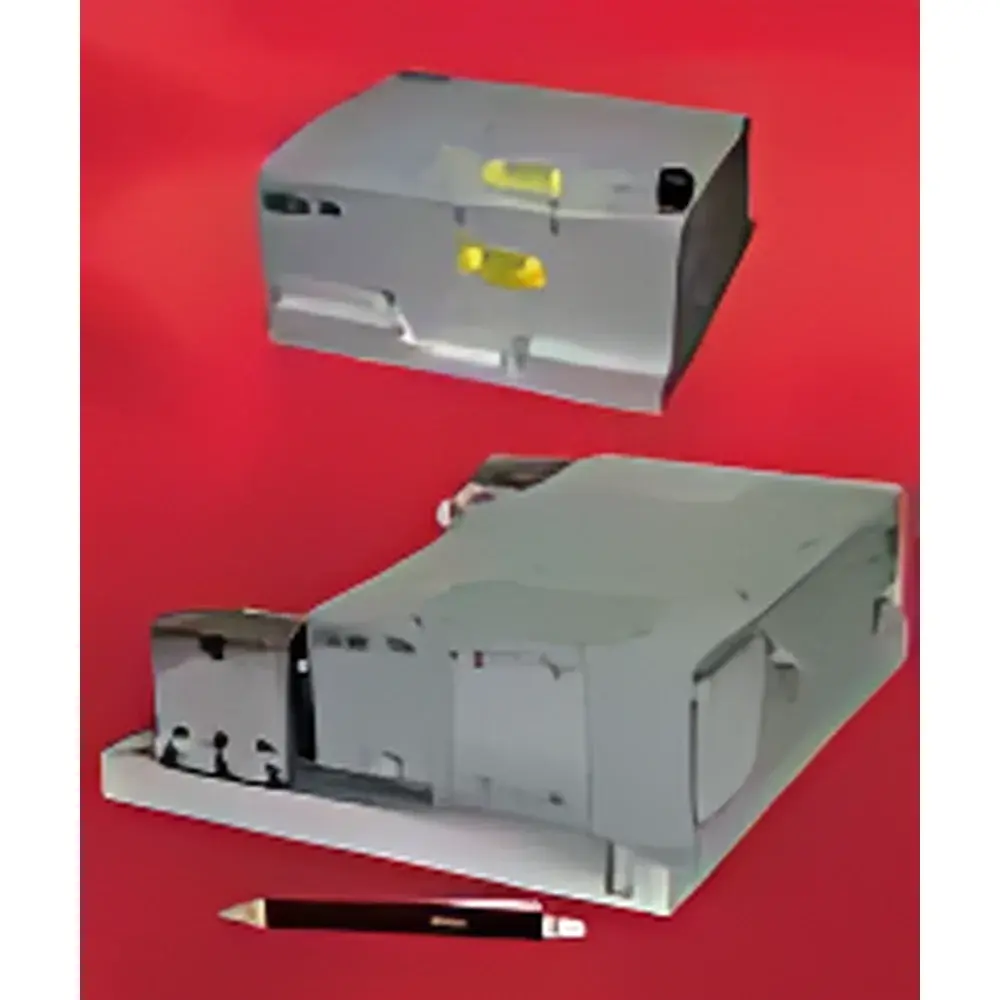
Indie Nanosecond Q-Switched Diode-Pumped Nd:YVO4 Laser
| Brand | Ekspla |
|---|---|
| Type | DPSS Q-Switched Solid-State Laser |
| Wavelength | 1064 nm |
| Pulse Duration | Nanosecond Range |
| Repetition Rate | Up to 100 kHz |
| Average Output Power | Up to 15 W |
| Pump Source | Semiconductor Diode |
| Gain Medium | Nd:YVO₄ Crystal |
| Cooling | Water-Cooled (Standard) |
| Beam Quality (M²) | Typically <1.3 |
| Polarization | Linear, >100:1 Extinction Ratio |
Overview
The Indie nanosecond Q-switched diode-pumped solid-state (DPSS) laser from Ekspla represents a rigorously engineered solution for high-repetition-rate, high-peak-power pulsed laser applications in industrial and scientific environments. Based on the Nd:YVO₄ (neodymium-doped yttrium orthovanadate) gain medium, this laser employs intracavity electro-optic or acousto-optic Q-switching to generate stable, temporally compressed pulses in the nanosecond domain (typically 10–25 ns FWHM). The fundamental emission at 1064 nm is generated via stimulated emission under 808 nm diode pumping, with optimized thermal management ensuring long-term power stability and beam pointing consistency. Its design prioritizes robustness, low temporal jitter (<1 ns RMS), and high pulse-to-pulse energy stability (<1.5% RMS over 8 hours), making it suitable for integration into automated manufacturing lines and precision laboratory setups where deterministic ablation, marking, or nonlinear frequency conversion is required.
Key Features
- High average output power up to 15 W at 1064 nm, maintained across the full repetition rate range (1 kHz to 100 kHz)
- Nanosecond pulse duration with excellent temporal profile fidelity and minimal pulse pedestal
- Superior beam quality (M² < 1.3) enabling tight focusing for high fluence applications
- Integrated thermal management system with precision water-cooling interface compliant with DIN 12876-1 standards
- Low timing jitter (<1 ns RMS) and high trigger-to-pulse delay stability (<±500 ps) for synchronization with external motion stages or detectors
- Comprehensive internal diagnostics including real-time pulse energy monitoring, temperature logging, and pump diode current feedback
- RS-232, USB 2.0, and optional Ethernet (TCP/IP) interfaces for remote control and system integration
Sample Compatibility & Compliance
The Indie laser is routinely deployed in processing of metals (e.g., stainless steel, aluminum, copper), semiconductors (Si, GaAs, SiC), dielectric thin films (ITO, SiO₂, Al₂O₃), and polymer composites. Its pulse parameters meet critical thresholds for non-thermal ablation initiation and controlled material removal without excessive heat-affected zone (HAZ) formation. From a regulatory standpoint, the system complies with IEC 60825-1:2014 Class 4 laser safety requirements, includes interlocked enclosure interfaces per EN 61496-1, and supports integration into ISO 9001-certified production workflows. Optional CE marking documentation and RoHS 2011/65/EU conformity statements are available upon request for end-user validation.
Software & Data Management
Ekspla provides the proprietary LaserControl Suite v4.x — a Windows-based application supporting full parameter configuration (repetition rate, Q-switch delay, burst mode sequencing), real-time oscilloscope-style pulse train visualization, and automated calibration routines. All operational logs (pulse energy, cavity temperature, diode voltage/current) are timestamped and exportable in CSV or HDF5 format. For regulated environments, the software architecture supports optional 21 CFR Part 11-compliant audit trail modules, including electronic signatures, role-based access control, and immutable log archiving — fully compatible with GLP and GMP documentation protocols.
Applications
- Precision micromachining of PCBs, flex circuits, and semiconductor wafers
- Laser-induced forward transfer (LIFT) of functional thin-film materials
- Marking and engraving of medical devices requiring UDI compliance
- Pumping of optical parametric oscillators (OPOs) for tunable mid-IR generation
- Time-resolved photoluminescence (TRPL) excitation in optoelectronic material characterization
- LIBS (Laser-Induced Breakdown Spectroscopy) source for elemental analysis in metallurgy and recycling
- Nonlinear frequency conversion (SHG, THG) in ultrafast metrology and quantum optics labs
FAQ
What is the typical pulse energy stability over an 8-hour continuous operation cycle?
Pulse energy stability is specified as ≤ ±1.5% RMS when operated within nominal thermal envelope and with stable line voltage (±2%).
Is external triggering supported, and what is the maximum input frequency?
Yes — TTL-compatible external trigger input accepts signals up to 100 kHz with programmable delay resolution of 1 ns.
Can the laser be upgraded to harmonic wavelengths (e.g., 532 nm or 355 nm)?
Harmonic generation modules (SHG, THG) are available as factory-integrated options; retrofitting requires optical alignment certification and cavity re-optimization.
Does the system include built-in pulse energy measurement?
A calibrated photodiode-based energy monitor is integrated into the beam path with analog output (0–10 V) and digital readout via LaserControl Suite.
What cooling infrastructure is required for continuous operation at 15 W output?
A recirculating chiller delivering 18–22°C coolant at ≥2 L/min flow rate and ≥3 bar pressure is mandatory; Ekspla provides detailed cooling interface specifications in the Installation Manual.




