
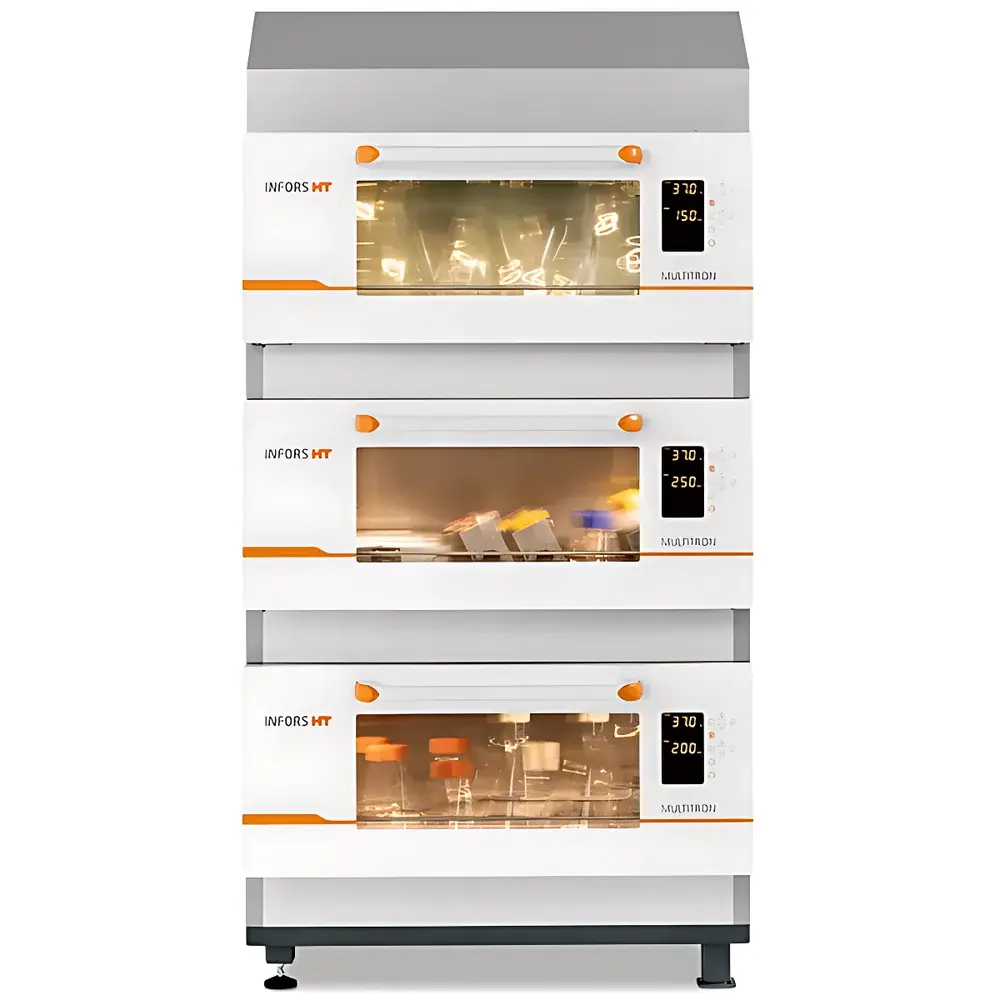
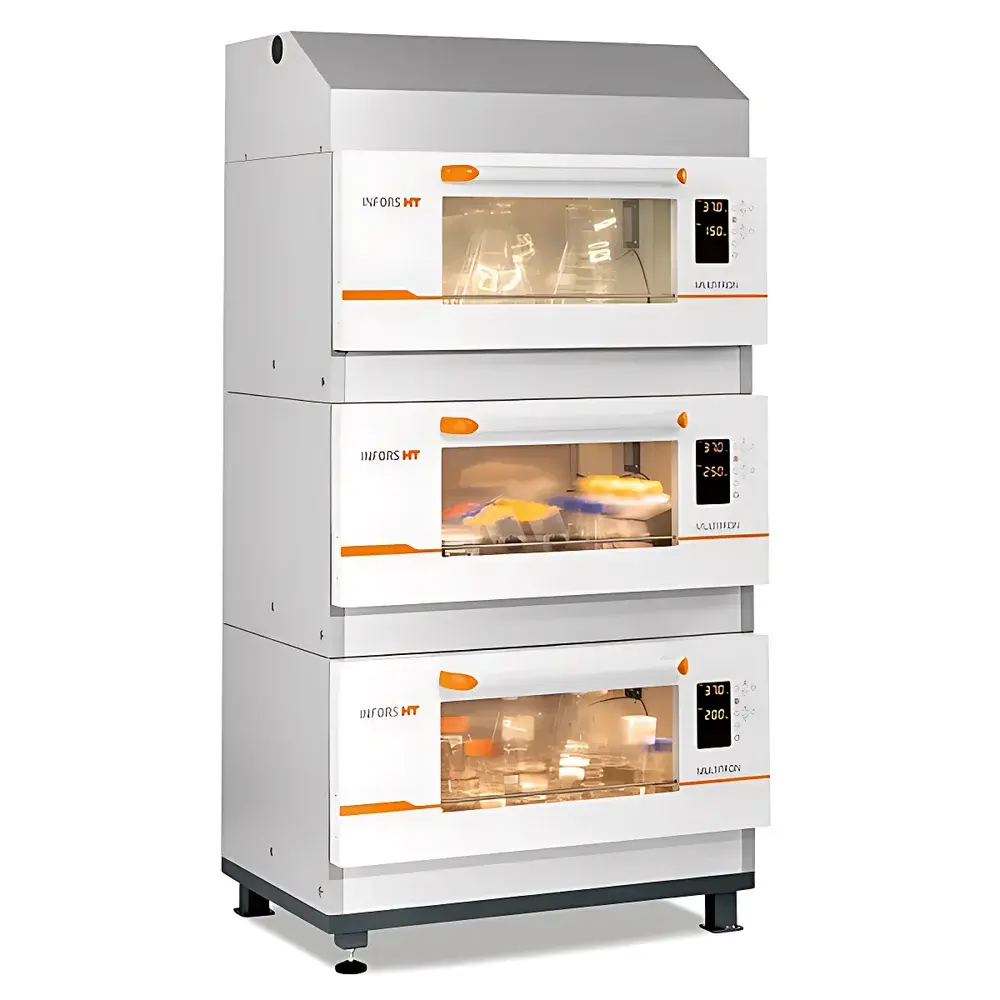
INFORS Multitron Cell Shaking Incubator (Cell Factory Platform)
| Brand | INFORS |
|---|---|
| Origin | Switzerland |
| Model | Multitron Cell |
| Temperature Range | RT+5°C to 65°C (RT−15°C to 65°C with optional side-mounted refrigeration unit) |
| Shaking Speed | 20–400 rpm (up to 1000 rpm at 3 mm amplitude) |
| Amplitude Options | Fixed: 3 / 25 / 50 mm |
| Adjustable | 12.5 / 19 / 25 / 50 mm |
| Temperature Uniformity | ±0.2°C |
| Temperature Stability | ±0.1°C |
| Chamber Volume | 250 L (single unit), 750 L (triple-stack configuration) |
| Max Load Capacity | 55 kg per tray (165 kg total for triple stack) |
| Humidity Control Range | 20–85% RH (±1% RH accuracy) |
| CO₂ Control Range | 0.1–20% (±1% FS, IR sensor, PID-controlled) |
| Illumination | LED light kit up to 200 µmol·m⁻²·s⁻¹ |
| Power Input | 230 V, 50/60 Hz |
| Safety Compliance | CE, IEC 61010-1, IEC 61326-1 |
Overview
The INFORS Multitron Cell Shaking Incubator is a high-precision, modular platform engineered for scalable, reproducible cell culture and bioprocess development under tightly controlled environmental conditions. Designed and manufactured in Switzerland with over five decades of expertise in bioreactor and incubation systems, the Multitron Cell integrates advanced magnetic drive technology, dynamic five-point balancing, and a fully sealed, water-resistant chamber architecture. Its core operational principle combines precise orbital shaking (with selectable amplitudes and speed resolution down to 0.1 rpm) with simultaneous regulation of temperature, CO₂ concentration, relative humidity, and illumination—enabling physiologically relevant mimicry of in vivo microenvironments. The system is validated for use in GLP-compliant laboratories and supports compliance with ISO 13485, USP , and FDA 21 CFR Part 11 when integrated with INFORS’ eve® software and audit-trail-enabled controllers.
Key Features
- Five-Point Magnetic Drive System: A center-mounted eccentric shaft combined with four peripheral load-distribution points ensures mechanical equilibrium across variable payloads (up to 55 kg per tray). This architecture eliminates vibration coupling, enables silent operation (<45 dB(A)), and guarantees smooth acceleration/deceleration without overshoot—even with asymmetric loading.
- Dual-Layer Insulated Viewing Door: Constructed from laminated safety glass with low-emissivity coating, the door maintains thermal integrity while permitting unobstructed visual monitoring at ambient temperatures as low as 23°C below setpoint (when refrigeration is active).
- Modular Environmental Control Units: Plug-and-play modules include IR-based CO₂ sensing (0.1–20%, ±1% FS), stainless-steel heated-plate humidification (20–85% RH, ±1% RH), UV-C germicidal irradiation (optional), and programmable LED lighting (0–200 µmol·m⁻²·s⁻¹, spectral uniformity ±5%). All modules are independently calibrated and validated per ISO/IEC 17025 traceable protocols.
- Ergonomic Tray Handling System: A gravity-assisted, rail-guided drawer mechanism allows full extension of the M-Tray (470 × 850 mm) with automatic locking at insertion. The reinforced aluminum tray supports standard conical flasks (25–5000 mL), microtiter plates (up to 150 rpm on adhesive surface), or sterile moisture-retentive boxes (validated for ≤0.3% evaporation loss over 24 h at 150 µL/well).
- Water-Resistant Chamber Design: All critical electronics—including motor drivers, power supplies, and control boards—are externally mounted. Internal surfaces feature seamless, autoclavable-grade stainless steel (AISI 316L) and optional antimicrobial coating (>10⁵ log reduction against Gram+/Gram− bacteria and fungi, stable for >10 years under repeated cleaning and UV exposure).
Sample Compatibility & Compliance
The Multitron Cell accommodates diverse sample formats without cross-contamination risk: suspension cultures in Erlenmeyer flasks (25–5000 mL), adherent cells in multiwell plates (6–96-well), microbial colonies on agar slants, and phototrophic organisms under circadian-light regimes. Its direct-heated humidification system prevents condensation inside vessels—critical for long-term mammalian culture—and its CO₂ delivery path includes 0.2 µm sterilizing filters compliant with ISO 13408-1. All optional modules undergo factory validation per ASTM E2500 and EU Annex 15 guidelines. The system meets IEC 61010-1 (electrical safety), IEC 61326-1 (EMC), and EN 61000-6-3 (radiated emissions), and is CE-marked for both laboratory and cleanroom installation (ISO Class 5–8 compatible with optional HEPA-filtered air recirculation).
Software & Data Management
Control and data acquisition are managed via INFORS’ eve® software suite—a GxP-ready platform supporting role-based user access, electronic signatures, and full 21 CFR Part 11 compliance (including audit trails, data immutability, and secure backup). eve® enables remote monitoring via Ethernet (TCP/IP), real-time graphing of all process parameters (temperature, rpm, CO₂, RH, light intensity), and automated generation of IQ/OQ/PQ documentation packages. Users can define multistep programs (e.g., ramp-hold-cool cycles, diurnal light transitions, or staggered CO₂ pulses) with time-stamped event logging. Data export conforms to CSV, PDF, and XML formats; integration with LIMS and MES systems is supported through OPC UA and RESTful API interfaces.
Applications
- Mammalian Cell Culture: Maintains pH stability via precise CO₂ control (±0.1% resolution) and minimizes medium evaporation using molecular steam humidification—validated for CHO, HEK293, and iPSC lines over 14-day runs.
- Microbial Fermentation: Supports high-density bacterial (E. coli, Bacillus), yeast (Pichia pastoris), and filamentous fungal (Aspergillus) growth using 25/50 mm amplitudes and speeds up to 400 rpm.
- High-Throughput Screening: Enables parallel processing of >23,000 assays (triple-stack configuration) with identical environmental profiles across all trays—essential for dose-response studies and biobanking.
- Photobiology Studies: LED illumination kits support photosynthetic efficiency assays (Chlamydomonas, Synechocystis), seed germination kinetics, and circadian rhythm analysis with programmable dawn/dusk transitions.
- Regulatory-Sensitive Workflows: Validated for USP ancillary equipment qualification, EP 2.6.27 sterility assurance, and ISO 5725-2 precision testing in QC/QA labs.
FAQ
What is the maximum allowable load per tray, and how is weight distribution managed?
Each M-Tray supports up to 55 kg with automatic dynamic rebalancing across five contact points. Load asymmetry does not compromise stability or noise performance.
Can the Multitron Cell operate under sterile conditions required for cGMP manufacturing?
Yes—when equipped with UV-C irradiation, antimicrobial chamber coating, and autoclavable humidification reservoirs (Schott Duran® 5 L bottles), it meets ISO 14644-1 Class 5 cleanroom requirements for ancillary equipment.
Is remote monitoring and alarm notification supported?
All units include Ethernet connectivity for eve®-based remote access; configurable digital alarm outputs (dry contact or 0–10 V) integrate with central building management or SCADA systems.
How is humidity delivered without condensation inside culture vessels?
Water is atomized on a 140°C 316L stainless steel plate, generating sterile molecular steam that disperses uniformly via forced-air circulation—eliminating liquid-phase condensation and microbial carryover.
What validation documentation is provided with the system?
Factory-issued IQ/OQ protocols, calibration certificates (NIST-traceable sensors), and material compliance declarations (RoHS, REACH, UL) are included. Custom PQ support is available upon request.



