
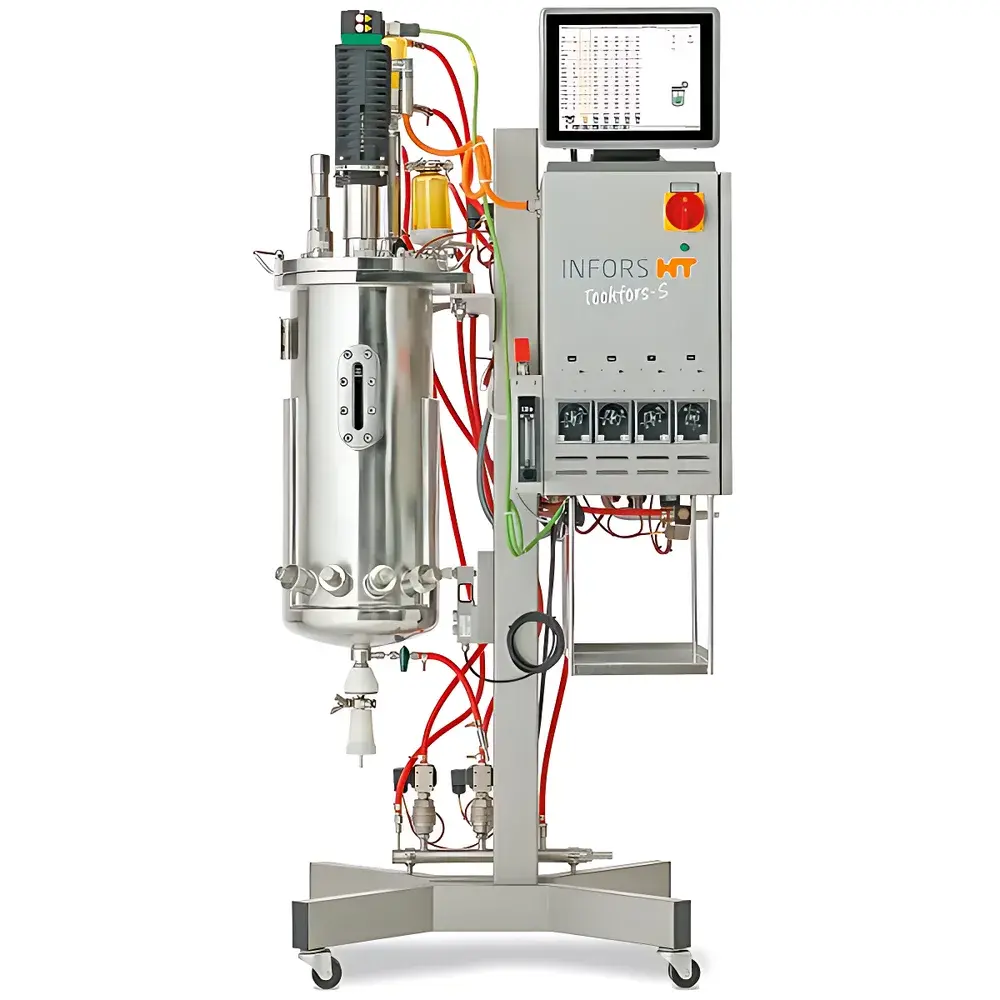
INFORS Techfors-S Sterilizable-in-Place (SIP) Pilot-Scale Bioreactor
| Brand | INFORS |
|---|---|
| Origin | Switzerland |
| Model | Techfors-S |
| Volume Range | 5–20 L (standard configurations) |
| Sterilization | In-situ steam sterilization (SIP) |
| Control System | IRIS v4.0 with real-time monitoring & cascade control |
| Gas Control | 4+1 gas mixing station (Air/O₂/N₂/CO₂ + Air backup) with optional thermal mass flow controllers (MFCs) |
| Agitation | Top-driven mechanical stirring with adjustable speed (0–600 rpm) |
| Temperature Control | Jacketed vessel with independent steam/water pathways |
| Sampling | Bottom-centered sterile sampling valve with dedicated SIP line |
| Pumping | Up to 5 programmable digital peristaltic pumps (4 standard, 1 optional) |
| Filtration | 0.2 µm hydrophobic membrane filters (side-mounted inlet/outlet) |
| Data Interface | RS-232, Ethernet (optional), FDA 21 CFR Part 11 compliant audit trail (IRIS software) |
| Compliance | Designed to support GLP/GMP workflows |
Overview
The INFORS Techfors-S Sterilizable-in-Place (SIP) Pilot-Scale Bioreactor is an engineered platform for scalable, reproducible, and regulatory-compliant bioprocess development in academic, contract development and manufacturing organization (CDMO), and industrial R&D laboratories. Built on a modular stainless-steel (AISI 316L) vessel architecture, the Techfors-S operates on core bioreactor principles: precise dissolved oxygen (pO₂) control via cascaded agitation–gas–pressure–feeding logic; uniform thermal distribution through a dual-path jacket system; and sterility assurance via validated in-situ steam sterilization (SIP) of both vessel and critical fluid paths—including the bottom-mounted sampling valve. Its 5–20 L working volume range bridges benchtop screening and early-stage process characterization, enabling seamless technology transfer to larger production-scale systems. The reactor is explicitly designed for mammalian cell culture, microbial fermentation, and recombinant protein expression workflows where batch-to-batch consistency, contamination control, and data integrity are non-negotiable.
Key Features
- Modular SIP Architecture: All wetted components—including vessel, jacket, sparger, sampling valve, and gas inlet/outlet manifolds—undergo full-cycle steam sterilization at ≥121°C for ≥20 min without disassembly. Steam distribution in the jacket employs a fine-helix internal tube with micro-perforations, ensuring uniform heat transfer and eliminating localized overheating that may degrade heat-sensitive media.
- Bottom-Centered Sterile Sampling Valve: Positioned at the geometric nadir of the vessel, this valve enables complete drainage with ≤0.5 mL residual volume. It features an independent SIP line and integrated steam trap, allowing terminal sterilization immediately prior to each sampling event—critical for aseptic transfer to seed trains or analytical workflows.
- Optimized Peristaltic Pump Layout: Four high-precision digital peristaltic pumps (expandable to five) are arranged in a horizontal configuration to isolate pump tubing from potential drips or condensate. Each pump supports programmable time-based or event-triggered feeding (e.g., exponential feed, pH-stat addition), with flow accuracy traceable to gravimetric calibration protocols.
- Gas Delivery & pO₂ Cascade Control: Standard 4+1 gas mixing station (Air, O₂, N₂, CO₂, and redundant Air) interfaces with optional thermal mass flow controllers (MFCs). Gas composition and total flow are dynamically adjusted in real time by the IRIS software to maintain user-defined pO₂ setpoints—coordinating agitation speed, backpressure (with optional pressure kit), and O₂ enrichment in multi-step feedback loops.
- Ergonomic & Maintainable Design: Integrated castor wheels enable stable repositioning; quick-release hose clamps and silicone-free sanitary fittings minimize cleaning validation burden. Side-mounted 0.2 µm hydrophobic filters conserve headspace and simplify filter replacement. An optional motorized lid-lift mechanism facilitates access to impellers, baffles, and sensors—recommended for vessels ≥15 L.
Sample Compatibility & Compliance
The Techfors-S accommodates suspension cultures (CHO, HEK293, E. coli, Pichia pastoris), adherent cells on microcarriers, and shear-sensitive primary isolates. Its design conforms to fundamental bioprocess engineering standards: ISO 20957 (bioreactor performance testing), ASTM E2500 (user requirement specification and risk-based qualification), and EU GMP Annex 1 (sterile process simulation readiness). While not pre-certified as medical device hardware, its construction materials, surface finish (Ra ≤ 0.4 µm), and documentation package support IQ/OQ/PQ execution under GLP or GMP frameworks. All sterilization cycles generate electronic records with timestamped parameters—fully compatible with FDA 21 CFR Part 11 requirements when IRIS audit-trail functionality is enabled.
Software & Data Management
IRIS v4.0 serves as the integrated control and data acquisition engine. It provides real-time visualization of all analog/digital inputs (pH, DO, temperature, pressure, RPM, gas flows, pump status), with configurable alarm thresholds and email/SMS notifications. The software supports scripting-based automation: users define conditional logic (e.g., “if pH drops below 6.8 for 30 sec, initiate base pump at 2 mL/min”) and sequence-controlled events (e.g., timed nutrient pulses synchronized with growth phase detection). Crucially, IRIS includes Bioprocess Replay Mode—a deterministic playback function that re-executes historical control actions (agitation ramps, gas shifts, feed profiles) using identical timing and setpoint logic, enabling rigorous experimental replication across operators and timelines. Raw data export is available in CSV, Excel, and ASAM MDF4 formats for third-party analysis (e.g., MATLAB, Python pandas).
Applications
- Process characterization studies for monoclonal antibody (mAb) and viral vector production
- Media optimization and feed strategy development under controlled pO₂ and pH regimes
- Scale-down model validation for commercial bioreactors (e.g., correlation of kLa, mixing time, and shear stress)
- Regulatory filing support: generation of robust process data packages compliant with ICH Q5, Q8, and Q9 guidelines
- Training platform for bioprocess engineers on cascade control, sterilization validation, and aseptic technique
FAQ
Does the Techfors-S support automated sterilization cycle logging?
Yes. All SIP cycles are logged with start/end timestamps, jacket temperature profiles, steam pressure history, and condensate drain status. Logs are stored locally and exportable in PDF or CSV format.
Can the IRIS software be validated for use in GMP environments?
Yes. INFORS provides a comprehensive Validation Support Package (VSP), including URS templates, FMEA reports, test scripts (IQ/OQ), and evidence of cybersecurity controls aligned with IEC 62443-3-3.
Is the bottom sampling valve suitable for mycoplasma-grade sterile transfer?
When operated with validated SIP parameters and paired with sterile connecting tubing (e.g., C-Flex or Pharmed BPT), the valve meets ISO 13408-2 requirements for aseptic sampling in cell therapy workflows.
What is the maximum allowable operating pressure for the Techfors-S vessel?
The standard vessel is rated for 1.5 bar(g) working pressure and 2.0 bar(g) maximum allowable working pressure (MAWP), certified per PED 2014/68/EU.
How is temperature uniformity verified during qualification?
INFORS recommends mapping studies using calibrated PT100 probes at ≥9 spatial points (per ASTM E2500 Annex A2), with acceptance criteria of ±0.5°C deviation across the working volume at setpoint.




