
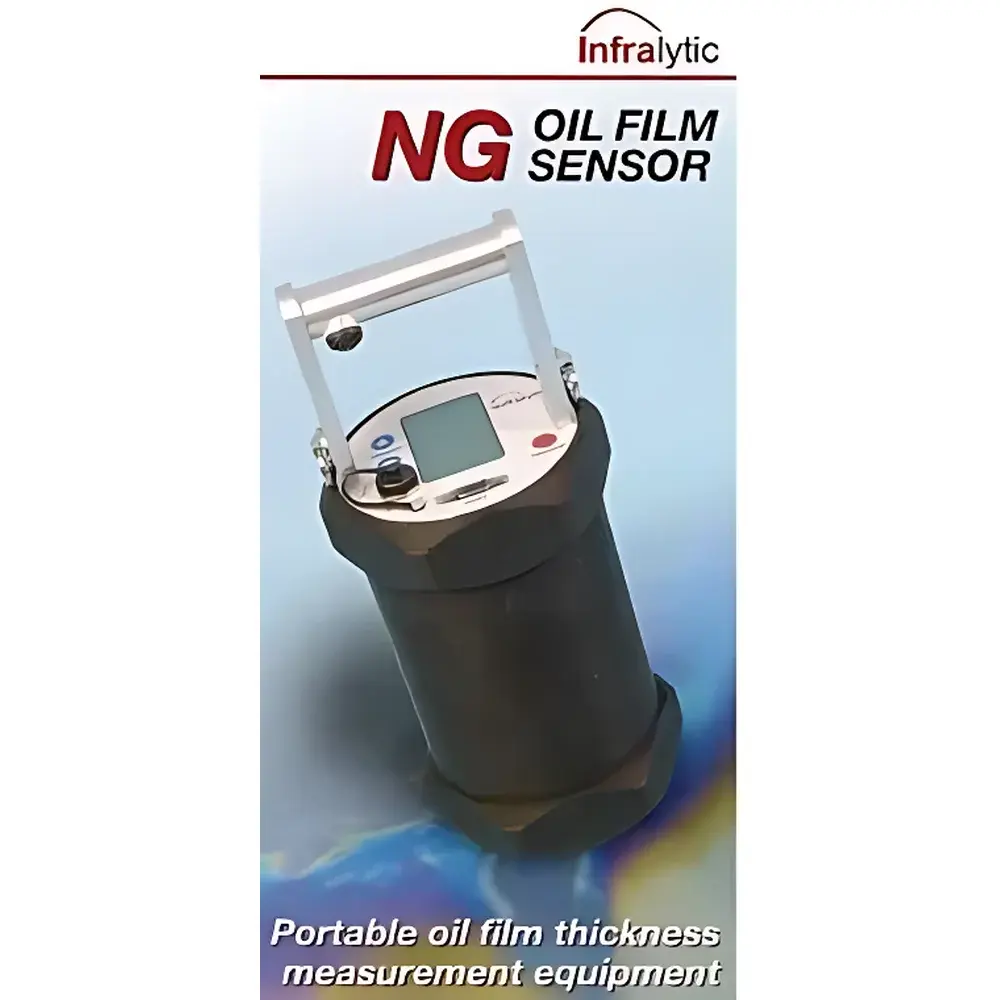
Infralytic NG2 Portable Infrared Oil Film Thickness Gauge
| Origin | Germany |
|---|---|
| Manufacturer Type | Authorized Distributor |
| Origin Category | Imported Instrument |
| Model | Infralytic NG2 |
| Pricing | Upon Request |
Overview
The Infralytic NG2 Portable Infrared Oil Film Thickness Gauge is a field-deployable, non-contact analytical instrument engineered for the rapid, quantitative determination of organic thin-film thickness on metallic substrates. It operates on the principle of near-infrared (NIR) absorption spectroscopy, utilizing proprietary band-pass interference filters tuned to characteristic C–H stretching and bending vibrational modes (typically 1.7–2.3 µm spectral region). By measuring the intensity attenuation of reflected NIR radiation at specific wavelengths—calibrated against reference standards—the device computes film mass per unit area (g/m²) or equivalent dry-film thickness (µm), assuming known coating density and refractive index. Designed for in-line process monitoring and offline quality verification, the NG2 delivers laboratory-grade accuracy in production environments where portability, speed, and operator independence are critical—particularly in cold-rolled steel, aluminum sheet, galvanized steel, electrical steel (silicon steel), and beverage can manufacturing.
Key Features
- Measurement completed in ≤1 second per spot, enabling high-throughput inspection across coil lines or finished goods.
- Non-destructive, non-contact operation—no sample preparation, no surface contact, zero risk of coating disturbance or substrate scratching.
- Integrated rechargeable NiMH battery providing >8 hours of continuous operation; compatible with universal AC/DC charging kit.
- Ergonomic handheld design (weight < 0.9 kg) with integrated shoulder strap and ruggedized transport case for factory-floor durability.
- Backlit LCD display with intuitive icon-based interface; real-time measurement values, statistical summary (mean, std dev, min/max), and pass/fail indicators based on user-defined tolerance bands.
- Factory-calibrated using traceable NIST-traceable reference standards; supports user-defined calibration curves for custom oils, resins, or passivation chemistries via PC software.
Sample Compatibility & Compliance
The NG2 is validated for use on flat, conductive metallic surfaces including low-carbon steel, hot-dip galvanized (HDG) steel, electrogalvanized (EG) steel, aluminum alloys (e.g., AA1050, AA3003, AA5182), and grain-oriented/non-oriented silicon steels. Surface curvature must be < 5 m radius; roughness (Ra) should not exceed 1.6 µm to ensure optical coupling consistency. The instrument complies with IEC 61326-1:2013 (EMC requirements for laboratory and industrial use) and meets CE marking directives. Measurement methodology aligns with ASTM D7865–22 “Standard Practice for Determining Coating Mass per Unit Area on Metallic Substrates Using Infrared Spectrophotometry” and supports GLP/GMP documentation workflows through audit-trail-enabled software export.
Software & Data Management
Data acquisition, calibration management, and reporting are handled via the optional Infralytic Control Suite (Windows-compatible). The software enables batch configuration of measurement protocols, multi-point mapping (X-Y grid logging), statistical process control (SPC) chart generation (X̄/R, Cp/Cpk), and export to CSV, PDF, or XML formats compliant with enterprise LIMS integration. All measurement sessions include timestamp, operator ID, instrument serial number, calibration version, and environmental metadata (ambient temperature/humidity if logged externally). Full 21 CFR Part 11 compliance is supported via electronic signature, role-based access control, and immutable audit trail recording.
Applications
- Verification of rust preventive oil dosage on cold-rolled steel coils prior to packaging or annealing.
- Quantitative assessment of chromate-free passivation layer uniformity on galvanized steel strips.
- Control of fingerprint-resistant (FR) coating mass on pre-painted aluminum sheets used in consumer electronics housings.
- Insulation coating thickness validation on grain-oriented silicon steel laminations for transformer core manufacturing.
- Resin solids deposition monitoring on aluminum beverage can bodies during coil coating line commissioning and maintenance.
- Root-cause analysis of lubricant starvation or over-application in automotive stamping operations.
FAQ
Does the NG2 require daily recalibration?
No—factory calibration remains stable for ≥6 months under normal operating conditions. A quick verification check using the supplied reference standard is recommended before each shift.
Can it measure on painted or lacquered substrates?
Only if the underlying metallic layer is optically accessible and the topcoat is transparent in the NIR range (e.g., thin acrylic clearcoats); opaque pigments or thick polymer layers will interfere with signal penetration.
Is surface temperature a critical factor?
Yes—measurements are valid between 10 °C and 40 °C ambient; deviations beyond this range require thermal compensation enabled via optional IR temperature sensor integration.
What is the minimum measurable oil mass?
Detection limit is 0.1 g/m² for typical mineral-based rolling oils on steel; sensitivity varies with oil chemistry, substrate reflectivity, and film homogeneity.
How is traceability maintained for regulatory audits?
Each unit ships with a certificate of calibration referencing NIST-traceable standards; software-generated reports include full chain-of-custody metadata required for ISO 9001, IATF 16949, and FDA audits.



